







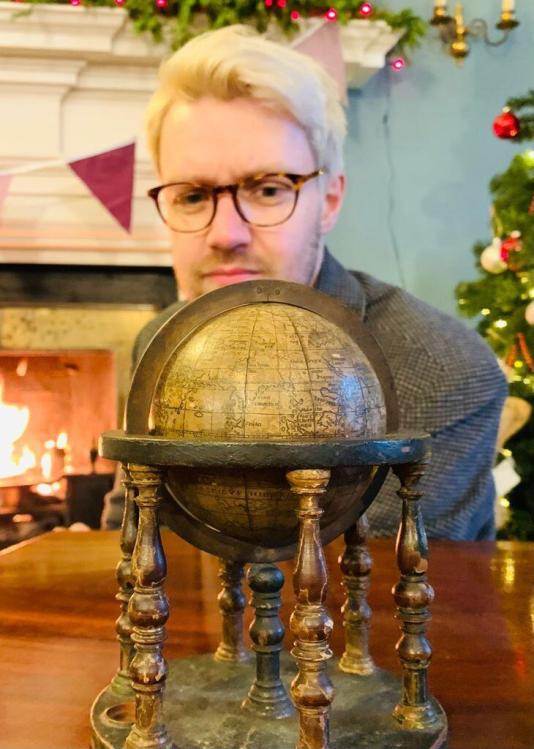
A ‘priceless’ ancient globe depicting the world in the 1500s – discovered at a free valuation event – is believed to be the oldest example of its kind ever offered at auction.
The globe, found by Hansons Auctioneers, is due to go under the hammer on Thursday, December 16. It dates back to circa 1550/60 – making it nearly 500 years old – and has a guide price of £20,000-£30,000.
However, research has revealed that not only is it one of the earliest terrestrial globes in existence, it is potentially the oldest ever offered at auction.
Jim Spencer, head of the Library Auction at Hansons, said: “I’ve contacted major museums and institutions, and I’ve spoken with leading galleries and other specialists. Most museums said they were unable to help because they don’t have anything like it in their collections, but one put me on the track of French map maker Francois Demongenet who was active in 1550/60.
“One specialist said 16th-century globes are nigh on impossible to come across. The leading galleries were as keen as mustard and said it’s absolutely right for the period. In terms of value, the general consensus is that it’s a ‘complete unknown’ and should be very exciting to watch. Our globe looks like it could be the earliest ever offered at auction.
“The oldest terrestrial globe in the world is the Erdapfel from 1492. The second oldest, the Ostrich Egg Globe from 1504, was sold at the London Map Fair in 2012. Then comes the Hunt-Lenox Globe, circa 1510. The age of our globe firmly places it among the rarest in existence. It’s older than other terrestrial globes in many major museums, including the British Library and British Museum.”
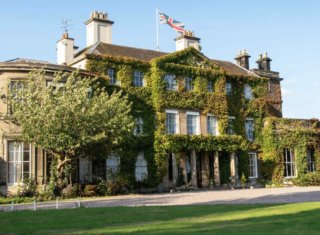
Jim was stunned when a client, from North Wales, brought the item along to Hansons’ Staffordshire saleroom, Bishton Hall at Wolseley Bridge, for free valuation.

He said: “The vendor had a number of objects and was unsure if the globe was anything of great significance, so one of the valuers called me over to take a look. I expected to pick up a modern reproduction, but I was instantly struck by the engraved gores, which indicated authentic age.
“I couldn’t wait to begin researching it. I don’t think it’s possible to say what its monetary value is because I have nothing to compare it with, but I’m guiding at £20,000-£30,000 and feel it must surely reach or soar beyond that. If the globe gains the interest it deserves, the sky’s the limit. To me, it feels priceless. It could be very special indeed. It’s just so early and fragile to have survived the centuries.”
CLICK HERE TO VIEW DEC 16 CHRISTMAS LIBRARY & HARRY POTTER AUCTION CATALOGUE
The 16th-century terrestrial globe is by, or a derivative of, Francois Demongenet, a French physicist and geographer. He is best known for a set of globe gores which became a model for other engravers and carvers of miniature globes.
It depicts a world before Australia had even been discovered by Dutch explorer Willem Janszoon in 1606. The country appears on the globe as part of a southern land mass called Terra Incognita – unknown land – and is empty.
Meanwhile, Japan is called ‘Sipannge’; islands near Java are termed‘Gryforum Insule’; North America is marked ‘Devicta ann 1530’ and South America is marked ‘Nova Terra Inventa anno 1492’ and ‘Canibales Tropophagi’.
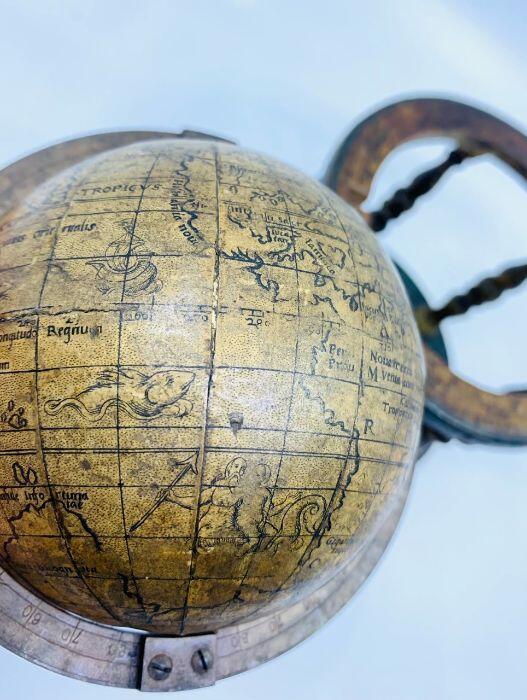
“The sheer age of the globe is mind-blowing,” said Jim. “People would’ve been wearing ruffs and codpieces when they first handled this globe in Elizabethan England. No European had sighted let alone set foot on Australia.
“It includes depictions of sea monsters as, at that time, people believed fantastical creatures lived beneath the waves. In 1583, English explorer Sir Humphrey Gilbert claimed to have encountered a lion-like monster with ‘glaring eyes’ during a voyage.
“So many places hadn’t been explored. It’s amazing to think of all the historical events this delicate little globe has survived. As well as coming through two world wars, it was made a century before the Great Fire of London in 1666. To me, it feels like a museum piece.
“Exploration flourished in the 1500s thanks to improved navigational skills. For example, Sir Francis Drake became the first Englishman to sail around the world, circumnavigating the globe between 1577 and 1580. He was encouraged in his adventures by Queen Elizabeth I.

“Christopher Columbus discovered the Americas in 1492 and Portuguese traders António da Mota and Francisco Zeimoto reached Japan in 1543. This was a time of seafaring adventurers, naval warfare and the original pirates of the Caribbean.
“I know Demongenet-style globes have been sold in the past constructed of brass or silver, and they achieved big sums, but this is so fragile with the engraved paper gores. A sheet of the unused gores alone is important and valuable, but to see an actual globe like this, it’s just incredible.
The globe was originally in the collection of Major Edward Croft-Murray (1907-1980), former Keeper of Prints and Drawings at the British Museum, prior to its purchase be the vendor.
“I guess we’ll never know how Major Croft-Murray acquired the globe, but we do know he was one of the ‘Monuments Men’ who rescued all manner of treasures during the war,” said Jim. “This globe transports us right back, and almost encapsulates the fragility of our planet.”
The globe, lot 150, features 12 engraved gores, a stippled effect to the seas with several monsters and ships and a depiction of Greek god of the sea Triton. It will be offered in Hansons Auctioneers’ December 16 Christmas Library Auction at Bishton Hall, Staffordshire. To find out more, email [email protected]. Catalogue: www.hansonslive.co.uk or www.the-saleroom.com.