


On the eve of the 110th anniversary of the Battle of the Somme a remarkable and unflinching diary of a young WWI soldier has come to light, revealing the unimaginable horror of "going over the top", write Charles Hanson - Hansons Auctioneers
Etwall, Derbyshire

Located in the heart of Derbyshire, Hansons Derbyshire Saleroom in Etwall is not only the headquarters of our operations but also the vibrant auction house for a wide range of specialist auctions. This is where we host an exciting array of sales, from collectibles and antiques to Toys, Militaria, Coins, and much much more.

Find out more
Bishton Hall

Situated within beautiful landscaped gardens in Staffordshire, Bishton Hall, a grade II listed Georgian mansion, creates the period setting to assess and showcase antiques.

Find out more
London

Hansons Richmond builds on the success of monthly London Fine Art & Antiques sales led by a dedicated team since 2018. Situated in a highly regarded area of the capital, it offers a complete range of auction services.

Find out more
Hansons Newark

Welcome to Hanson's Newark, where we honour the timeless tradition of the classic auction experience. Formerly known as Northgate Auction Rooms, we continue to uphold the old-school values of live, in-person bidding, bringing the excitement and authenticity of traditional auctions to the heart of Newark.

Find out more
Hansons Cornwall

Nestled in West Cornwall, Hansons Auctioneers in Penzance offers a warm and welcoming environment for buyers, sellers, and collectors alike. As part of the renowned Hansons Auctioneers network, our Penzance saleroom provides a unique and personalised auction experience.

Find out more
The Old Post Office Leicester Square

Hansons’ Kent is located close to the market town of Tonbridge in the picturesque village of Penshurst on the Kent/Sussex border. Situated in the beautiful grounds of the Penshurst Estate, we are ideally located to welcome you for valuations and sale days.

Find out more
Banbury, Oxfordshire

Hanson Holloway’s operates from the longest-established saleroom in the historic market town of Banbury. As well as Oxfordshire, it serves the neighbouring counties of Buckinghamshire, Warwickshire and Northamptonshire.

Find out more
Royston, Hertforshire

Hanson's Hertfordshire is based in Royston and operates jewellery, fine art & collectables auctions and valuations throughout Hertfordshire and surrounding areas, including Cambridgeshire, Essex, Suffolk and North London.

Find out more
Beds/Bucks

Based in Woburn and Aspley Guise we hold jewellery, silver, fine collectable auctions from the Woburn Hotel. Valuations throughout Bedfordshire, Buckinghamshire and Northamptonshire.

Find out more
Hansons Auctioneers | Norfolk

Hansons Norfolk is based in Roughton, North Norfolk. Just 5 miles from the seaside town of Cromer, Hansons Norfolk holds jewellery, silver, fine art and collectables auctions and valuation days as well as free home visits for larger collections.

Find out more
Lichfield, Staffordshire

Hansons Auctioneers is pleased to work with Rare Book Auctions in Lichfield, managed by Jim Spencer. Rare Book Auctions hold dedicated monthly sales of antiquarian books, modern firsts, manuscripts, autograph letters, photographs, ephemera, prints & caricatures, and maps & globes.

Find out more

News

On the eve of the 110th anniversary of the Battle of the Somme a remarkable and unflinching diary of a young WWI soldier has come to light, revealing the unimaginable horror of “going over the top”, write Charles Hanson

 |  By Kirsty Myatt

Of all the lots that come into our saleroom, none are more moving than those relating to those brave men and women who fought, and died, for this country.

Our militaria sale on May 27 sees one of the most incredible pieces of WWI memorabilia I have ever seen go under the hammer.

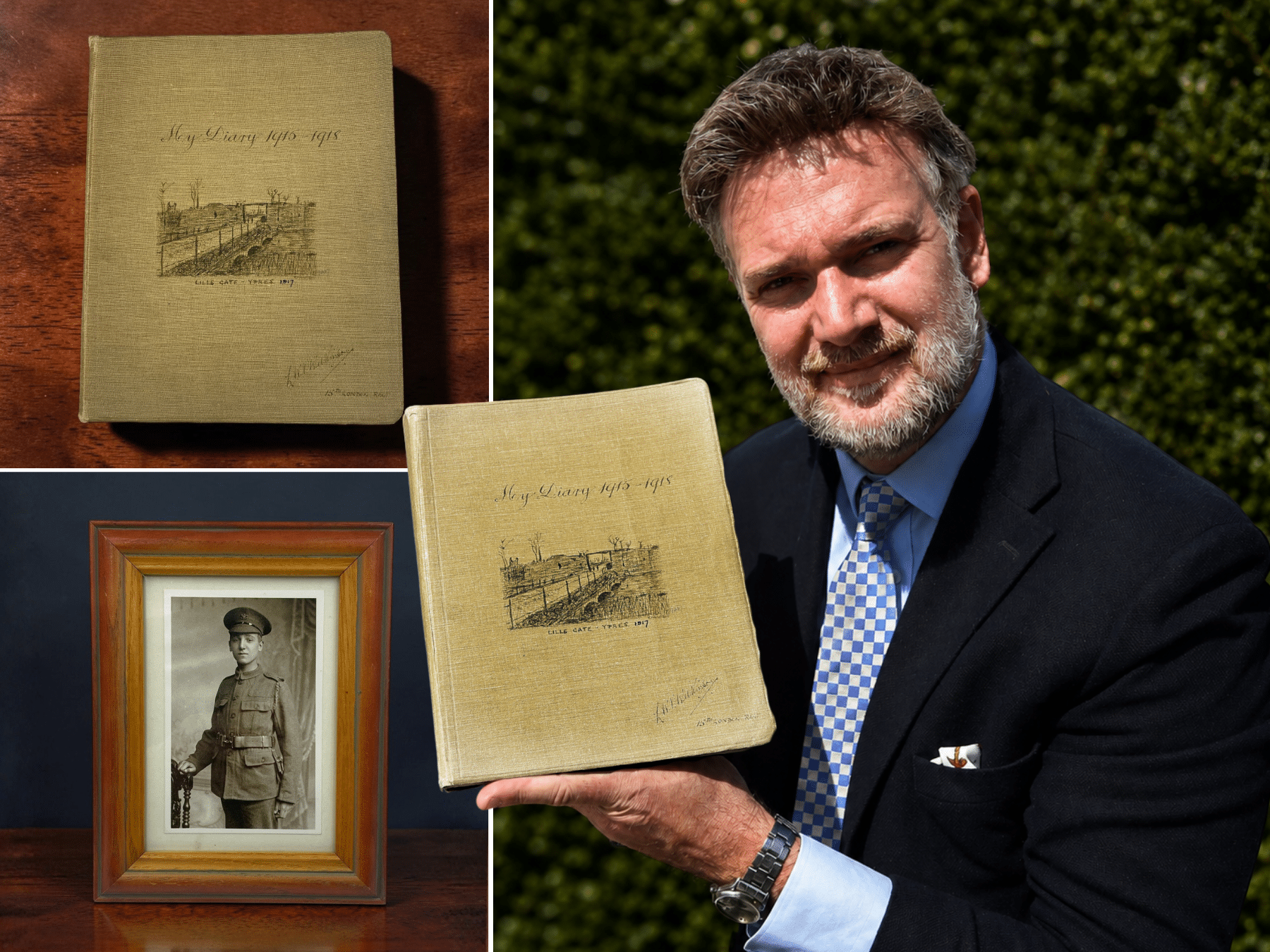
It is the diary of 19-year-old Private Leonard Wilkinson who signed up aged just 17 in 1915. 

While the pages span four years, its most moving passages relate to the eight-day Battle of Flers-Courcelette in September 1916 – one of many in the conflicts in the 141-day Somme Offensive.

Private Wilkinson survived the battle but others in his company were not so lucky, with 350 out of 500 men dying on the French battlefield. 

In his diary he describes the first time British tanks were ever used in combat on September 15 – their debut being an abject failure.

He writes: “Two tanks or “caterpillars”, as we knew them, had been allotted to us, but these did not help us at all.” 

He describes how one became stuck in a muddy trench, with the other bursting into flames which, more usefully, acted as a landmark for disorientated troops.
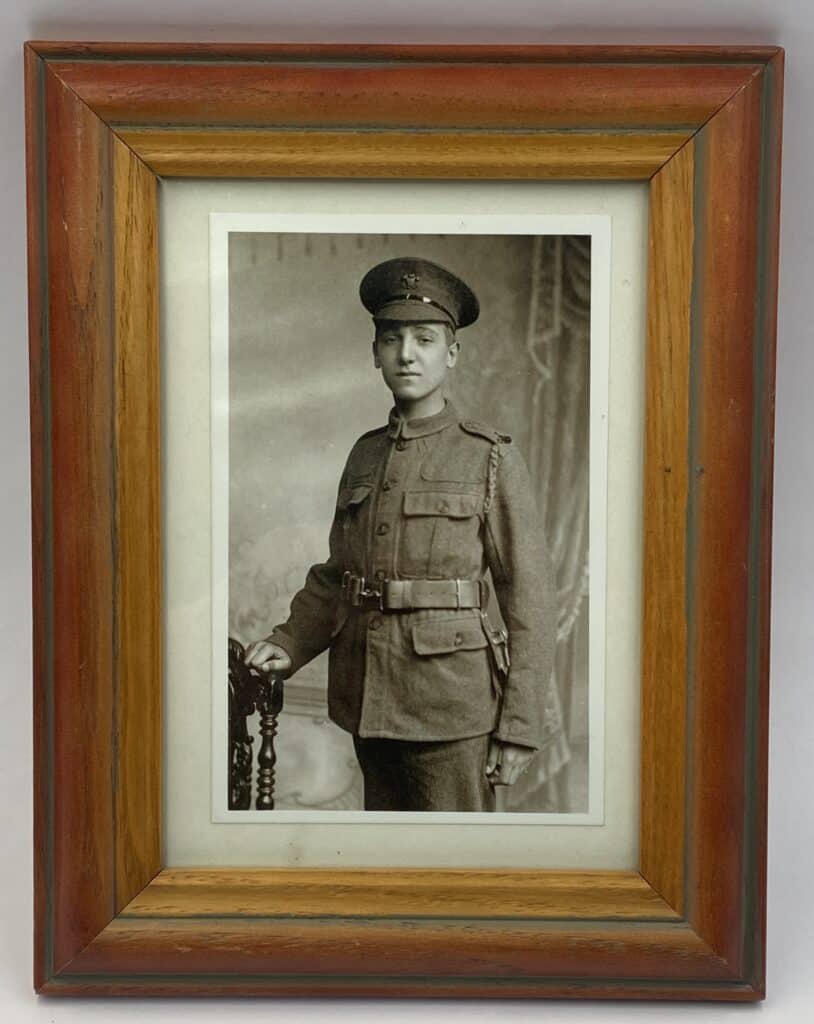
Private Leonard William Vernon Wilkinson of the 15th (County of London) Battalion (Prince of Wales Own Civil Service Rifles) London Regiment
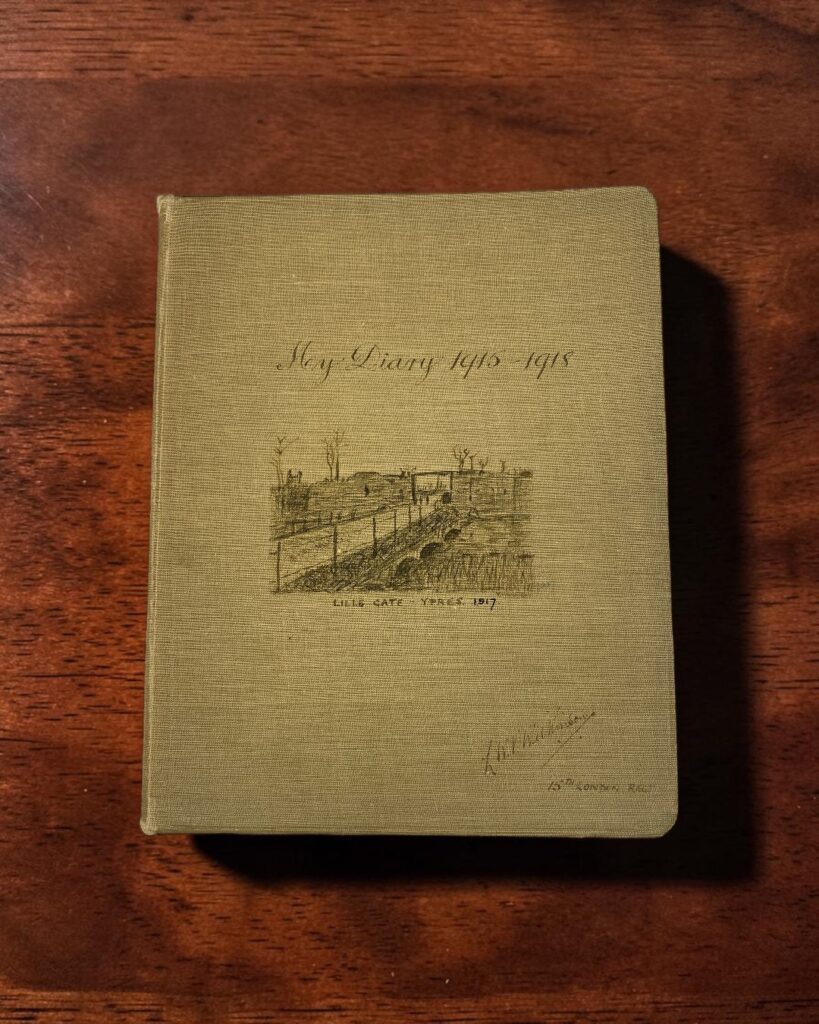
The front cover has an ink sketch by Private Leonard Wilkinson, showing the ‘Lille Gate, Ypres 1917’, with the author’s signature and his regiment. The diary goes on sale at HansonsAuctioneers’ militaria auction on May 27 with a guide price of £1,200-£1,500

Wilkinson was a junior accountant working near The Oval when he joined the 15th London Regiment – the so-called Civil Service Rifles, named for its many civil service and ‘pen-pushing’ recruits. 

On midnight on September 14, the battalion was informed it was to “go over” the following morning at 6.20am. 

He writes “We were “in for it”, that we could plainly see.”

In the early dawn he and two teenage comrades swapped addresses pledging to write to each other’s parents if their son did not make it.

One of the trio, 18-year-old Private Pete Faulkner, would be dead just hours later. 

On the morning of the attack Leonard and his friends attempted breakfast but the “jam tasted of paraffin”, gratefully swigging a rum ration instead.

He writes: “We clambered over the top of the parapet and were immediately met with a murderous machine gun fire, some of my pals falling at once. 

“The din was terrific… the rattle of dozens of Jerry machine guns made it seem impossible for us to live a second under the hail of bullets that showered by us, yet we pushed on.”

Within seconds another pal, 18-year-old Private Alec Reader, was dead.
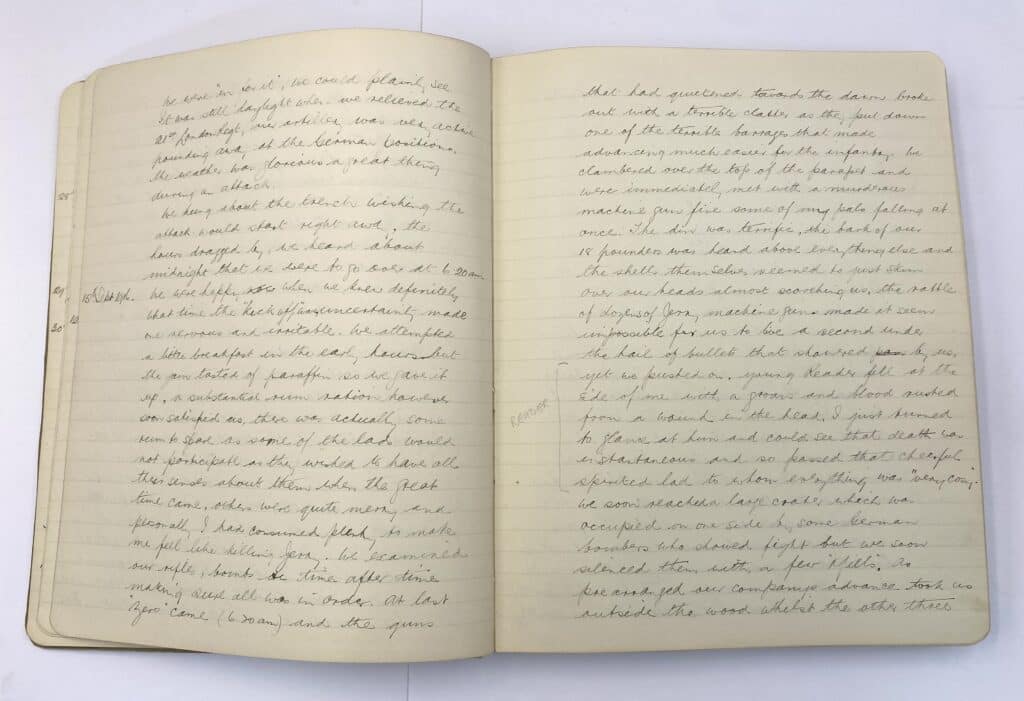
Private Leonard Wilkinson transcribed his original four Trench notebooks, now lost, into a larger album in 1921. This page is the entry for September 15, 1916

Wilkinson writes “Young Reader fell at the side of me with a groan and blood gushed from a wound in his head, I just turned to glance at him and could see that death was instantaneous and so passed that cheerful spirited lad.”

The diary describes the following eight days of sleepless horror, clambering over mud-drenched bodies from trench to trench, dodging bullets and even feigning death.

Hours into the turmoil, Wilkinson left three newfound comrades to smoke a few “woods” (Woodbine cigarettes), returning to find all three dead.

He writes: “The third man was a terrible sight, he had been killed instantly, all the flesh had been blown away from his skull leaving just a skeleton of a face, bits of flesh, brains and blood were all over the place.”

Wilkinson is unflinching in listing the German soldiers he killed, which he describes as “murders”, with their deaths continuing to haunt him throughout the diary and beyond.
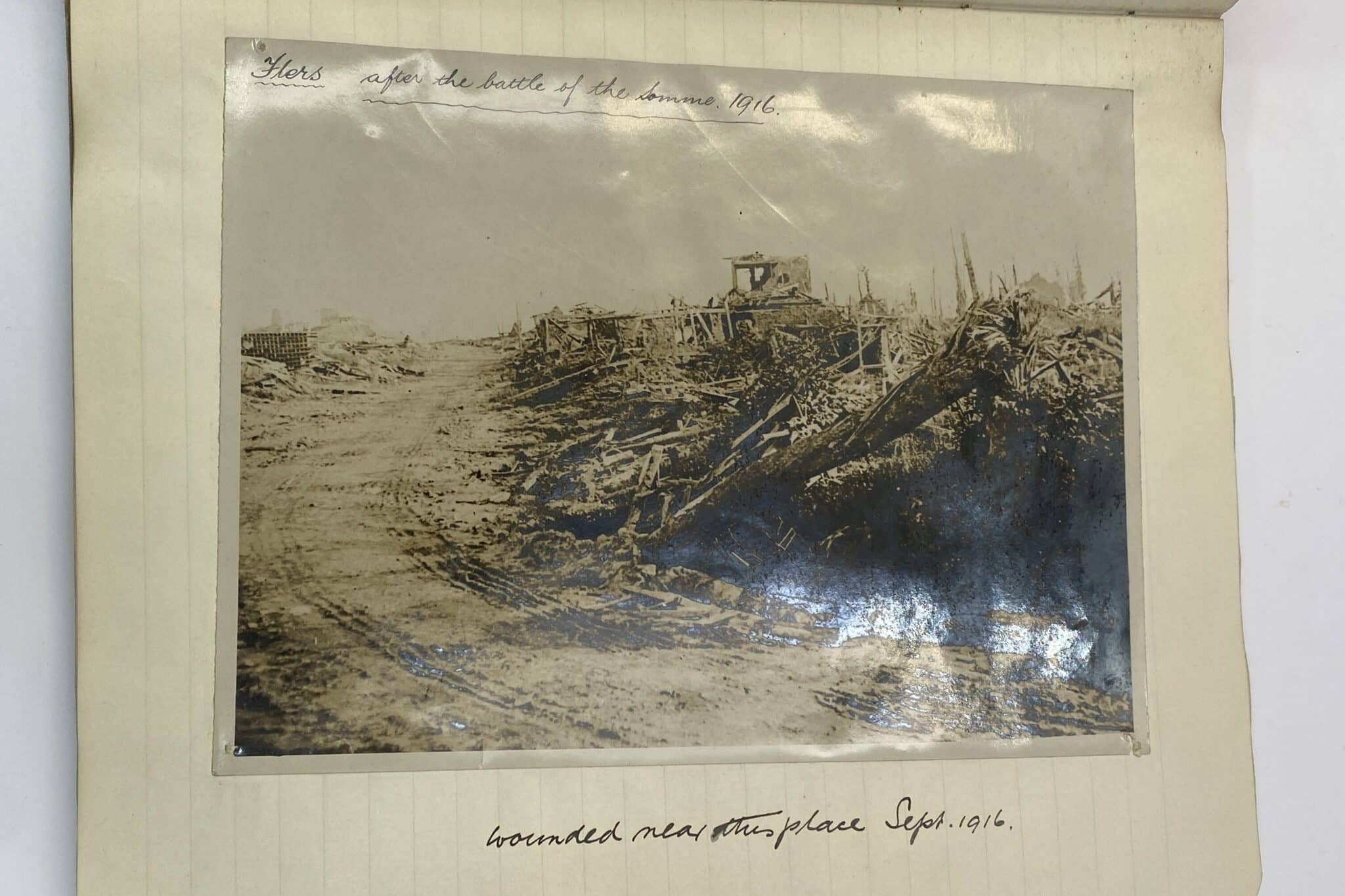
A photograph with the handwritten description Flers after the battle of the Somme 1916. Wounded this place September 1916
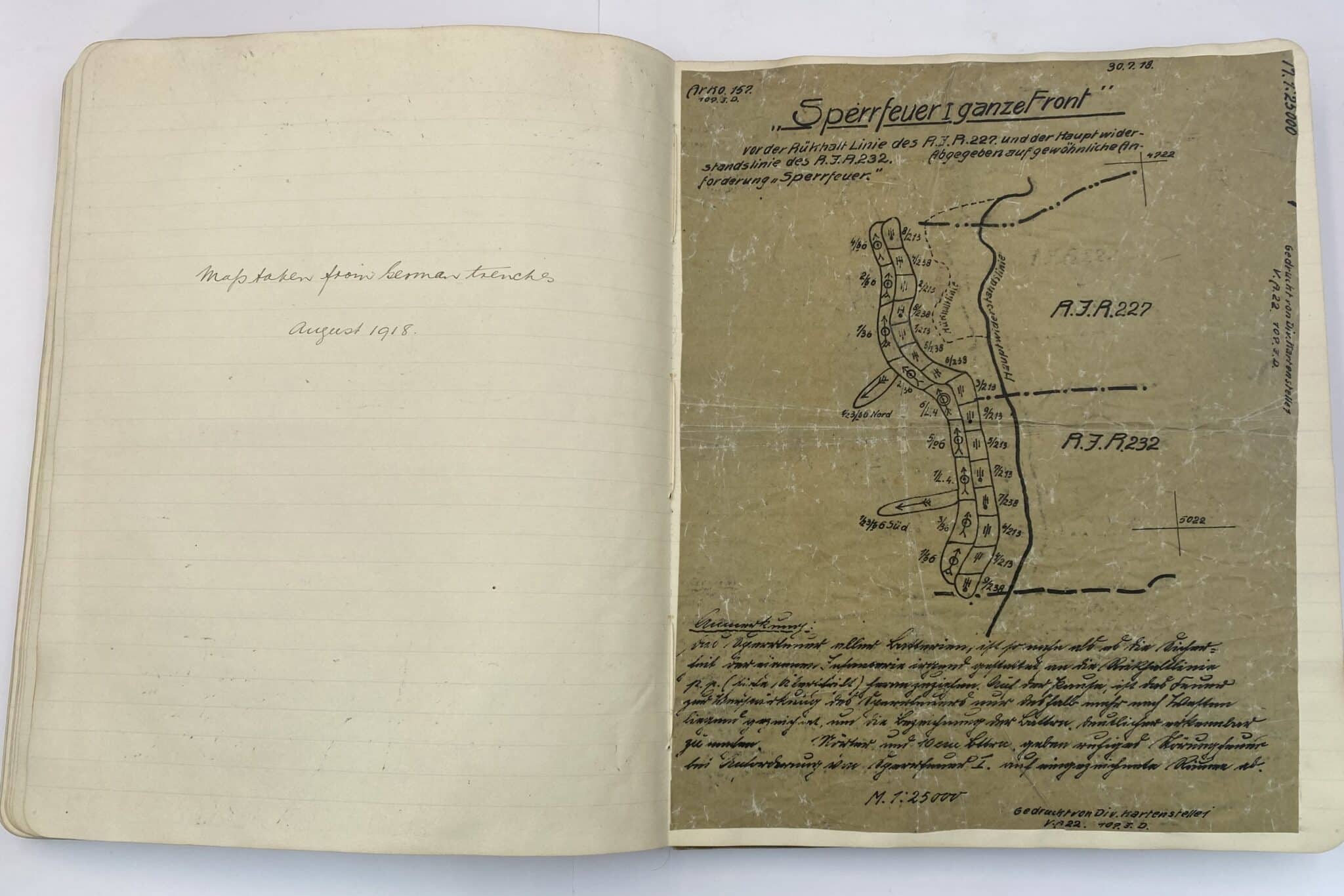
An original German trench-artillery map reading Sperrfeuer ganze Front which translates roughly as Barrage fire across the entire front. It has the handwritten English note Map taken from German trenches – August 1918

His grandson, John Wilkinson, who consigned the diary for sale, said: “He never spoke about his experiences in the war- not once. I think he was scarred by it all and reading the diary I think I can understand why. I was 12 when he died. I remember him as a dignified man who we would visit every Sunday in his care home. He was very proper.”

Wilkinson continued to serve in WWI until the Armistice, fighting in both Ypres and the Spring Offensive and being awarded both the British War Medal and the Victory Medal.

When he returned to civilian life in 1919 – still age just 22 – took up a job at Barclays Bank in Leicester, where he was to meet his future wife Betty Elson who he married in 1927.

In 1921 he transcribed his original four Trench pocketbooks into the album on sale.

He died on April 13, 1977, at the age of 80.

What these men went through defies our understanding today. The scale of the loss was unimaginable. I am privileged to have encountered Private Wilkinson, even if it is only through the pages of his diary.

Auction Details

Auction: The Hansons Medals, Militaria & Firearms Auction
Auction date: 27th May 2026 | 10am
Location: Hansons’ Derbyshire Saleroom
Auction contact: [email protected]
Catalogue/bidding: www.hansonslive.co.uk | www.the-saleroom.com