









Views on alien existence in the 1600s have been uncovered thanks to the discovery of a 324-year-old book in the Cotswolds – which could sell for thousands of pounds at auction.
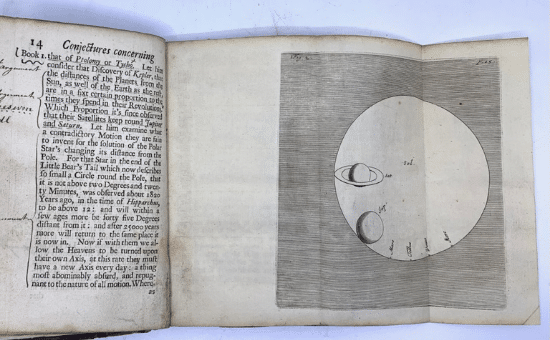
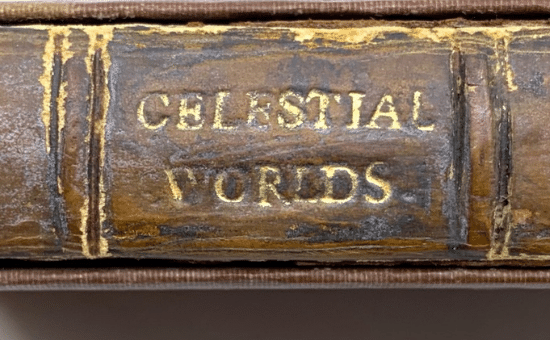
The ancient tome entitled The Celestial World Discover’d: Or, Conjectures Concerning the Inhabitants, Plants and Productions of the Worlds in the Planets, was found at a free antique valuation event at Fosseway Garden Centre, Moreton-In-Marsh, by books valuer Jim Spencer.
The first edition – published in 1698 – was written by Christiaan Huygens, who shares his deep fascination with the potential existence of extra-terrestrial beings. He questioned why God would have created other planets ‘just to be looked’ upon from Earth and concluded they must serve a purpose.

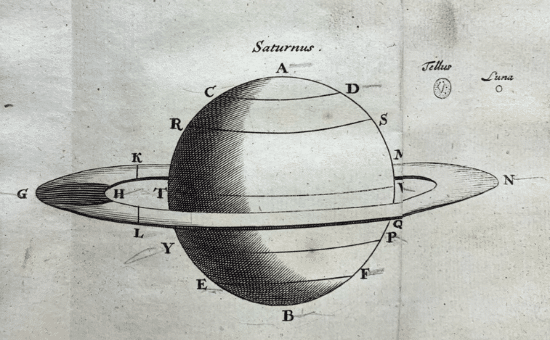
He attempts to describe what intelligent alien life on other planets might look like, especially on Jupiter and Saturn. He also concluded ‘That there is some rational Creature in the other Planets, which is the Head and Sovereign of the rest, is very reasonable to believe.’
Huygens wrote his book in English and Latin, and an English version has been uncovered. It’s illustrated with five folding plates and was printed for Timothy Childe at the White Hart at the West-end of St Paul’s Church-yard, London.
Such is its rarity, the ‘out-of-this-world find’, lot 304, is set to go under the hammer with a guide price of £2,000-£3,000 in Hansons Auctioneers’ July 7 Library Auction at Bishton Hall in Staffordshire.
Jim, who’s heading back to Fosseway Garden Centre on May 24 in search of more antique treasures, said: “It’s fascinating to think who turned these pages in 1698, what they must’ve felt when reading these descriptions of life on Jupiter or Saturn before gazing up at the night sky.
“The book tries to describe what extra-terrestrial beings might look like, how they spend their time, even what their music sounds like. It seems almost comical, but it’s informed by scientific reasoning, and who knows how our own thoughts on these matters will appear to people looking back in 324 years.
“It’s a curious feeling when flicking through this book. The subject matter belongs to the future or science fiction, yet the writer is speaking to us from the past. I found myself realising that we’ve since explored not only more of space, but more of our own planet. For instance, he rules out the possibility of much larger animals than those here on Earth, but this was written before we’d understood anything of the dinosaurs.
“I think the subject matter is so compelling because it makes us chuckle at what they didn’t know, while staring up at the heavens and realising it’s still a mystery. It really is an out-of-this-world find.”

In his book, Huygens thinks it unlikely the size of a planet influences the proportions of its animals and plants, because otherwise ‘there would be Animals in Jupiter ten or fifteen times larger than Elephants, and as much longer than our Whales. And their Men must be mere Goliahs’.
He speculates that there must be intelligent life capable of reason and more advanced than the other animals on their planet – akin to the difference between ‘Man’ and ‘Beast’ on Earth.
On the subject of what aliens might look like, he concludes they must have hands and feet like ours. ‘What could we invent or imagine that could be so exactly accommodated to all the design’d uses as the Hands are? Shall we give them an Elephant’s Proboscis. ‘Tis true, these beasts can lay hold of, or throw any thing, can take up even the smallest thing from the Ground … But all this is nothing to those Conveniences the Hand is so admirably suted to.
‘That they have Feet scarce any one can doubt…[unless] they have found out the art of flying in some of those Worlds.’
He imagines they too must enjoy astronomy and observation. And so ‘we must give them Bodies and Strength’ to use their telescopes. ‘For if we should make them little Fellows about the bigness of Rats or Mice, they could neither make such Observations as are requisite; not such Instruments as are necessary to those Observations.’
They must sail boats. ‘if their Globe is divided like ours, between Sea and Land, as it’s evident it is (else whence could all those Vapors in Jupiter proceed?) we have great reason to allow them the art of Navigation…especially considering the great advantages Jupiter and Saturn have for sailing, in having so many Moons to direct their Course’.
They must enjoy leisure time like us: ‘For if these new Nations live in Society, as I have pretty well show’d they do, ’tis somewhat more than probable that they enjoy not only the Profit, but the Pleasures arising from such a Society: such as Conversation, Amours, Jesting, and Sights.’
They must enjoy music, even the same notes as us. ‘It’s the same with Musick as with Geometry, it’s every where immutably the same, and always will be so. For all Harmony consists in Concord, and Concord is all the World over fixt according to the same invariable measure and proportion…if they take delight in Harmony, ’tis twenty to one but that they have invented musical Instruments.’
They must suffer ‘Misfortunes, Wars, Afflictions, Poverty’, because that’s what leads us to invention and progress. ‘If Men were to lead their whole Lives in an undisturb’d continual Peace, in no fear of Poverty, no danger of War, I don’t doubt they would live little better than Brutes, without all knowledge or enjoyment of those Advantages that make our Lives pass on with pleasure and profit.’
Library Auction entries invited
To arrange a book valuation or to discuss consigning an item/collection into Hansons’ next Library Auction, please email [email protected]