








I often say that auctioneering is as much about people as it is about possessions. Behind every object lies a story waiting patiently to be rediscovered and, if we’re lucky, shared once more.
Some stories make us smile, others astonish us with their rarity or value, but every so often an item arrives that simply stops you in your tracks. This is one of those discoveries.
Recently, at Hansons Derbyshire, we were entrusted with a small collection of family keepsakes belonging to Private John Brookfield Wareing, a First World War soldier who was killed in action on 20 September 1917 at the age of just 36.
Financially, it carries a modest estimate of £50-£70. Yet, to me, its true worth lies far beyond any auction catalogue entry or hammer price. Some treasures simply cannot be measured in monetary terms. They reside instead in memory, humanity and the enduring power of remembrance.
As we mark the 110th anniversary of many of the defining moments of the First World War this year, I find discoveries such as this particularly moving. History can sometimes feel distant and confined to the pages of textbooks or carved into the stone of memorials. Yet collections like this gently remind us that behind every date was a beating heart, behind every casualty was a family, and behind every name was a life being lived.
Private Wareing was not merely a soldier. He was a father.
That simple fact is perhaps what makes this collection so profoundly touching.
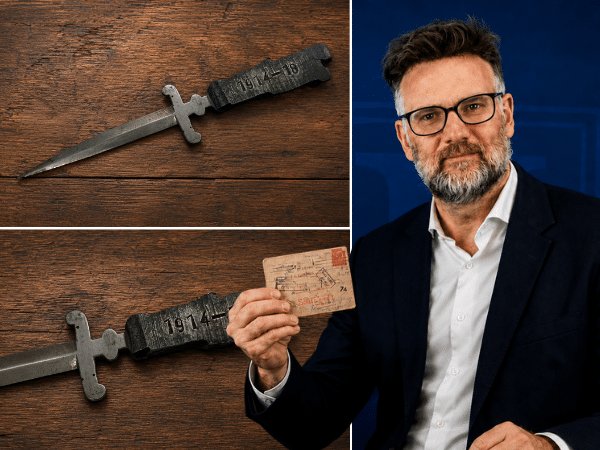
Among the three items is an extraordinary letter opener, or paper knife, fashioned from a single piece of First World War shrapnel and stamped ‘1914-1918’. Believed to have been created as a memorial piece at the end of the conflict, it is an object that perfectly captures the contradictions of remembrance itself.
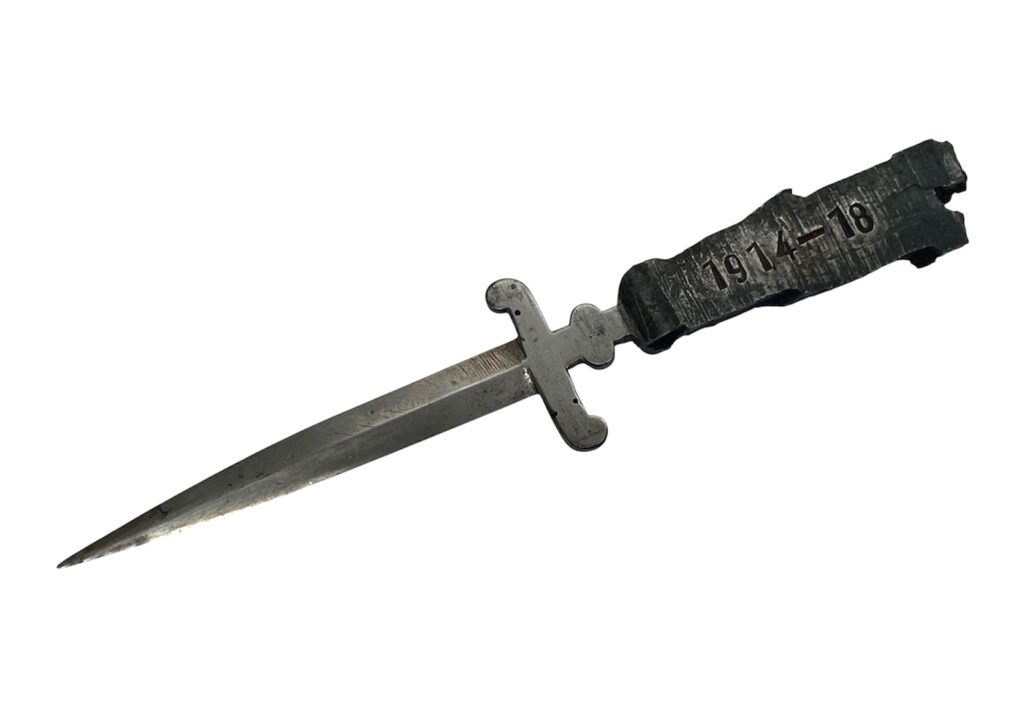
Its jagged handle remains battle-scarred and untouched, while the blade and cross guard have been painstakingly worked into the shape of a dagger. There is something deeply symbolic about transforming an instrument born of destruction into an object intended to preserve memory. It feels almost poetic.
Alongside it sits what I consider to be the emotional heart of this collection – a handwritten letter from Private Wareing to his young son, Tom.
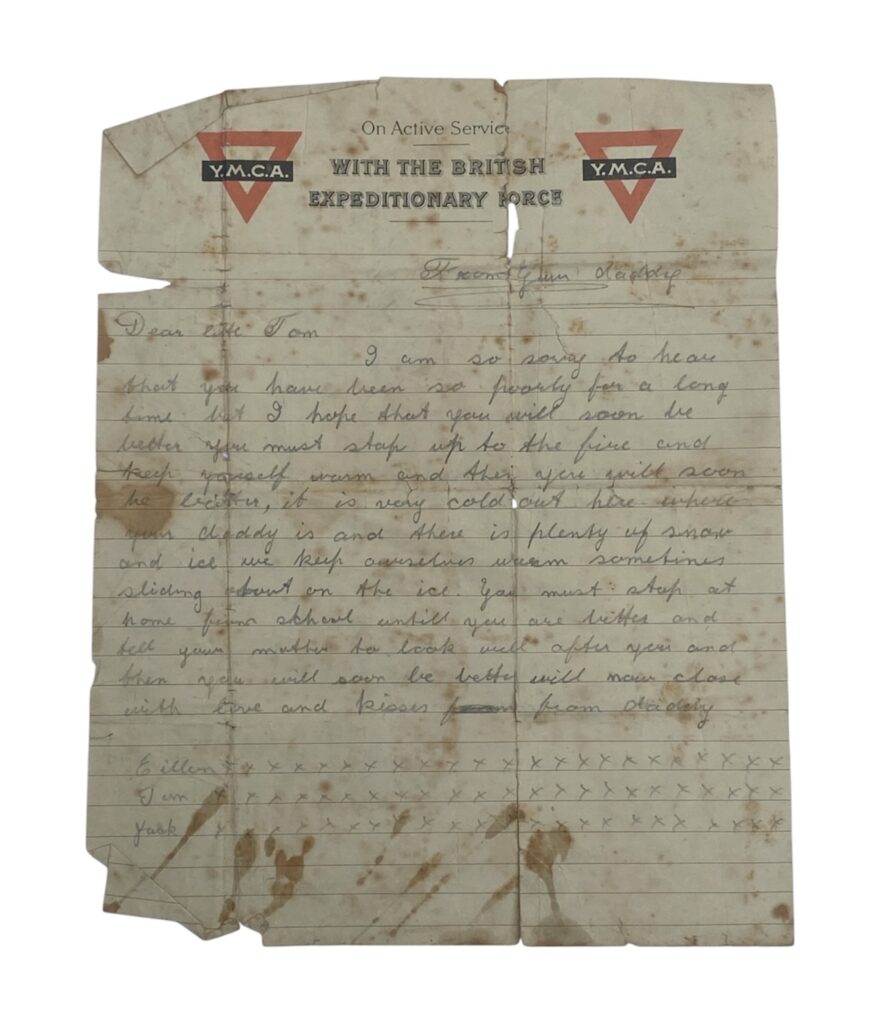
Written on YMCA headed paper during his military service, it contains no tales of battle or hardship. Instead, it offers something infinitely more precious – the everyday words of a loving father concerned for his little boy’s wellbeing. He affectionately encourages Tom to “step up to the fire and keep warm” and advises him to stay home from school while recovering from illness.
I must confess, reading those words gave me pause.
There is something extraordinarily powerful about hearing a voice echo across more than a century. Suddenly, Private Wareing is no longer simply a name recorded in military history. He becomes wonderfully, heartbreakingly human. He is a father missing his son. A man hoping his child is warm, comfortable and getting better.
The letter is thought to date from late 1916 or early 1917. Less than a year later, Private Wareing would lose his life.
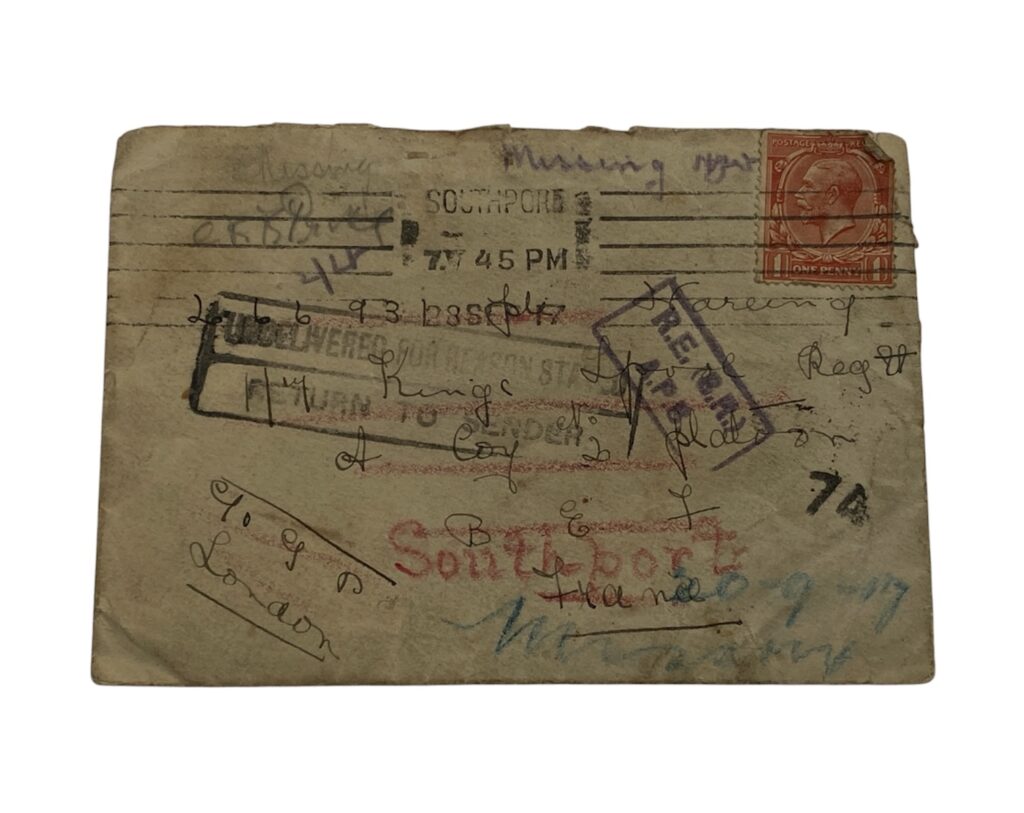
The final item within the collection is perhaps the most poignant of all. An envelope addressed to the soldier himself bears the ink stamp, “Undelivered for reasons stated”, together with handwritten annotations recording him as “missing 20-9-17”. Most heartbreakingly, the postmark is dated eight days after he was known to have been killed.
It is impossible not to wonder about the hands that held that envelope. Who was waiting for news? Who opened it? What conversations took place around a family table more than one hundred years ago?
Private Wareing served with the 1st/7th Battalion of the King’s (Liverpool Regiment) before later being attached to the Royal Engineers at the time of his death. Today, he is commemorated at the Tyne Cot Memorial in Belgium alongside thousands of others who made the ultimate sacrifice.
The story behind the shrapnel letter opener remains something of a mystery and, in many ways, I rather like that. Given Private Wareing’s connection with the Royal Engineers and the craftsmanship involved, it is possible it was made by a comrade and presented to his family as a memorial after the war. Sadly, we can never know for certain, but perhaps some mysteries are all the more beautiful for remaining unsolved.
What we do know is that someone cared enough to preserve these items for more than a century. Thanks to that act of quiet guardianship, Private Wareing’s story continues to live on.
More than 100 years after his death, his words are still being read. His love for his son can still be felt. His sacrifice is still being remembered.
Collections such as this are also a gentle reminder that, at Hansons, we don’t simply encourage people to sell. In fact, I often find myself saying quite the opposite. We meet many clients who are unsure what to do with treasured family possessions and my advice is always the same – if you’re not sure, keep it.
I always want our clients to be certain there is no family member they wish to pass something on to before they ever consider selling it. Family archives are unique voices from the past and some things are simply too close to our nearest and dearest to part with lightly.
There is a soft sentimentality to objects like these. They are more than antiques or collectables; they are fragments of lives once lived. Sometimes their greatest value is not what they might achieve at auction, but the memories they preserve for generations to come.
For me, that is one of the great joys and privileges of auctioneering. We are not merely custodians of objects – we are custodians of stories. Sometimes they make us marvel, sometimes they make us laugh and, every so often, they move us deeply.
This collection has done exactly that.
The First World War collection relating to Private John Brookfield Wareing will be offered for sale in an upcoming Hansons Derbyshire auction. If you have a hidden treasure waiting to be rediscovered, or simply an object whose story you would like to understand, the Hansons team would be delighted to help. And if you’re still not quite sure whether to part with it, my advice remains unchanged – keep it until you are.