









As regular readers of this column may know, my love of the past, and everything related to it, started with a coin.
I was 12 when I first unearthed a Charles I silver shilling, dated 1630, using a metal detector on my parents’ farm in Derbyshire.
Even then, as I stared at its muddy face I tried to imagine how life would have been centuries ago as it was passed from palm to palm.
What had that coin paid for? Which rowdy scenes of tavern life had it witnessed?
So I am heartened to discover as we moved into 2026 that coin collecting in the UK is seeing a renaissance in interest.
It’s not just among gentlemen of a certain age, like me, but among a whole new generation with a passion for history – even the TikTokers are getting involved.
It seems as coins become less common in daily life, older and more unusual coins are becoming more desirable, not less.
And, aside from the cultural and historic interest, there are the tax breaks.
Because coins such as sovereigns and Britannias are legal currency, they are exempt from capital gains tax allowing investors to make unlimited tax-free profits on them.
But for a romantic like me, it’s not the tax breaks that are appealing, it’s the stories they tell.
In an increasingly digital world, how we love to hold physical objects with artistic or historic appeal in our hands.
None more so than this beauty which we have consigned for sale in 2026.
For many coin collectors it is known as the most beautiful coin ever struck in the UK, and if you look closely you will see why.
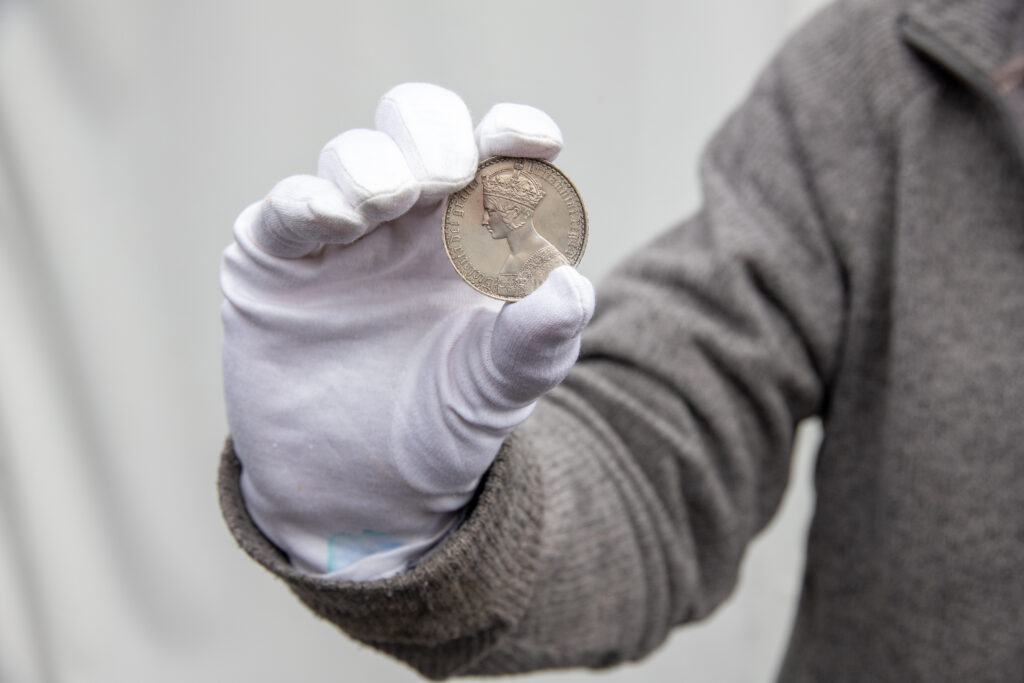
Among numismatists, it is known as the “gothic crown”, and it was issued to celebrate Queen Victoria’s 10th year on the throne.
We don’t always associate Queen Victoria with youthful beauty. She is more often portrayed as the dour old widow dressed in black towards the end of her reign.
But in 1847, when this coin was minted, she was aged just 28.
It was designed by William Wyon, the chief engraver at the Royal Mint – and Victoria’s favourite.
It was heavily inspired by the fashion of the day for gothic revivalism with all its ornate embellishments.
Victorians loved nothing more than medieval nostalgia, in part to counteract the rise in industrialism.
As a result the era was noted for its dark gothic novels like Mary Shelley’s Frankenstein and Bram Stoker’s Dracula, as well as both romanticism and architectural grandeur.
One of the best known being the Houses of Parliament. Ravaged by fire in 1834, in 1840 work started on replacing the original medieval palace with a faux-medieval edifice.
The influence of the all-pervasive movement can be clearly seen on the coin
Wyon portrayed the young queen with not only a gothic-style coronet, he also included medieval-inspired lettering and ornamentation.
The monarch even has a medieval hairstyle with a long plait framing the ear, while her dress’s bodice and lacework make her look more like someone from a painting by Millais or Dante Gabriel Rossetti, than a reigning queen.
In short, the gothic crown coin isn’t just currency — it’s a miniature work of art.
The star quality it evokes is similar to the glamorous photographs of the young Elizabeth II giving her a touch of the Hollywood film star.
Only 8,000 where minted making them highly sought after by collectors worldwide with some willing to pay thousands for a nice example.
The reverse was engraved by Wyon but designed by William Dyce, it features four crowned shields, forming a cross around the arms of the Order of the Garter.
Two of the shields feature the arms of England: three lions passant. The other two are emblazoned with a lion rampant for Scotland, and harp for Ireland. In the angles are roses, a shamrock and a thistle.
This is a Latin inscription written in ornate Gothic (Blackletter) script, which translates to May God guard these United Kingdoms, in the Year of Our Lord.
In 2023 Heritage Auctions in America sold an 1847 gothic crown for $276,000 (£200,000) beating the then record of $186,000 (£140,000) a year before.
But with value comes forgery and so in this picture below, our coins expert Will Hayward has placed one genuine gothic crown among two forgeries. Can you spot the real one?
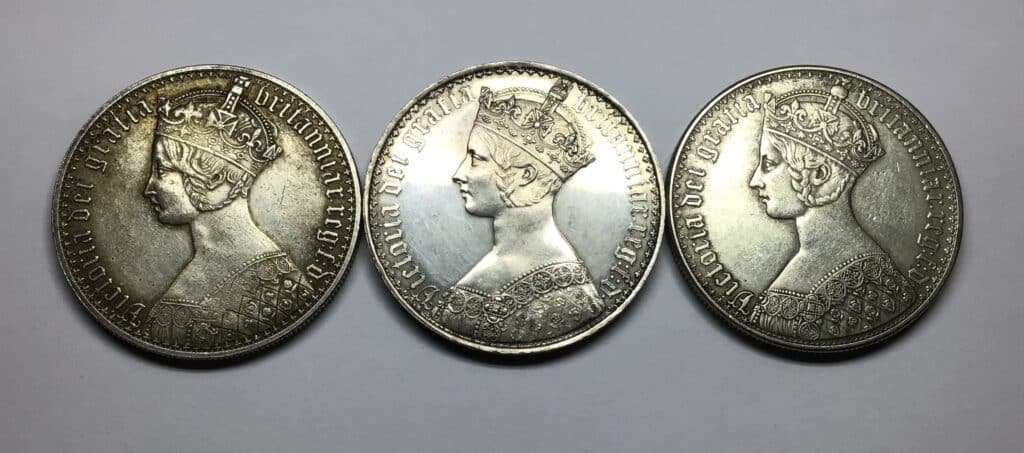
It will be offered for sale in our coins and banknotes auction on February 19 with an estimate of £2,000 to £3,000. If you do decide to take up this rewarding hobby, I hope to see you these.