







Nothing quite connects you to history, and the men and women who have walked its stage, like a letter. Holding an outpouring of emotion in one’s hands years after it was consigned to paper is a powerful feeling.
More so if it was expressed by a national hero, and even greater if it came from one of the most turbulent points of his, and his country’s, life. Such was the case when we were consigned two letters for sale which had recently come to light. Both were penned by one of the most famous writers in the English-speaking world – Rudyard Kipling.
In his day Kipling was nothing short of a global literary sensation. His fame peaked with The Jungle Book, in 1894, Kim in 1901 and the Just So Stories a year later. In 1907 he received the Nobel Prize in Literature – the youngest recipient at the time and the first English-language writer to receive it. Today his popularity has unquestionably dimmed. But, even so, US president Donald Trump found time to praise the writer on his recent state visit. Extolling the history of Britain, he called Shakespeare, Dickens, Orwell and Kipling “incredible people.”
Great Tragedy
But beyond the fame and literary talent Kipling nursed great tragedy. In 1899 his beloved eldest daughter Josephine died from pneumonia at the age of six. But more heartache was to come. By 1915, his 18-year-old son, John, one of six divisions taking part in the Battle of Loos. was missing in action on the Western Front. Sometimes called the Big Push, it was a bloody three-week offensive which saw 61,000 casualties of whom nearly 8,000 were killed outright.
The horror and devastation were felt on the battlefield and by families around the world. Not least by the Kiplings because, in many ways Rudyard Kipling blamed himself for his son signing up. At the outbreak of the war, the writer – an ardent supporter of the British Empire and its military causes – added his weight to bolster the war effort. Perhaps keen to impress his father, Kipling’s only son John was desperate to serve his country.
When his son’s poor eyesight made him ineligible for military service, Kipling used his influence to secure him a commission in the Irish Guards. Knowing the casualty rate, he must have known he was signing his son’s own death warrant. But he and wife Carrie thought it essential to prevent a German victory.
Carrie told her mother: “One can’t let one’s friends’ and neighbours’ sons be killed in order to save us and our son. There is no chance John will survive unless he is so maimed from a wound as to be unfit to fight. We know it and he does – we all know it.” Sure enough on the second day of the Battle of Loos in northern France, Lieutenant John Kipling was reported missing, plunging his parents into frantic uncertainty. Clinging to the hope he might still be alive, Rudyard Kipling made repeated enquiries through official and unofficial channels.
Kipling-signed letters
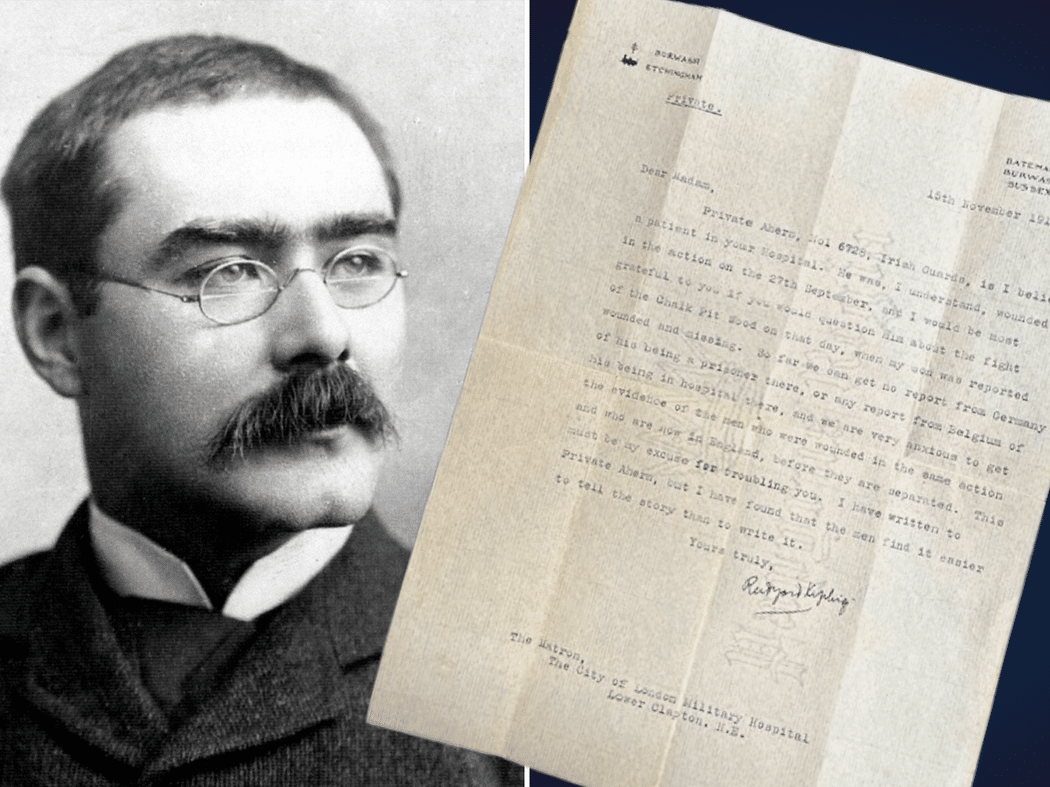
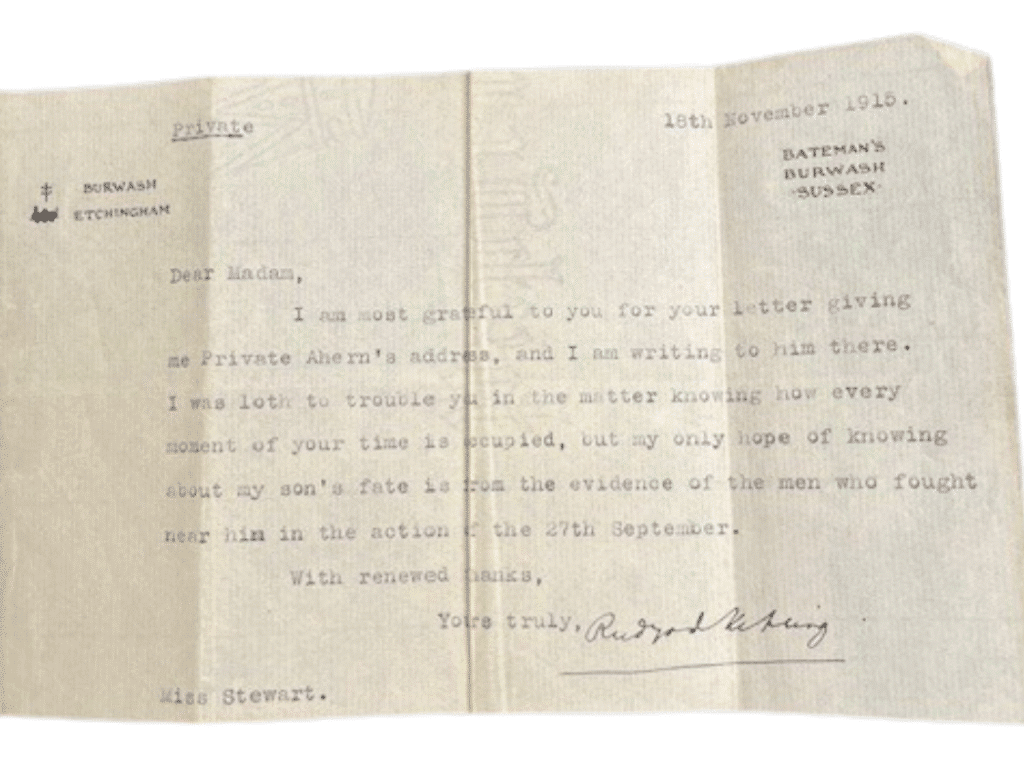
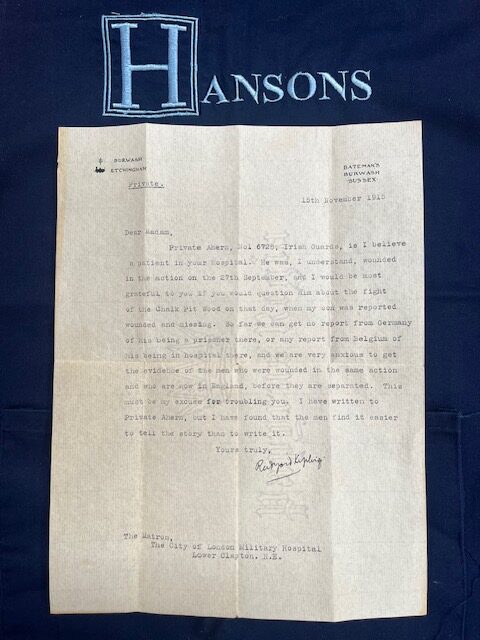
Part of this correspondence has recently come to light. Written from the family home of Bateman’s in Sussex and dated November 15th, 1915, Kipling’s signed letter is addressed to the matron of the City of London Military Hospital. In it Kipling asks if one of her patients, Private Joseph Ahern of the Irish Guards, who was wounded alongside his son, may have any information on his fate.
He writes: “So far we can get no report from Germany of his being a prisoner there, or any report from Belgium of his being in hospital there, and we are anxious to get the evidence of the men who were wounded in the same action and who are now in England, before they are separated. This must be my excuse of troubling you.” In another desperate plea he writes: “My only hope of knowing my son’s fate is from the evidence of the men who fought near him on the action of the 27th September.”
In 1916, the army officially declared John dead, though his body had not been found. This loss had a profound effect on Kipling who later wrote: “If any question why we died / Tell them, because our fathers lied.” Perhaps an acknowledgement of the guilt he felt.
The loss of John Kipling reminds us of all the young lives that terrible conflict cut short and the devastated families it left behind. As for Private Joseph Ahern from whom Kipling sought information on his son, he recovered only to be sent back to the Front, where he too died on July 31st 1917. The ultimate sacrifice made on our behalf.
The letters are expected to make £800-£1,200.

Auction Details
Auction: Hansons Derbyshire Fine Art Auction
Auction date: 10th October 2025 | 9:30am
Location: Hansons Derbyshire Saleroom
Auction contact: [email protected]
Catalogue/bidding: www.hansonslive.co.uk | www.the-saleroom.com