








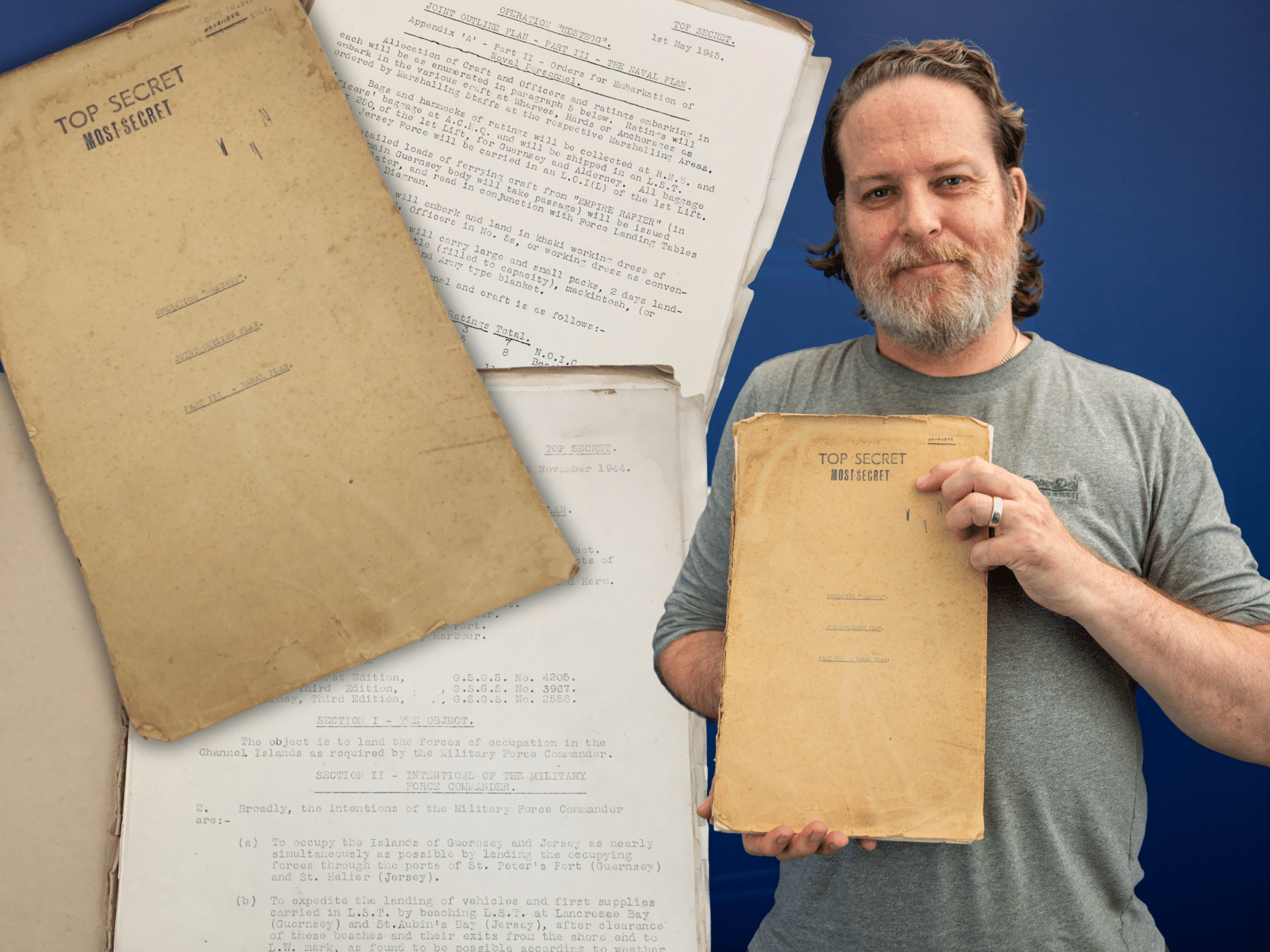
80 years after the liberation of the Channel Islands, a top-secret military plan of the potentially perilous operation, found in a cardboard box in Derbyshire, has come to light.
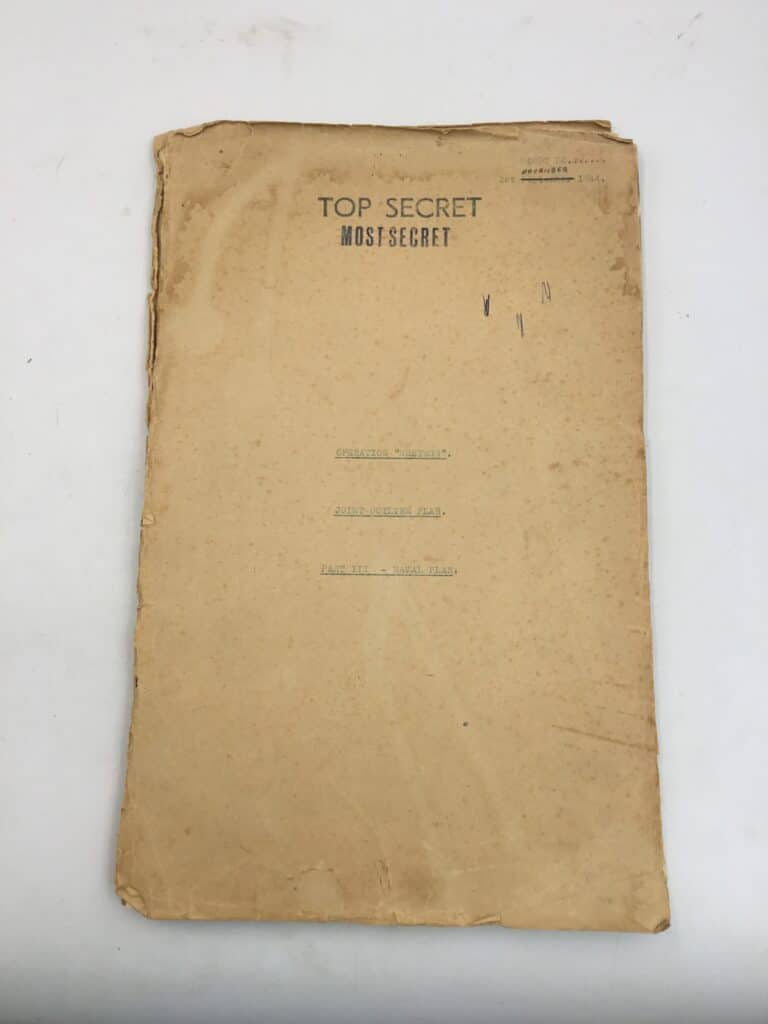
The document outlines “Operation Nestegg” – British force’s plans to free the German occupied islands – in meticulous detail, from the number of ships taking part, to mine sweeping instructions for the surrounding seas.
While ultimately no blood was spilt, it was not known if the 40,000 German troops stationed there would give up the only Nazi-occupied part of the UK without a fight.
The 50-page document detailing the mission will go the hammer at Hansons Auctioneers’ sale in Derby, was discovered in a cardboard box as part of a job lot at a previous auction.
Its militaria expert, Matt Crowson, said: “It’s an incredible story. The document had been part of a dusty box of papers in a UK saleroom, the value of which was considered negligible. But on closer examination the vendor came across a piece of WWII history detailing the freeing of the only Nazi-occupied area of the UK.”
It will appear in the Derby August Medals, Militaria & Firearms Auction on August 13 with a guide price of £800-£1,200.
Starving islanders
Five years after the islands were invaded in 1940, the lives of the 80,000 residents (including 41,00 on Jersey, 24,500 on Guernsey, 470 on Sark and 18 on Alderney) were in utter desperation – with the final winter driving many almost to starvation.
Since D-Day in June 1944, when the Allies had begun to recapture France, the islands had been cut off from food, coal and medicines.
By VE Day on May 8, 1945, the stakes could not have been higher – only liberation could save them.
Plans for a full-scale British military takeover had been shelved in 1943, for fear of loss of life and widespread destruction to towns and villages.
Two years later, with an estimated 40,000 die-hard Germans still guarding the islands, no one knew what bloody fate might await reoccupying British troops.
The top-secret document details the mission’s aims in meticulous detail.
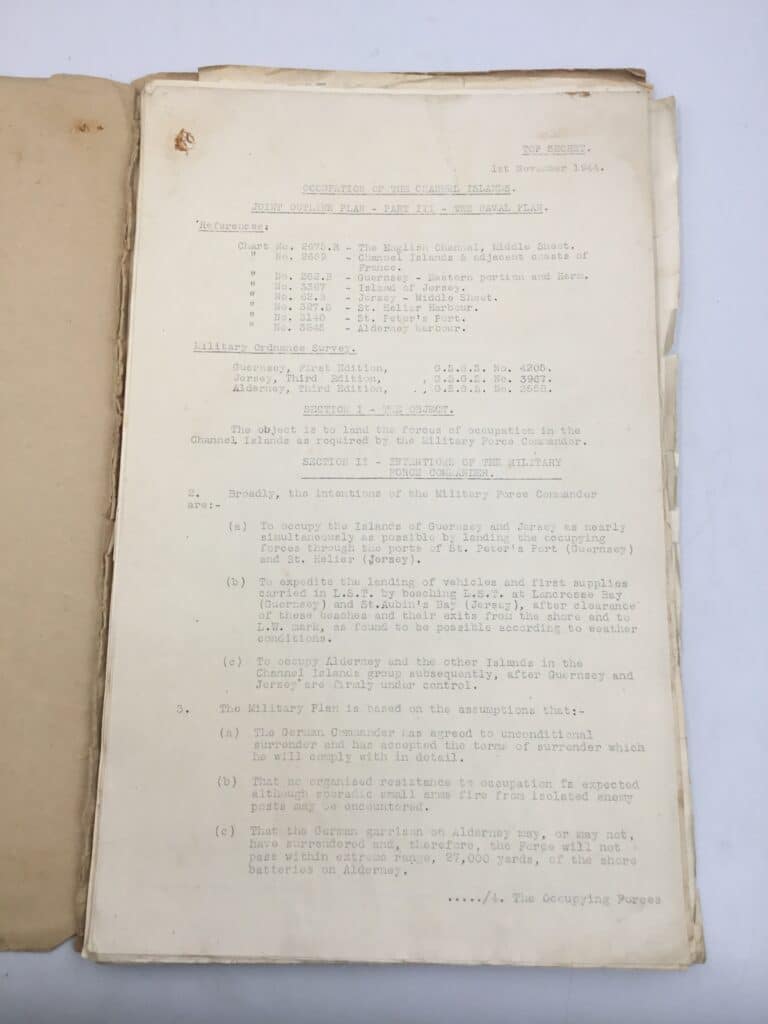
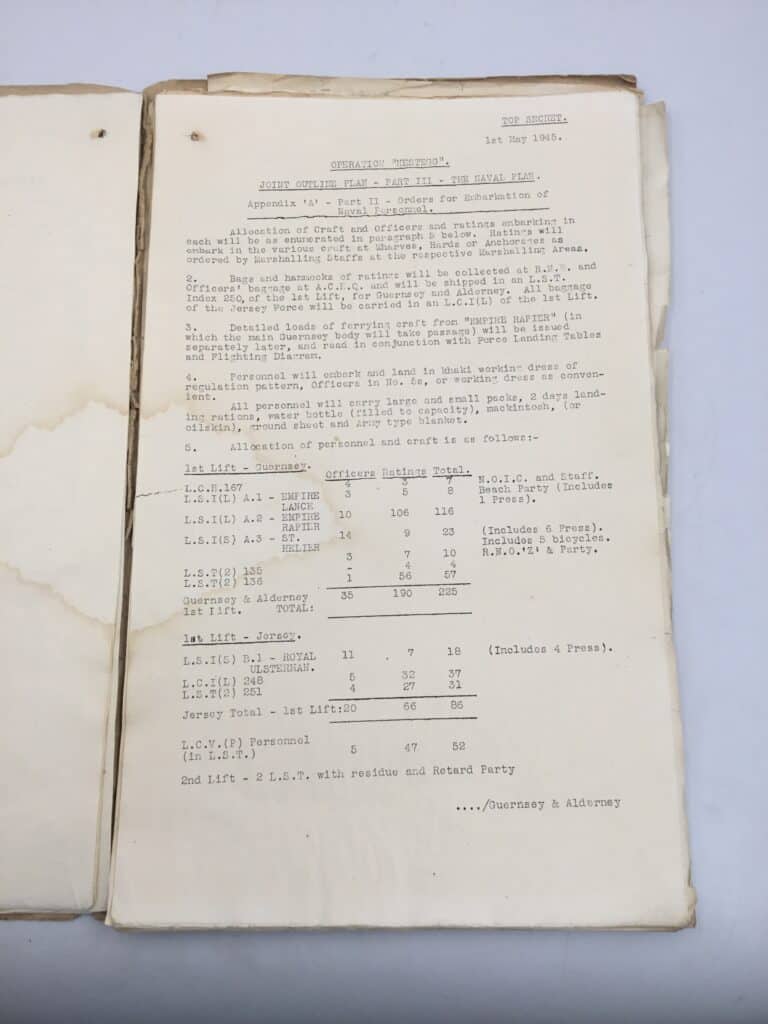
It reads: The intentions of the Military Force Commander are: – To occupy the Islands of Guernsey and Jersey as nearly simultaneously as possible by landing the occupying forces through the postso pf St. Peter’s Port (Guernsey) and St. Helier (Jersey).
Further instructions provide intricate details of the well worked-out plan: “Personnel will embark and land in khaki working dress of regulation pattern. Officers in No. 5s, or working dress as convenient. All personnel will carry large and small packs, 2 days landing rations, water bottle (filled to capacity), mackintosh (or oilskin) ground sheet and Army type blanket.”
Perilous mission
The difficulty of landing troops simultaneously on Jersey and Guernsey meant three 700-man battalions and engineer units were required.
In addition to which the beaches deemed suitable for landings, such as St Aubin’s Bay in Jersey and L’Ancresse in Guernsey, had a treacherous 33ft (10m) tidal range.
Despite the difficulties, Operation Nestegg was a success.
At 7.14am on May 9, at St. Peter’s Port in Guernsey, an uncontested surrender was made onboard HMS Bulldog with General Major Siegfried Heine, German Commander-in-Chief of the Channel Islands.
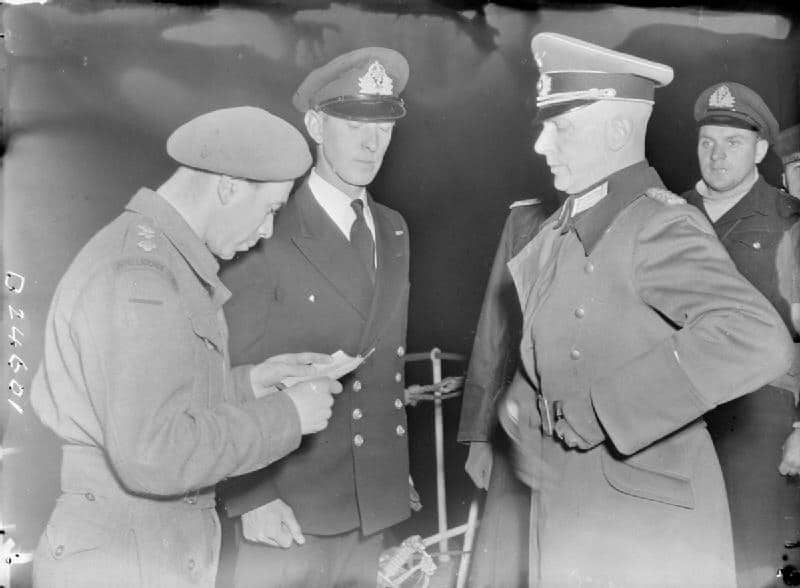
Swastika flags on the German boats were replaced by the White Ensign and an advance party of British went ashore at the Cambridge Steps to be met by cheering crowds.
At 10am a similar surrender was signed on Jersey, aboard the HMS Beagle, with Sark liberated on May 10. On May 16 British troops landed on Alderney, where most of the population had left.
Soon after British currency replaced the Reichsmarksand free ‘treats’, including tobacco, chocolate and tea were handed out. Food was delivered sufficient to provide each civilian with 2,750 calories per day for three months.
Matt Crowson continued: “A document like this really brings home the suffering of the Channel Islanders during the German occupation, some 2,300 of whom were deported to German prison and internment camps. By the time of the liberation in 1945 many were close to starvation. The essential role played by the men and women involved in Operation Nestegg, and their story of freedom, cannot be underestimated. And the fact the document came to light in the 80th anniversary year of Liberation Day makes it even more special.”
Auction Details
Auction: Derby August Medals, Militaria & Firearms Auction
Auction date: 13th August 2025 | 9:30am
Location: Hansons Derbyshire Saleroom
Auction contact: [email protected]
Catalogue/bidding: www.hansonslive.co.uk | www.the-saleroom.com