







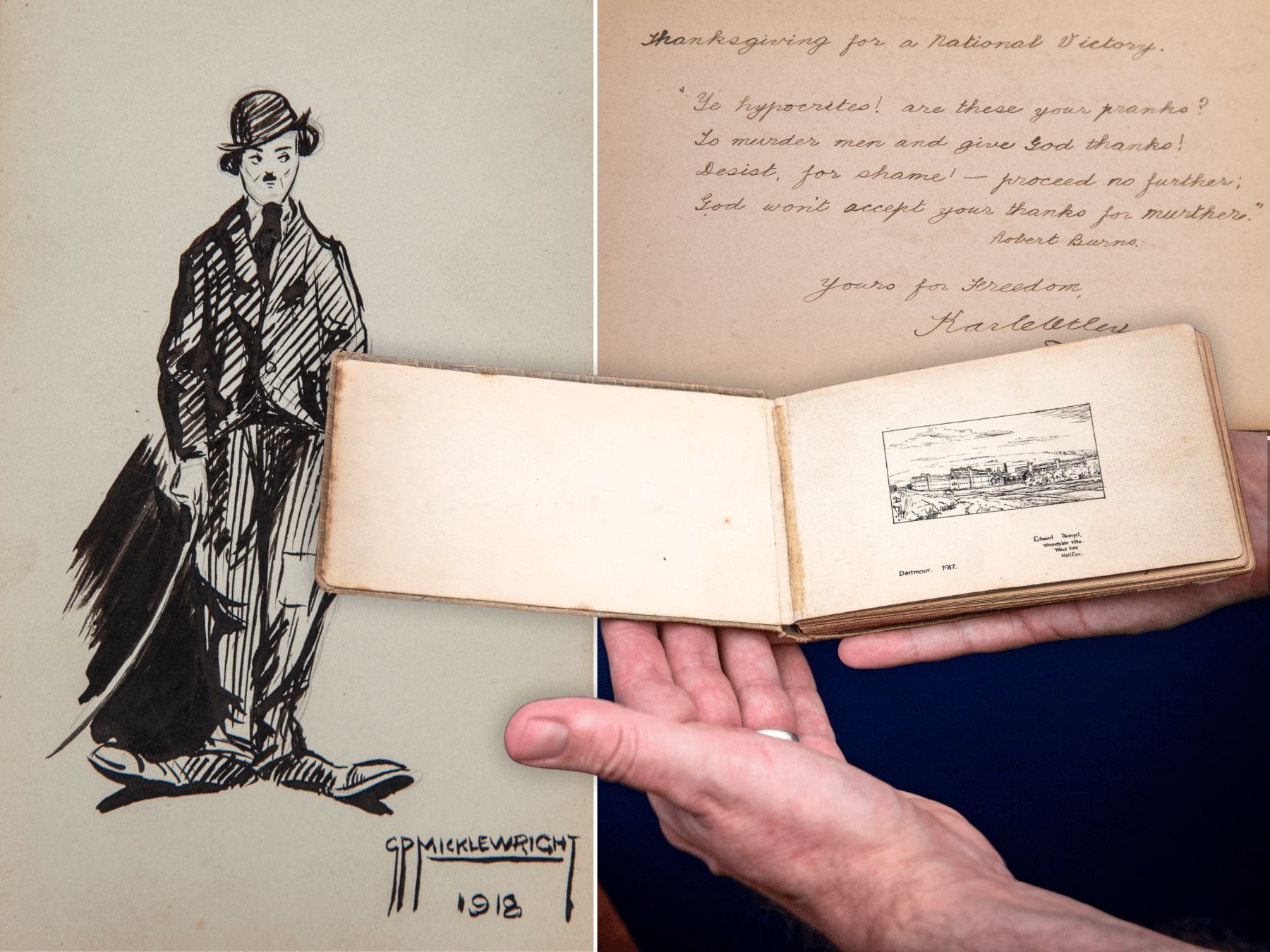
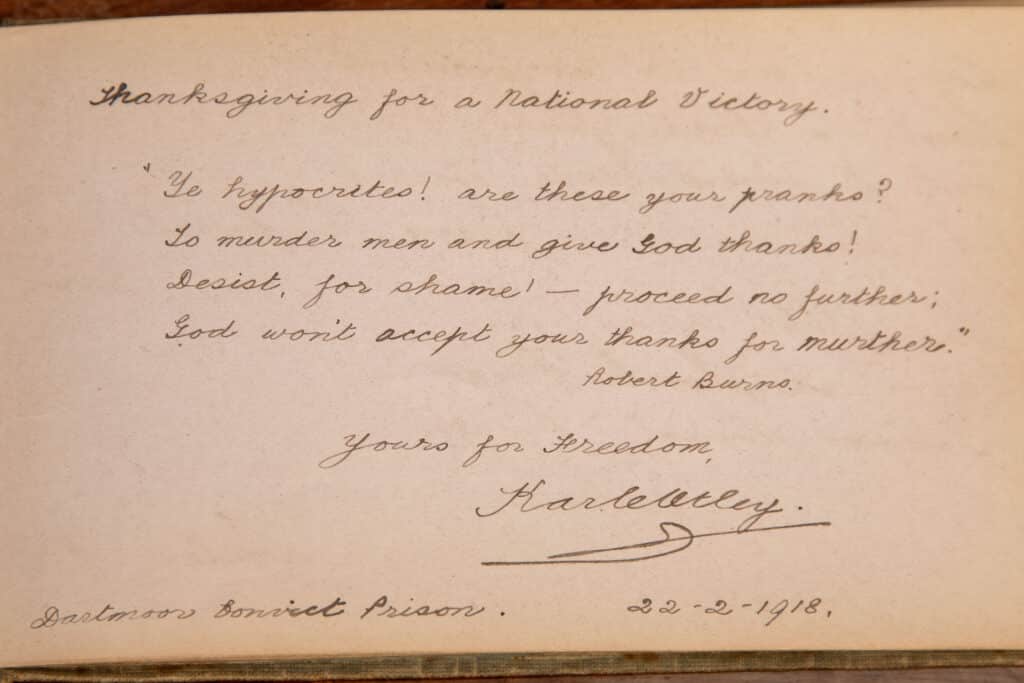
A rare WWI album, the work of conscientious objectors held in Dartmoor Prison, is to go under the hammer on this month.
Some 1,000 conscientious objects, known as COs, or “conchies”, were imprisoned in the jail from 1917 when it was divested of its criminal population and housed only COs. First called Dartmoor Work Centre, later renamed Princetown Work Camp, imprisonment was a far cry from the men’s civilian days. Viewed as traitors and cowards, they were often treated worse than prisoners. Punishments included fines, solitary confinement and hard labour shifting granite on the famous moor.
In total at least 73 COs around the UK died from the brutal treatment they received, two in Dartmoor, while others suffered long-term physical and mental illness. Some committed suicide.
Their plight is reflected in the 58-page book which is expected to make £400-£600 when it appears at Hanson Auctioneers, in the Derby August Medals, Militaria & Firearms Auction, on the 13th August.
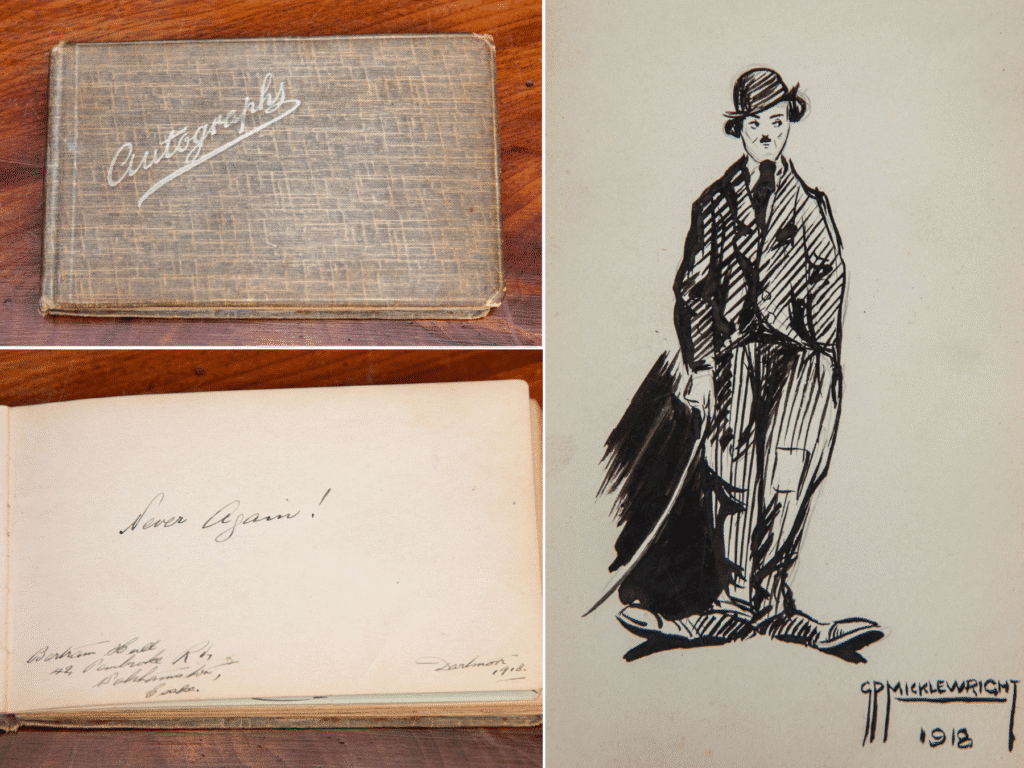
One page contains a pen-and-ink illustration made by book illustrator, George Peace Micklewright (1893-1951) who went on to create a series of satirical cards detailing the life of a CO and design the covers of more than 2,000 books.
Like others in the jail, after he refused to take part in any aspect of the war effort, Micklewright was arrested, fined, and imprisoned at Lichfield, Warwick and Wormwood Scrubs before being sent to Dartmoor.
On another page Wallace Cartwright wrote: “If music be the food of love – play on.” Cartwright was 18 at the time of his imprisonment with documentation from the army authority asserting: “An eighteen-year-old could have no beliefs strong enough to warrant exception from military service.”
On another page William Shaw writes on May 17, 1918: “The machine gun is powerful. But a united working class can spike it.”
Taking a stand
When the Military Service Act of 1916 introduced conscription for the first time in British history, up to 16,000 men refused to wear the ‘King’s Uniform’ and take up arms to fight the enemy.
Most, including Quakers, Plymouth Brethren and Methodists, were following hard-felt religious beliefs. Others held political anti-war views, including anarchists and radical socialists.
Newspapers vilified them branding them cowards and they were ostracised by both family and society. Once they declared themselves a conscientious objector, a CO faced a local tribunal which, after hostile cross examination, assigned their fate.
Most were given non-combatant roles, serving in the Non-Combatant Corps (derided as the “No Courage Corps”) to work on farms, or in hospitals or even as grave diggers. Another group of COs – known as “absolutists” – refused to support the war effort in any way. Those who failed to comply with NCC orders were arrested and court-martialled – treated as soldiers who had disobeyed orders, rather than civilians.
Hansons’ militaria specialist Matt Crowson said: “Even after the war, COs were denied employment with many carrying the stigma of for years. But in hindsight, this group of men have been increasingly recognised for their courage and moral conviction. The Peace Pledge Union among others now honours their stance and various memorials, including the CO memorial in Tavistock Square, London, unveiled in 1994, pays tribute to their convictions.” The album is part of Hansons’ medals, militaria and firearms sale at its Etwall saleroom near Derby.
Auction Details
Auction: Derby August Medals, Militaria & Firearms Auction
Auction date: 13th August 2025 | 9:30am
Location: Hansons Derbyshire Saleroom
Auction contact: [email protected]
Catalogue/bidding: www.hansonslive.co.uk | www.the-saleroom.com