






The buzz of insect life is something we all notice in summer but bugs of all shapes and sizes play a formidable role in antique jewellery too.
Golden spiders with opal bodies and ruby eyes or dragonflies with wings fluttering with amethysts are familiar sights in our salerooms.
These valuable decorative insects are beauties to behold – and sought after at auction. This type of jewellery was wildly popular, particularly in Victorian times. To have a gem-filled spider brooch attached to your gown was a thing of pride.

This may seem odd now – particularly for arachnophobes – but the Victorian era brought with it huge life changes sparked by the Industrial Revolution, changes that made people hark back to nature.
Increasingly, people moved away from rural villages to work in towns and cities, so much so the countryside became a place of nostalgia. This romanticised memory of rural life was celebrated in insect jewellery. In the face of rapid urbanisation, natural motifs like insects were seen as genteel, nurturing and virtuous.
Consequently, the Victorian era saw insect jewellery designs blossom. This was influenced by the British interest in Egypt that accompanied the building of the Suez Canal from 1859-1869. In Ancient Egypt, scarab beetles were a common symbol of good luck and appeared as a motif in jewellery.

In the 1860s Victorian women began to wear beetles and other insect motifs on their clothes and accessories. Precious gems were incorporated into insect designs, enhancing the vividness of the pieces as well as adding value. Insect bodies were often represented with large gemstones.
Some jewellers took this passion one step further by creating live insect jewellery. Some Victorian women wore live beetles encrusted with gemstones, kept in tiny gold cages and attached to their clothes or lapels with a pin.
Even then, this was frowned upon. Mrs H R Hawes, author of The Art of Beauty published in 1883, wrote, ‘The large and gaudy insects that crawl over them are cheap and nasty to the last degree… at present, the bonnets and the brains they cover are too often not unfit companions’.

Nevertheless, the Victorians unleashed a natural world of beauty into jewellery, turning bugs, bees, butterflies, dragonflies – and even spiders – into objects of desire. Other creatures appeared on jewellery too. For example, a late Victorian fox brooch achieved a guide price of £250-£400 at auction.
Queen Victoria, who reigned from 1837 to 1901, had a huge influence too. When she became engaged to Prince Albert, he gave her a serpent ring with emerald eyes, her birthstone. The serpent symbolises eternity and his gift inspired a wave of serpent jewellery.

The use of nature in objects of desire does not end there. All creatures great and small continually enthral designers. Take Stuart Devlin, one of the world’s most well-respected 20th century silversmiths and goldsmiths.
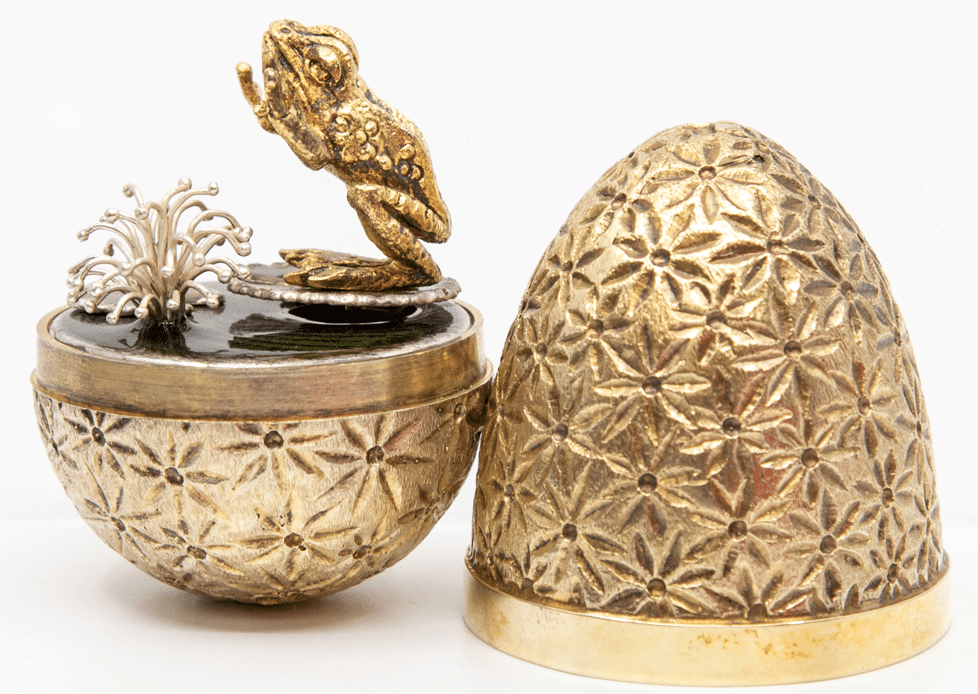
Devlin, who opened a small workshop in London in 1965, developed his own take on the famous Fabergé eggs, which were created as gifts for Russian Tsars Alexander III and Nicholas II between 1885 and 1917. Devlin created limited-edition silver gilt surprise eggs. These collectors’ items sell for hundreds of pounds today. One example we had the pleasure of auctioning revealed a surprise frog on a green enamel lily pad.
Even a rat can delight in jewellery form. Early 20th Century Japanese white metal and gold rat cufflinks from the late Meiji/Taisho period sparked bidding delight. When it comes to good period or antique jewellery, auction demand is dazzling.
Right now, jewellery and gold are excelling at auction. In an unstable world people prefer to invest in tangible assets. To give you an example of high values, a huge gold cross and chain assessed for potential auction has been valued at £29,000 for its gold scrap weight alone. The cross is 8ins long.

Forgotten or unwanted gold such as old crucifixes, pocket watches, chains and even broken jewellery can bring you rich rewards at auction. Among many items to do well recently was a rare Victorian Buckle ring which had a secret compartment hiding another older Fede ring. It had been bought by the vendor for scrap prices. When it sold at Hansons the hammer fell at £1,250.
That old jewellery gathering dust in drawers really is worth its weight in gold.
To arrange a free jewellery valuation/consignment, email Hansons’ Head of Jewellery Helen Smith: [email protected]