








Stunning design and artistic endeavour shine bright at the bleakest of times as a futuristic lamp lighting up our saleroom has demonstrated.
Stargazers may immediately guess what planet this eye-catching Art Deco lamp represents. It is, of course, Saturn, known for its prominent ring system and named after the Roman god of wealth and agriculture.
Saturn’s rings are represented by the rim on this simple, elegant lamp in Hansons’ February 23 Decorative Arts Auction. It’s part of a single-owner collection of Art Deco lighting poised to get bidders aiming high at auction.
Art Deco lamps have long been popular but the Saturn example is particularly special. It was made for the New York World’s Fair which took place in America in 1939. That date is embedded in history for a very different reason – it marked the start of the Second World War.

But the rumble of conflict could not halt the emergence of new design. The planetary lamp, designed to be used on a desk or small table, was made by the LJ Houze Convex Glass Co., a firm founded in 1914 at Point Marion, Pennsylvania, by Leon Houze and his son, Roger.
Houze created the Saturn souvenir lamps for display and sale at the 1939 event held at Flushing. It was offered in a variety of pastel shades at a show which attracted more than 44 million visitors between April 1939 and October 1940.
This example comes in luminescent frosted glass sprinkled with blue stars and crescent moons. It sits on a white frosted conical skyscraper base. In perfect working condition, it has a guide price of £100-£150.
The beauty of Art Deco objects is that they look modernistic for their time. Consequently, they suit most home interiors today but are instantly recognisable as vintage classics.
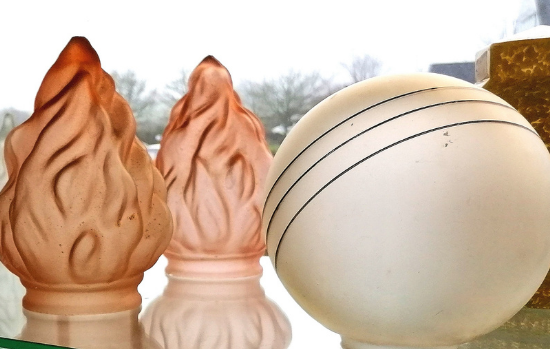
Art Deco is a style of visual arts, architecture and design that first appeared in France just before the First World War. It influenced the design of buildings, furniture, jewellery, fashion, cars, movie theatres, trains, ocean liners, and everyday objects. It took its name, short for Arts Décoratifs, from the International Exhibition of Modern Decorative and Industrial Arts held in Paris in 1925.
From its outset, Art Deco was influenced by the bold geometric forms of Cubism and the Vienna Secession; the updated craftsmanship of the furniture of the eras of Louis Philippe I and Louis XVI; and the exotic styles of China and Japan, India, Persia, ancient Egypt and Maya art. The Empire State Building, Chrysler Building, and other skyscrapers of New York City built during the 1920s and 1930s are monuments of the style.
In the 1930s, during the Great Depression, Art Deco became more subdued. New materials arrived, including chrome plating, stainless steel and plastic. A sleeker form of the style, called Streamline Moderne, appeared in the 1930s featuring curving forms and smooth, polished surfaces.

Art Deco is one of the first truly international styles, but its dominance ended with the beginning of the Second World War and the rise of functional modern architecture. So the Saturn lamp was made at turning point in design history.
For me, it encapsulates the true meaning of Decorative Art, a term used to describe an item with is both decorative and functional. It’s one of many objects in Hansons’ February sale which includes a wide array of colourful Moorcroft pottery.
We have been privileged to sell a number of important single-owner Moorcroft collections and the Decorative Arts sale sees some fine examples from the Midlands pottery firm emerging to tempt fans around the world.

Moorcroft dates back to 1897 when Staffordshire pottery James Macintyre & Co discovered a prodigious talent in the shape of 24-year-old designer William Moorcroft. Within a year he was in charge of the company’s art pottery studio.
He went on to start his own business and Moorcroft’s first innovative range of pottery, Florian Ware, was a great success. It won him a gold medal at the St Louis International Exhibition in 1904, a world fair. Unusually at that time, he adopted the practice of signing his name, or his initials, on nearly all the pottery he designed.
Moorcroft produced an extensive array of moderately-priced domestic tableware plus hand-painted art pottery. His reputation was enhanced when Queen Mary, a keen collector of his works, granted him a royal warrant in 1928. Such was Moorcroft’s impact, his designs remain popular today and, just like the Art Deco lamp, still look contemporary.
Auction entries invited
Entries are invited until February 2 for Hansons’ February 23 Decorative Arts Auction. These specialist sales are held all year round. To arrange a free valuation, email Barry Jones: [email protected].
To arrange a free valuation of any type or home visit, email [email protected] or call 01283 733988.