








Fine works of art live forever, collected and admired through the generations, and few are more entrancing than the glass art of Frenchman René Lalique.
His designs and Art Deco style, which emerged in the 1920s, have entranced the world for more than a century. If anything, they are even more popular today than at their inception in his Parisian workshop. Proof of this came courtesy of Hansons’ Derbyshire Iconic Design Auction. Lalique wares were the top-selling lots in September’s sale. View all results
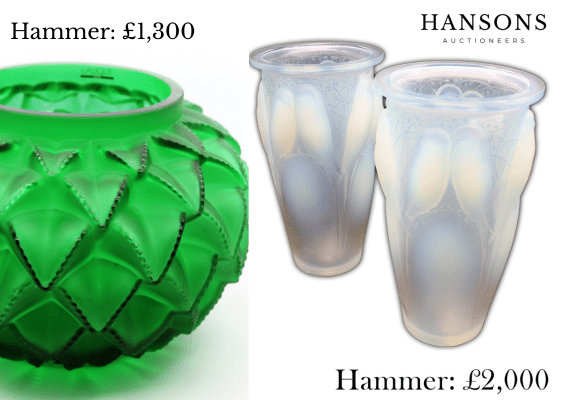
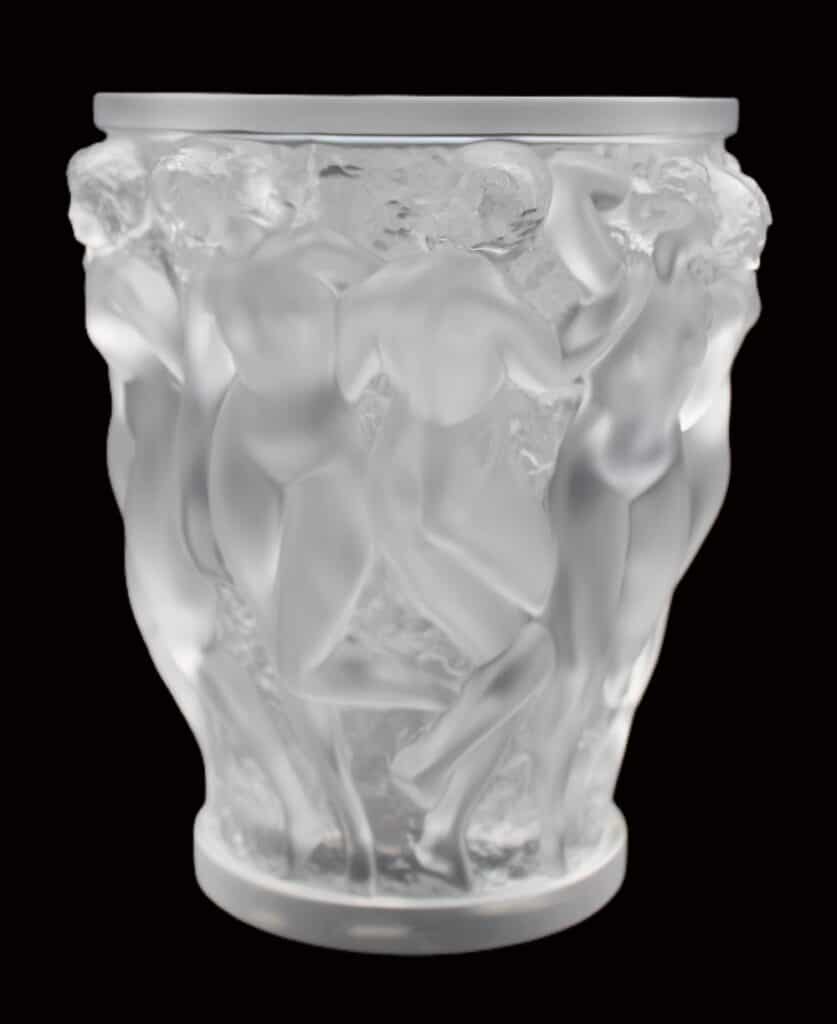
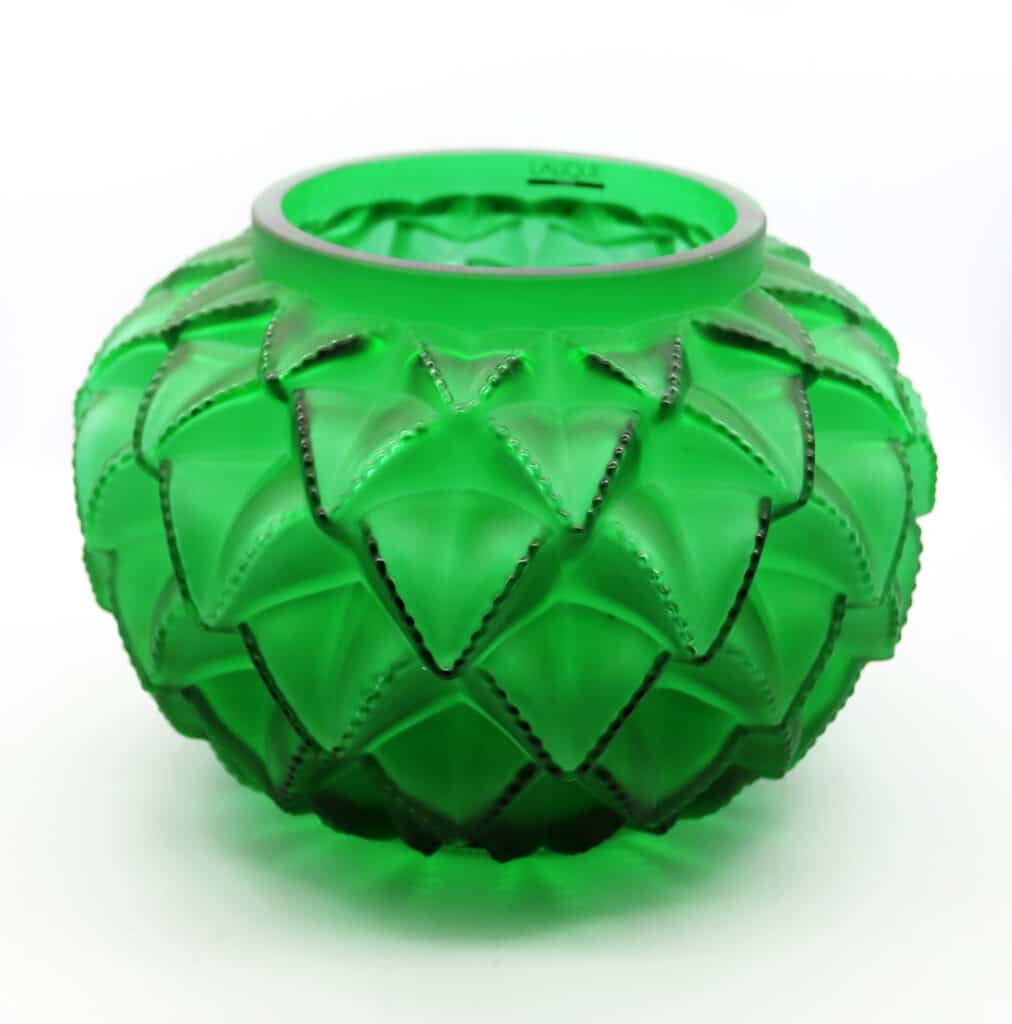
In demand was a pair of Lalique Perruches or Ceylon opalescent glass vases signed ‘R. Lalique’. Decorated with birds nestling head to head, they hammered at £2,000, despite chips and scratches. In similar vein, lot 46, a Lalique Bacchantes clear and frosted crystal vase, signed ‘Lalique France’, made £1,450. This elegant piece was decorated with a moulded relief of the young priestesses of Bacchus, the Roman god of wine. Meanwhile, a glorious-in-green Lalique Grand Languedoc crystal vase with satin finish achieved £1,300.

These examples are the tip of the iceberg when it come to Lalique wares. As well as his glass art he is known for perfume bottles, vases, jewellery, chandeliers, clocks and car hood ornaments. His talent even emerged aboard ship and in buildings. He was responsible for six towering glass structures that simulated fountains arranged beneath a massive coffered glass ceiling, all enhanced by illumination both before and after dark, in the grand salon of French ocean-liner SS Normandie. He also created interior fittings, cross, screens, reredos and the font at St Matthew’s Church in Jersey. Built in 1840, this beautiful place of worship is known as The Glass Church.
Such is the respect for Lalique, his works are held in museums the world over including Lisbon’s Museu Calouste Gulbenkian, the Lalique Museum of Hakone in Japan, the Musée des Arts Décoratifs in France, London’s Victoria and Albert Museum and the Corning Museum in New York State, USA.
Lalique (1860–1945), a jeweller, medallist and glass designer, was a prodigious talent. Though born with innate natural ability, looking back at his life it’s easy to understand how he became so accomplished. His creative talent was nurtured from a young age.
His early life was spent learning the methods of design and art he would use in later life. At the age of two, his family moved to the suburbs of Paris but in the summer holidays they travelled to Aÿ in France where he was born. These trips influenced his naturalistic glasswork.
In 1872, aged 12, he entered the Collège Turgot where he started drawing and sketching. He attended evening classes at the Ecole des Arts Décoratifs in Paris and spent two years at London’s Crystal Palace School of Art. This enhanced his graphic design skills and further nurtured his naturalistic approach to art.
In 1876, aged only 16, Lalique was apprenticed to Parisian Art Nouveau jeweller and goldsmith Louis Aucoc, a leading Parisian jeweller. The young Lalique grasped this opportunity to learn jewellery production and design.
In fact he never stopped learning, or experimenting with new ideas. While working, he continued his studies at the Ecole des Arts Decoratifs. By 1881, he was working as a freelance designer for several French jewellery firms including Cartier and Boucheron.
Thanks to his ambition and accomplishments, in 1885, aged only 25, he opened his own business. He had even more freedom to design and make his own jewellery and other glass pieces. After 1895, Lalique also created pieces for Samuel Bing’s Paris shop, the Maison de l’Art Nouveau, which gave Art Nouveau its name. He had many fans. One of Lalique’s major patrons was British-Armenian businessman Calouste Sarkis Gulbenkian, who commissioned more than 140 of his works over nearly 30 years.
In 1890, Lalique opened a jewellery store in the Opéra district of Paris. It was at this time that some of his most famous jewellery designs were created. He also experimented in his use of glass. The main motif of Lalique’s jewellery was the natural world. He was influenced not only by the nature of the French countryside but also by the motifs of Japanese nature art.
His innovative ideas saw him incorporate materials into his jewellery which at that time were not widely used in high-end pieces such as glass, horn, pearl, semi-precious stones, enamel and ivory. He used typical period gemstones for artistic appearance only, not for their value. Lalique’s jewellery and glassware became works of art in their own right, sparking worldwide interest and demand. They still do as Hansons’ results demonstrate.
Elsewhere in the auction world, in 2012 a Lalique vase achieved £280,000 from a a £20,000-£30,000 estimate. Meanwhile, in 2021, 39 Lalique pieces in a private single-owner collection achieved £1.4m. Suffice to say, if you have any Lalique at home, it’s a good time to part with your treasure.
Auction entries invited
Entries are invited for Hansons Auctioneers’ next Iconic 20th Century Design Auction.
To book a free valuation: [email protected] | [email protected]
T: 01283 733988.