







By Eric Knowles
The elegance of centuries long gone attract bidders with taste to the auction honeypot that is Georgian and Victorian jewellery.
Gems from these eras are sought after. Necklaces worthy of a lady in a Jane Austen novel or a Victorian woman of substance delight the eye and often deliver jaw-dropping results. It’s easy to see why.
As well as being tangible assets likely to increase in value, the uniqueness and quality of objects crafted centuries ago spark bidding wars. Recently, a 19th century foil closed back quartz rivière necklace (below) hammered at £3,800 from a £600-£800 guide at Hansons.
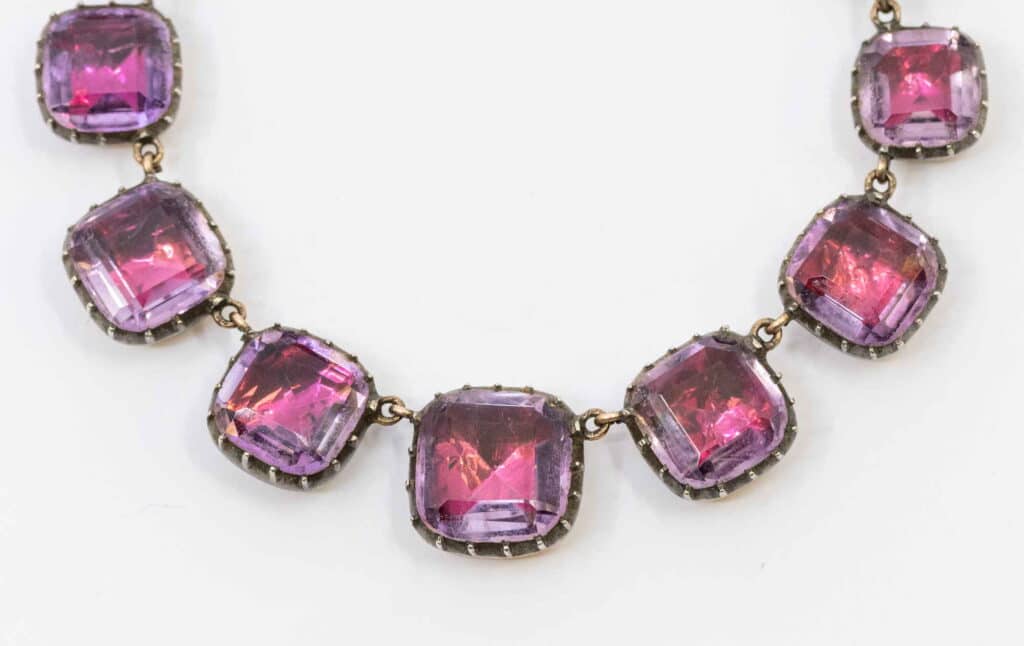
This belle of the auction ball boasted graduated, cushion cut, purple foil-backed stones, set in silver and gold. And yet it had been languishing in a box of costume jewellery, its owner unaware of its value or importance.
Pieces like this are often inherited, tucked away in drawers and forgotten about, sometimes for decades. Riviera or rivière necklaces have precious stones of the same shape and size all the way around. Often a rivière was part of a parure, a suite of matching jewellery including necklace, earrings, bracelet and brooch.
Rivières were popular in the Georgian era (1714-1830). This was a time when balls were the height of social delight for wealthy young ladies and glamorous events demanded jewels to dazzle a prospective beau.
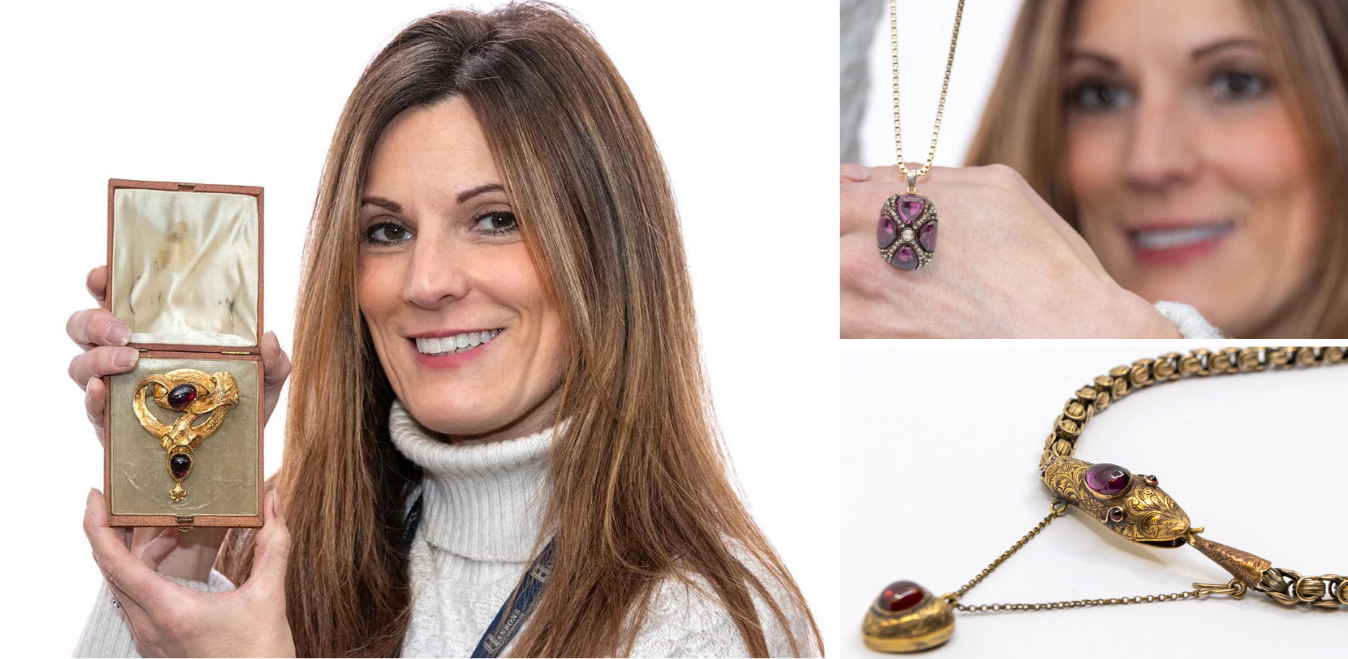
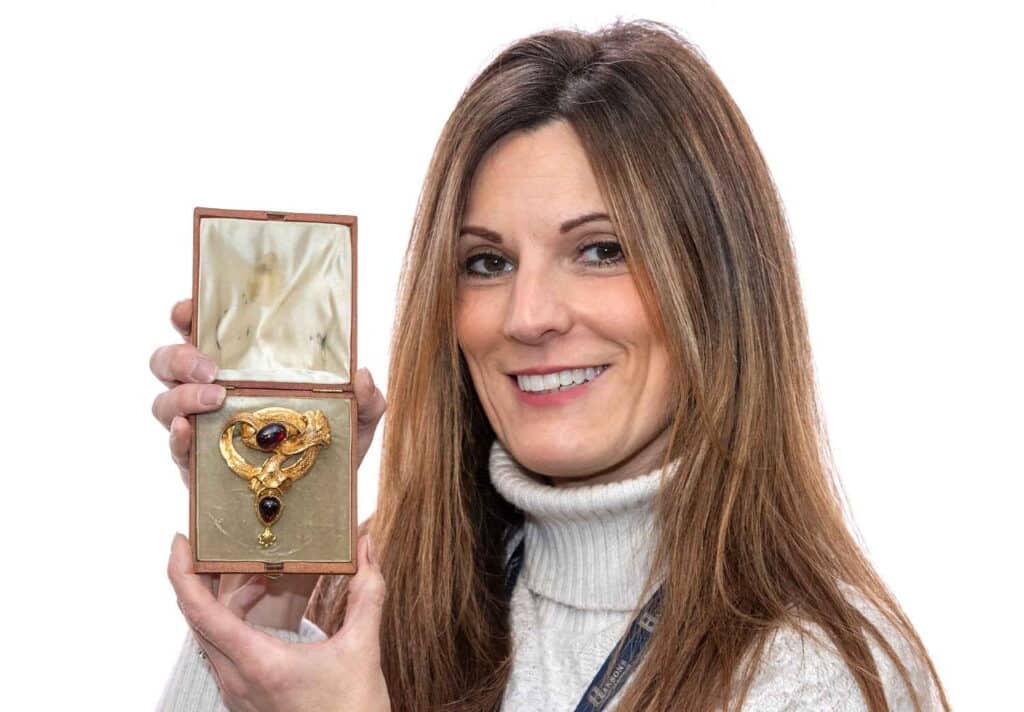
With results of this calibre to impress us the discovery of a collection of Victorian garnet jewellery, set for auction in March at Hansons, has delighted their team.
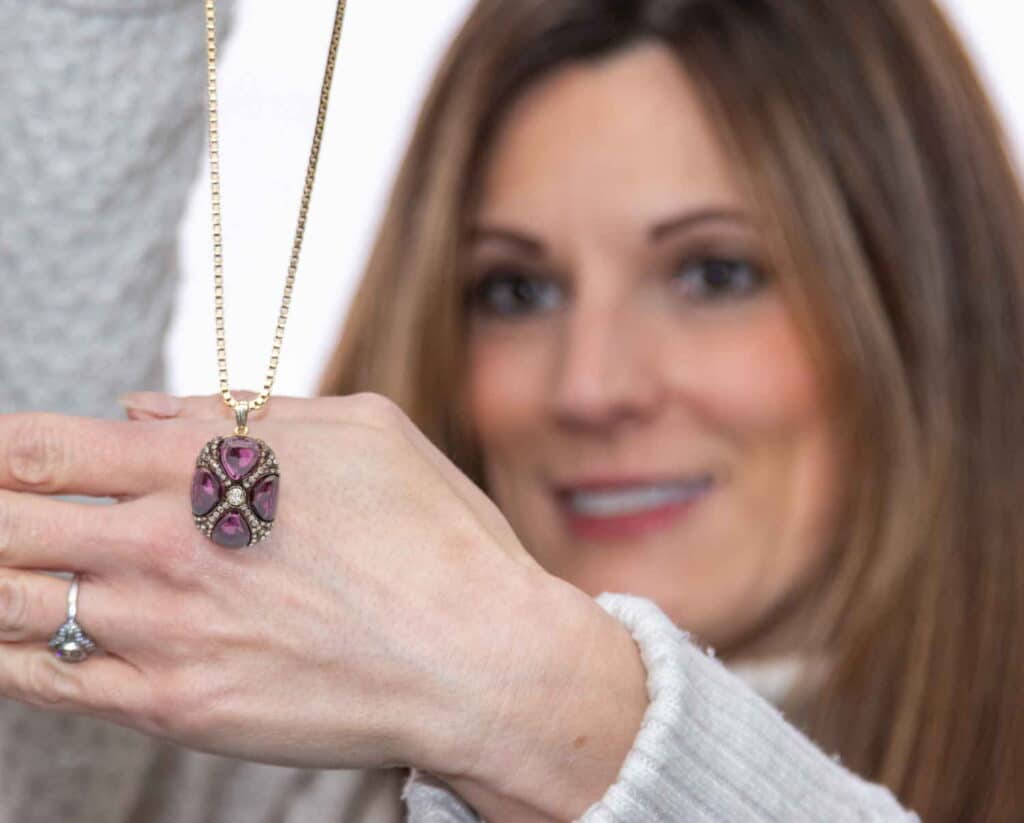
It includes a flamboyant garnet and gold brooch in original box, estimate £500-£700, and an exquisite 19th century French-made garnet and diamond-set mourning pendant locket, below, set with cabochon garnets and rose cut diamond accents, £2,000-£3,000. It opens to reveal a glazed compartment for a piece of hair or image of a loved one.
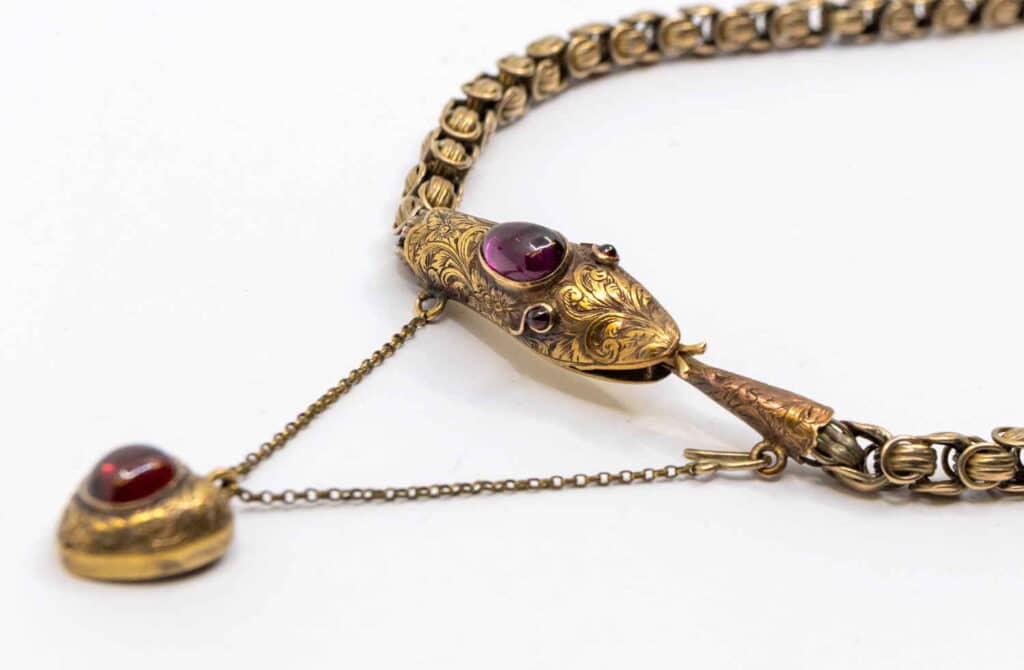
Bidders will also covet a Victorian garnet and 9ct gold serpent mourning necklace, below, suspending a garnet-set heart with glazed hair compartment, £800-£1,200. Garnets embellish the snake’s eyes and head, which has a gold spiked tongue.
This piece encapsulates two trends inspired by Queen Victoria in the mid to late 1800s – mourning and serpent jewellery. It may seem odd a venomous creature known for its ability to kill adorned jewellery but in Victorian times (1837-1901) snakes were popular symbols of eternal love, wisdom and commitment.
Prince Albert gave Queen Victoria an engagement ring shaped like a serpent. When he passed away Victoria mourned him for the rest of her life. As well as wearing black she commissioned mourning jewellery. These often featured compartments for hair or miniature portraits plus dates, initials or names.
Often mistaken for ruby, the garnet was thought to ward off the plague and prevent melancholy. Anglo Saxons mounted slivers of almandine garnet, the purplish red variety, in gold ornaments and jewellery.
The word garnet is thought to derive from the Latin word ‘granatium’ meaning pomegranate. The Middle English word ‘gernet’ also means dark red. But all garnets are not the colour of blood. They come in different varieties and shades including orange, brown, pink and blue.
The garnets themselves, a stone popular in jewellery since the Bronze Age, will also entice bidders. Examples have been recovered from Egyptian tombs and large single stones were often set in gold rings worn by people of high rank from Roman times to the 17th century.
The pyrope and almandine garnet were prolifically used in jewellery, especially in Victorian jewellery as seen in these examples. They often feature a cabochon (domed) shape as they were easy to cut and accentuated the stone’s colour. Garnets were highly prized defining opulence and wealth.
During the late 18th century a technique of foiling gemstones came into vogue. This involved mounting a thin, flat-cut garnet into a bowl shaped mount lined with coloured metal foil. This enhanced the colour of the stone.
Demand for this type of jewellery was fairly high. Apparently, during the French Revolution some officials’ wives wore a single row tightly round the neck imitating a bloody line to provoke aristocrats who might shortly face the guillotine.
The value of Victorian and Georgian jewellery is also enhanced by rarity. Much Georgian jewellery has not survived. Many families restyled pieces to keep up with trends, or sold them off and components were taken apart for their value. A sad loss as Georgian jewellery was crafted by hand due to lack of precision cutting machinery.
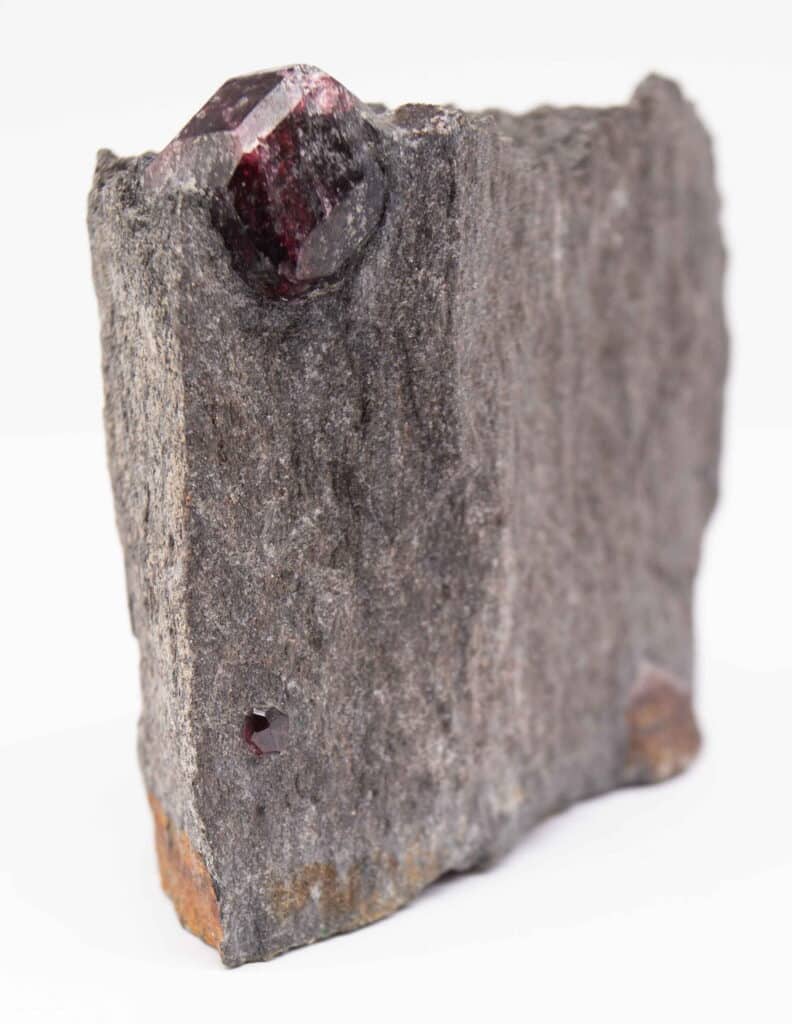
To gain an idea of the work involved in taking gemstone to jewellery, Hansons’ March auction also includes two garnet crystals in natural matrix – rock crystal – form, estimate £30-£40, above. It’s fascinating to see and another reminder of why these stones are so precious.
The Victorian garnet jewellery and garnet matrix will be offered in Hansons Auctioneers’ March 21 Derby Fine Art Auction. Further entries invited until February 29.
To book a free jewellery valuation, email Head of Jewellery Helen Smith: [email protected] or call 01283 733988