







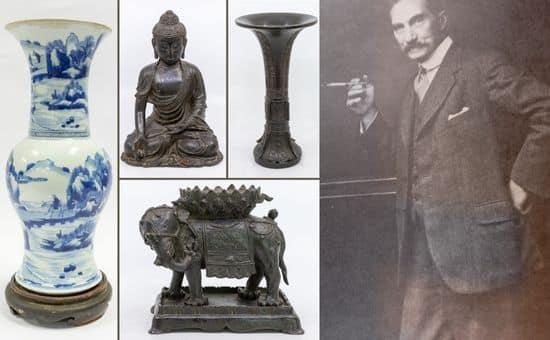
An extraordinary collection of Chinese ceramics, bronzes and works of art is set for auction (Jan 9, 2023) thanks to a railway engineer’s eye for beauty a century ago, writes CHARLES HANSON
From 1895 to 1920 Thomas Johnstone Bourne CBE, MICE (Member of the Institute of Civil Engineers) was employed as a civil and mechanical engineer on the construction of early railways in China.
Whilst there, he immersed himself in the culture and acquired items to decorate his family home. Consequently, a rich array of ceramics, bronzes, wood inlaid statuary, embroidered silks, dolls and ceremonial costumes of the late Ming and Qing periods were purchased.
His principal residence during this time was at Wei-Hai-Wei near the Gulf of Chihli, on the Korean Sea, and most of his work was in Shandong province. Some items were bought locally while others were presented as gifts for services rendered by war-lords and officials across whose lands the railways were built.
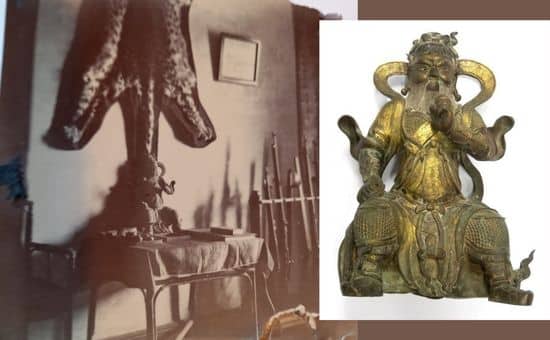
Provenance of this calibre is destined to set the saleroom alight in Hansons’ January 9 Winter Fine Art Auction. Chinese buyers are keen to repatriate historical treasures to their homeland and provenance is key. Consequently a grainy black and white photo from 1908 showing an auction item, a late Ming Dynasty, 17th century gilt bronze Wudi statue in the Bourne family home in China, takes on great importance.
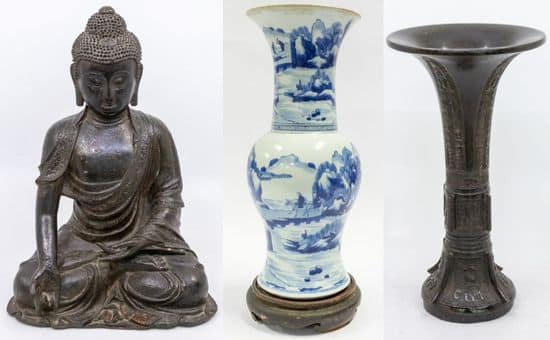
I predict strong demand across the 30-item collection which will be offered in Hansons’ Jan 9 Winter Fine Art sale. It includes centuries-old objects such as a 16th century, Ming Dynasty Chinese bronze Buddha, estimate £1,500-£2,000.
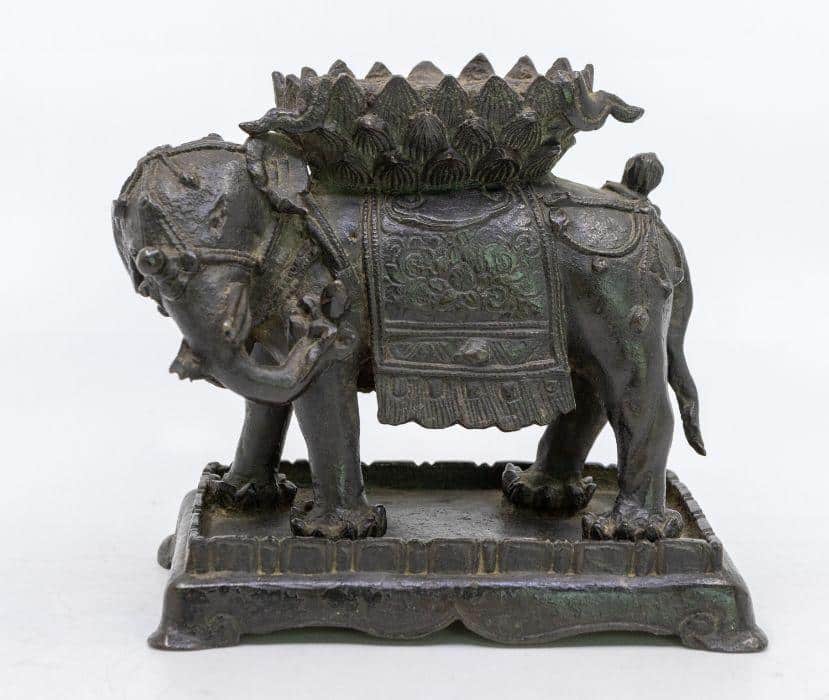
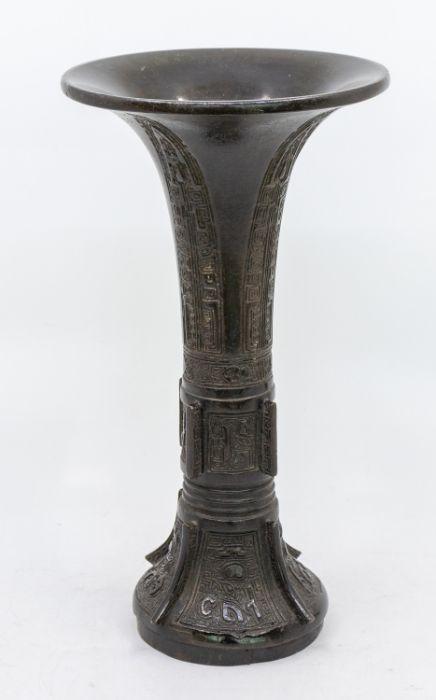
Other Chinese bronzes include lot 198, an archaistic Gu vase, late Ming/Qing Dynasty, 17th/18th century, £300-£500, and lot 195, an elephant censer, late Ming Dynasty 16/17th century, £100-£200.
A strong ceramics offering is lot 216, a Chinese blue and white porcelain landscape YenYen vase, Kangxi (1662-1722), £800-£1,200. It is painted with man on a mule and two seated scholars in a rocky and misty lakeland.
These objects have been treasured for decades. After his retirement in 1925, Bourne returned to live in Dorset, bringing his Chinese collections with him to decorate his home.

He died in 1950 but his widow lived for a further 20 years. On her death the collection was inherited by family members. They are no longer in a position to display it and preserve it as it deserves, hence its arrival at auction.
Collections like this not only celebrate Oriental art, they honour those who recognise quality, in this case Thomas Bourne – a man as extraordinary as his collection. As well as having a connoisseur’s eye for quality he enjoyed an outstanding career which led to royal recognition.
He first went to China in 1895 as assistant engineer for the new Formosan Government Railways. Initially, he moved to the Chinese mainland and worked for the Imperial Chinese railways under the Dowager Empress, and later for consulting engineers Cowdray Pearsons, main contractors for the Imperial government.
Empress Dowager Cixi (1835 -1908) was a Chinese noblewoman, and later regent, who effectively controlled the Chinese government in the late Qing dynasty for 47 years, from 1861 until her death.
She awarded Bourne the Chia Ho medal for his work on bringing a private branch line from the Pekin Syndicate Railway to the Forbidden City. He constructed the Syndicate line northwards passing the Shan-Hai-Kwan, the gate of peace, through a gap in the Great Wall created by floods.
His other engineering projects included Pekin to Tientsin 80 miles; Pekin to Hankow several hundred miles; Wi Ho to Su Nan Chan 150 miles; harbour tenders in Hong Kong and Bombay; the viaduct at Peng Pu and Pekin-Hankow main lines 200 miles.
In 1915, during the First World War, confidential overtures were made to Bourne by the British War Office with the possibility of recruiting a workforce from China to relieve administrative pressures behind the trenches in the French theatre of war.
Bourne was able to do this because large numbers of Chinese men had worked for him on his railway projects. They knew he could be trusted to pay them properly and not inflict punishments when work was not up to standard, which happened under the war-lords.
In a few short months he recruited an army of 92,000 men, an extraordinary feat. He ensured each one had his own contract of service, such as a British private would have.
Pay was shared between the volunteer in France and his family in Shandong. Uniform, accommodation, travel and food was supplied. They were not called upon to engage in hostilities but were used for transport services.
Sadly, some still lost their lives. Some 2,000 casualties were buried in special Chinese cemeteries on the French coast and at Noyelles, still cared for by the War Graves Commission. However, the remaining 90,000 returned to China in 1919 and 1920. For this work Bourne was made CBE by King George V.
The Bourne Chinese Collection will be offered in Hansons’ January 9 Winter Fine Art Auction. Catalogue/bidding: www.hansonslive.co.uk or www.the-saleroom.com. To enquire, or consign items for the next Fine Arts sale, email [email protected].
CLICK HERE TO VIEW JAN 9 WINTER FINE ART AUCTION CATALOGUE
Hansons’ salerooms reopen at 9am on January 3.