







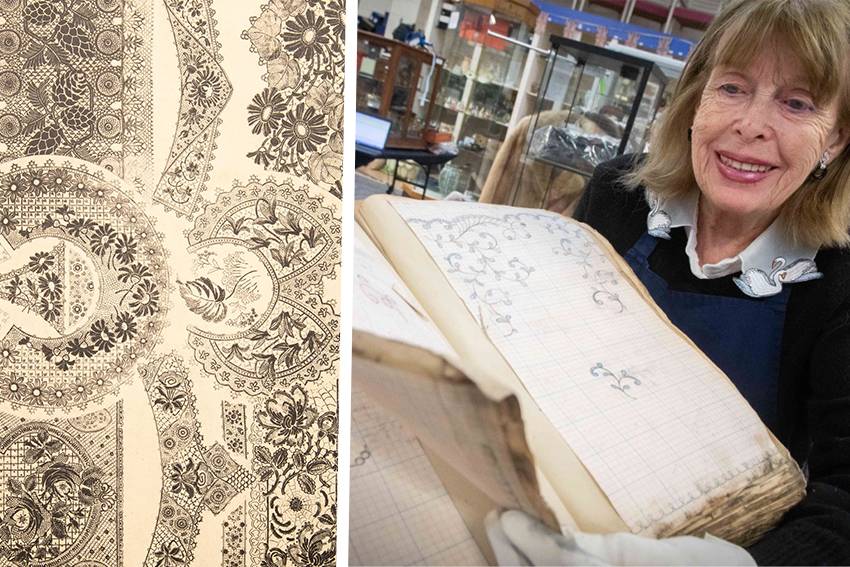
Costume museums around the world can bid for a rich historical archive encapsulating Europe’s lacemaking history – found in a Nottinghamshire loft.
The ancient items, which include huge books filled with rare lace making designs and samples from across Europe dating back to the 1800s, had been gathering dust in the loft for 20 years.

But now their Nottinghamshire owner has decided to sell the entire collection at Derbyshire’s Hansons Auctioneers.
The vendor, who wished to remain anonymous, said: “They were found at the former J Kirkland & Sons lacemaking factory in Lambley, Nottinghamshire, which I bought along with my business partners in 1984 to house our screenprinting business.
The factory was built in 1900 by J Kirkland, lace manufacturers in High Pavement in Nottingham’s Lace Market, to accommodate female workers in the Lambley area. Later, the lace industry declined and the property was used to produce high-quality children’s clothing.
In 1984 the business went into liquidation and the factory and all its contents went up for auction.
The vendor said: “As well as the building itself, we bought the contents of a mezzanine floor housed within it and that’s where I found the historical lacemaking books – some dating back to the late 1800s.
“I knew the archive was important but wasn’t sure what to do with it. When I retired in 1999, I took it home and put it in the loft. The books have been there ever since. I’d love to see them go to a museum, ideally in Nottingham.”
Notty Hornblower, owner of Derbyshire’s Hope House Costume Museum and textiles consultant at Hansons, said: “I was stunned when I saw this collection. It has to be one of the world’s richest lace-making archives.
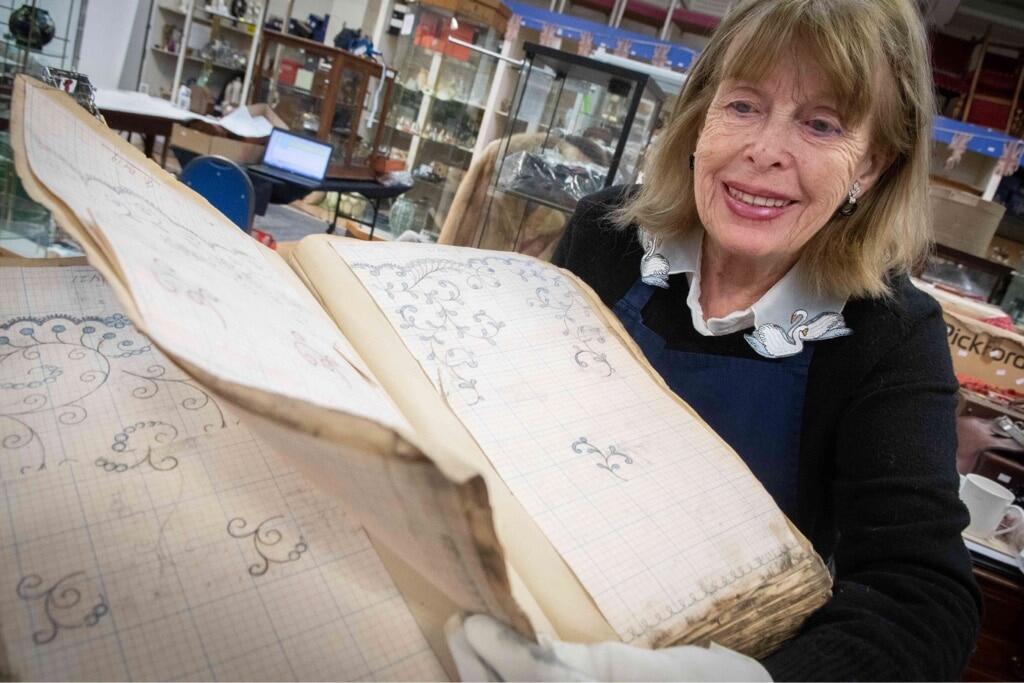
“It contains hundreds of antique lace samples including Victorian and Edwardian designs from right across Europe including Germany, Switzerland, Portugal, Valencia, Italy, Brussels, Ireland, Paris and, of course, England.
“J Kirkland sourced a multitude of designs to enrich and inspire their knowledge when lace making was at its height. It shows the key role they played in the world’s lace-making history. Thanks to the present owner that knowledge has been saved for posterity.
“It’s a truly fabulous archive and I will be alerting costume museums about it because that’s where it deserves to be. I am so pleased the owner understood its importance and looked after it for all those years.
“Nottingham was the centre of the world’s lace industry during the British Empire and this archive demonstrates that perfectly.”
Nottingham’s Lace Market played a rich role in the city’s industrial past. At its peak, its hosiery industry employed 25,000 mostly female workers in the 1890s. Lace declined as technology changed and the working population fell below 5,000 in the 1970s with many factories becoming derelict.
The origin of lace is disputed but the late 16th century saw both needle lace and bobbin lace became dominant in fashion and home décor. It was used to enhance the beauty of collars and cuffs, create adornments for the home and was used in religious vestments. In 1840, Queen Victoria inspired the use of lace in bridal gowns when she married in lace – a fashion which continues to this day.
The archive, due to be sold during Hansons’ March 28-April 4 Spring Fine Art Auction, is split into several lots and includes patterns for lace hand-drawn in pencil, estimate £200-£300. There are also three large folios containing samples of lace and a book, Oriental Lace Novelties, with samples of embroidered silk, tulle and muslin, estimate £200-£300.
Other lots include a large folio of lace samples stamped 1899, estimate £200-£300, six folios of English lace, estimate £80-£120, photos of French lace, Parisian lace printed on paper, Chantilly lace from 1904 printed for the Paris Exhibition, Belgian designs from a 1905 Exhibition of Liege and a folio of French, Italian, German and Dutch designs.
Among the vast collection is a book entitled Formes et Decors Moderne, The Fine French Porcelain Book, circa 1900, which shows designs for vases, kitchenware and bonbonniere, estimate £100-£200.
Mrs Hornblower said: “I would expect this archive to sell for in excess of £5,000 and I very much hope it gains much more than that. It’s an incredible treasure.”
The lace archive will be sold at Hansons Spring Fine Art Auction. Entries invited until March 8. To find out more, email [email protected] or call 01283 733988.