










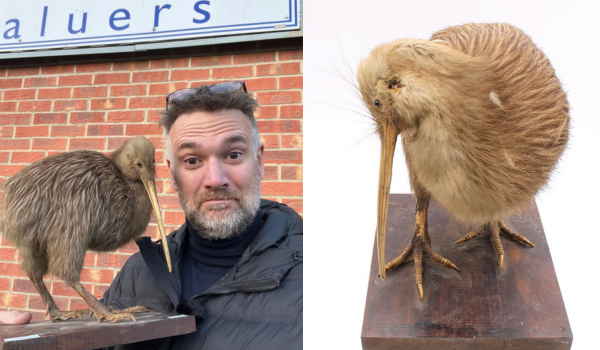
A stuffed New Zealand kiwi bird found in a hoarder’s garage has soared to success at auction.
The unusual piece of taxidermy went under the hammer with a guide price of £50-£60 at Hansons Auctioneers’ Derbyshire saleroom. However, intense pre-sale interest sparked a flutter of early-bird bids. Consequently, the price flew to nearly £2,000 before the live auction had even begun.
On sale day more bids flocked in from all over the world including America and Australia. The hammer finally fell at £2,750. The total paid, with premium, by a private UK online buyer was £3,608.

Charles Hanson, owner of Hansons Auctioneers, said: “It was an astonishing result for an ancient feathered friend found in a makeshift garage converted from a coal shed. I came across the bird during a visit to a hoarder’s property in Reading, Berkshire. It didn’t even have a working kitchen.
“The kiwi was perched between old cars parts and a motorbike. It was in remarkable condition considering it had no cover to protect it. It went to auction with a modest estimate but winged its way to glory thanks to its scarcity value.
“We have sold numerous examples of antique taxidermy but I have never seen a kiwi before. The discovery came about through a Derby client who instructed Hansons to carry out the Reading house clearance. She was thrilled by the result.
“It’s an unusual find because the kiwi is a flightless bird endemic to New Zealand. In fact it’s an iconic national symbol of the country. New Zealanders are known as Kiwis.

“Exactly how this particular bird (sold with two other birds, above) travelled 11,426 from the other side of the world to the UK remains a mystery. I suspect it may have been brought here by a wealthy British traveller in Victorian times. Perhaps it was inherited or purchased at auction years ago.
“The Victorians made the art of taxidermy popular. They were enthralled by mementos of exotic travel. Taxidermy was seen as a physical display of knowledge, wealth and artistry. You must bear also in mind that, without TV or internet, taxidermy offered a way to see and study creatures from afar.
“The rarity is enhanced because the kiwi is listed as vulnerable. There are five recognised species of the bird and all have been affected by deforestation. However, kiwis are no longer hunted.
“The New Zealand Māori traditionally believed kiwi were under the protection of Tāne Mahuta, god of the forest. They were used as food and their feathers were used for ceremonial cloaks. Today, while kiwi feathers are still used, they are gathered from birds that die naturally and some Māori consider themselves the birds’ guardians angels.”
The kiwi sold on January 23, 2024 at Hansons Auctioneers’ Derbyshire saleroom.
Auction entries invited
Taxidermy entries are invited for auction. To discuss a potential consignment, please email [email protected] or call 01283 733988.