








A great-grandfather’s 50-year devotion to antique porcelain is set to inspire bidders around the world – and shine the spotlight on Derbyshire’s rich ceramics heritage.
More than 60 impressive examples of mainly Pinxton and Derby wares, some dating as far back as 1765 and all manufactured in the county, will be offered by Hansons Auctioneers on June 30.
And the collection of rarities, including plates, cups, saucers and coffee cans, is all down to the unstinting devotion of ceramics connoisseur and retired brewery estate manager Barry Michael Wheatcroft, 87, from Farndon, near Newark, Notts.

Over the course of half a century, from the 1950s onwards, Barry amassed numerous rare items and carefully housed them in cabinets in his home.
Charles Hanson, owner of Hansons Auctioneers, said: “Barry’s eye for quality early porcelain has led to a collection which delivers a ceramics history lesson on a plate. These wares demonstrate the artistry and techniques involved in the manufacture of porcelain in England from the mid-1750s onwards.
“Derby and Derbyshire have much to be proud of in terms of their involvement in early porcelain production in England. In the mid-1700s Derby became renowned for producing exceptional quality porcelain. That proof of quality was evidenced by the fact that William Duesbury, then an enameller in London, paid considerably more for pieces manufactured in Derby than for figurines made by rival factories in Bow and Chelsea.
“Derby’s porcelain production predates the commencement of the works of William Duesbury, started in 1756 when he joined Andrew Planche and John Heath to create the Nottingham Road factory, which later became Royal Crown Derby.”
Barry’s daughter, Di Ablewhite, 62 a photoshoot location owner/stylist from Long Bennington, Lincolnshire, said: “Dad’s interest in collecting was sparked by a couple of pieces of old Derby porcelain. The ultimate pleasure is the thrill of the find. He was elated if he came across a rare piece. He scoured antiques fairs with his wife Jean and sometimes had the opportunity to buy pieces through his membership of Pinxton Porcelain Society.

“The finds took pride of place in their small bungalow. They dominated glass cabinets in four rooms. When we came to pack them for auction, they were stacked four deep. When we were children, my sister and I were never allowed to open the cabinets or dust the objects inside!”
“Dad’s decided to part with the collection now due to ill health. We never thought he would but he’s interested to see how well the items he has treasured for so long do at auction.”
Barry said: “My interest in local history initially emerged thanks to my home village of Farndon. I visited book fairs in search of old postcards and started to meet interesting porcelain dealers such as Nick Gent, a consultant valuer at Hansons. I was persuaded to join Pixton Porcelain Society and attended meetings in Pixton Village Hall for many years, learning all the time.”

According to Hansons, Pinxton’s popularity with collectors is down to its rarity – caused by the factory’s short lifespan. Pinxton Porcelain, based in the Derbyshire village of Pinxton in Bolsover, manufactured wares for 17 years from 1796 to 1813.
It was founded in 1795 by John Coke and porcelain painter William Billingsley. He had worked as a senior flower painter at Derby Porcelain Factory and was renowned for his floral art. His name and artwork designs crop up time and again in Barry’s collection.
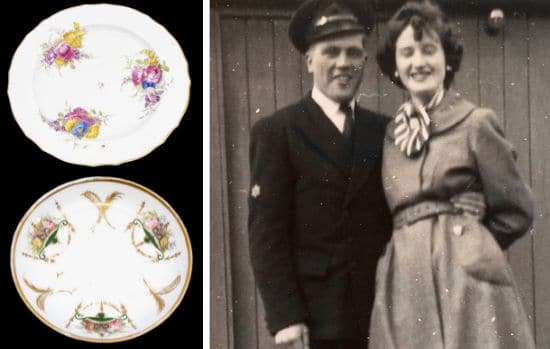
Pinxton has been described as the ‘most distinctive and distinguished of all English porcelain’ thanks to its beautiful shapes and patterns. Important lots set for auction include a Pinxton pattern 218 landscape decorated tea cup and saucer, polychrome landscape in the style of William Billingsley, circa 1796-1799, £200-£300.

Other examples include a Pinxton tea cup and saucer, pattern no.2 blue sprig, 1796-1799, together with a spiral fluted Pinxton pattern no.1 tea bowl and saucer, decorated in the red sprig pattern, £100-£200 and a Pinxton tea cup, saucer and coffee can, pattern no.1 red spring, 1796-1799, £100-£150.
Another impressive lot is a French hard paste coffee can, 1800, decorated with yellow ground and English landscape panel. It was exhibited at a Billingsley/Mansfield exhibition in 1999, £200-£300.
There is also a fine Nant Garw c-scroll moulded dessert plate, circa 1815, £350-£450, and a rare Swansea glacee porcelain saucer dish, decorated in Empire style with flower groups sitting on a green stand, Swansea mark in red script and no.27 in green. It, too, featured in the Billingsley/Mansfield exhibition, £200-£300.
Numerous examples of Derby porcelain include a puce mark pattern no. 80 plate, decorated by William Billingsley with three flower groups, £200-£300, and a Chelsea/Derby gold anchor feather moulded dinner plate, decorated with polychrome flower group, circa 1765, £80-£120.
Valuations and Consignments
If you have ceramics you are considering selling at auction, free valuations are available at Hansons, Heage Lane, Etwall, Derbyshire, with Barry Jones. Plus, on Tuesdays, 10am-4pm, consultant valuer Gillian Finney, a woman with immense knowledge of early 17th and 18th bone china as well as Crown Derby, Beswick, Doulton, Moorcroft and more, is available. To book, email: [email protected] or call 01283 733988.