









There is an art to life – and death. Something our ancestors knew only too well.
Mourning or memento mori jewellery has been around for centuries and it’s something we see from time to time.
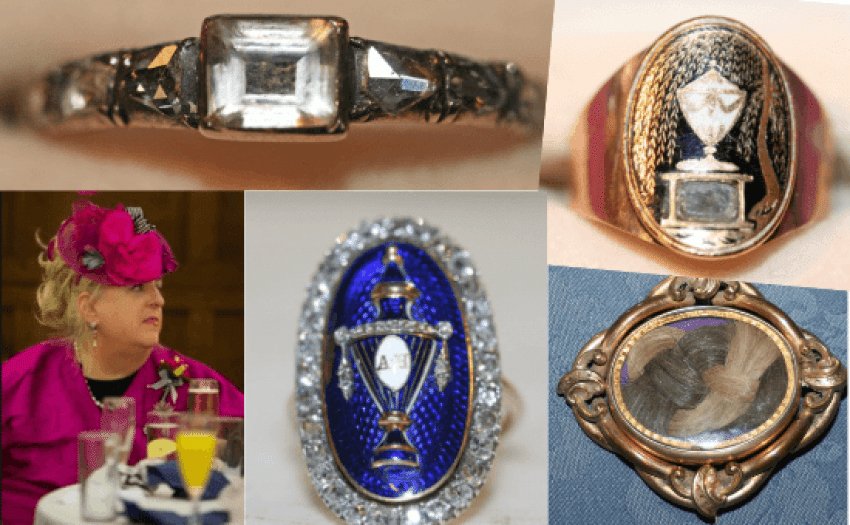
Locks of hair or even fragments of bone are captured within a piece of jewellery to remember a loved one. Sometimes a person’s name, age and year of death is elegantly inscribed on a gold ring, or a brooch depicts a mother weeping at her child’s graveside.
It is sad, incredibly sad, but also incredibly collectable and quite moving, according to our head of jewellery Helen Smith.
Right now, Helen’s team is immersed in cataloguing one of the most impressive private collections of mourning jewellery we have ever had the honour of selling, and she admits that, as you handle each piece and read the inscriptions, you’re sometimes moved to tears.
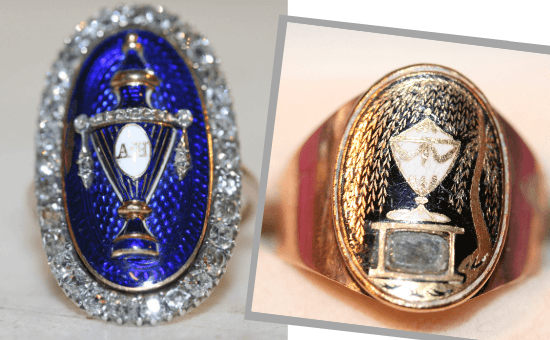
Back in the 1700s and 1800s life expectancy was much shorter and infant mortality was high. For example, an 18th century gold and black enamel mourning ring is inscribed, ‘Eliz Cartwright, died 10 Nov 1768, aged 35’.That was about average in terms of life expectancy back then. It climbed up to the heady heights of 41 years by 1820.
Perhaps the inevitability of what we would now regard as premature death made our ancestors accept loss more easily. Certainly, the passion for memento mori jewellery – memento mori is Latin for ‘remember that you have to die’ – was never intended to be macabre. It was meant to act as a gentle reminder to cherish each day because life is transient and fleeting.
Around 70 fascinating pieces of mourning jewellery, from 1712 onwards, were collected by the late Judith Howard, a woman renowned for her exquisite taste, style and wit.
She was quite a character, a force of her nature who achieved much in life. She only ever wanted to work at London’s Victoria and Albert Museum, the world’s leading museum of art and design, and became an expert on Sevres porcelain.
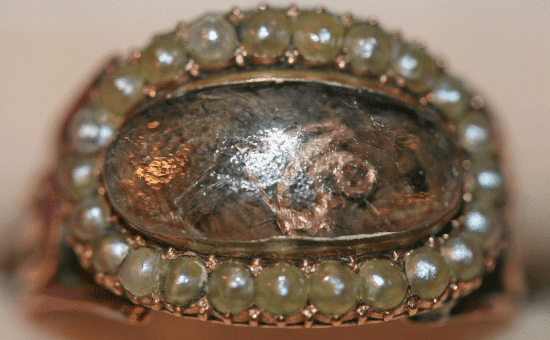
She also developed an admiration and understanding of mourning jewellery that inspired her to build one of the best and largest collections we have ever seen.
Jewellery has always been symbolic. Some of the world’s oldest-known forms of jewellery have been discovered in burial grounds, left deep within the earth as a sign of respect.
Mourning jewellery dates back as early as the 14the century and is seen as an English peculiarity. Early examples may appear a little more sinister featuring skeletal forms under crystal. Some feature the word ‘Rest’ while mourning rings of this period often include white enamelled skulls set with diamond eyes.
In the Georgian era (1714-1837) memorial jewellery became even more common place. One reason for this was because there was no photography. If a loved one died people wanted something they could touch to remember them by. Such items weren’t just for women. Men’s memorial cufflinks or pocket watches hung from braiding made from a deceased person’s hair were not unusual. Braided bracelets were also made.
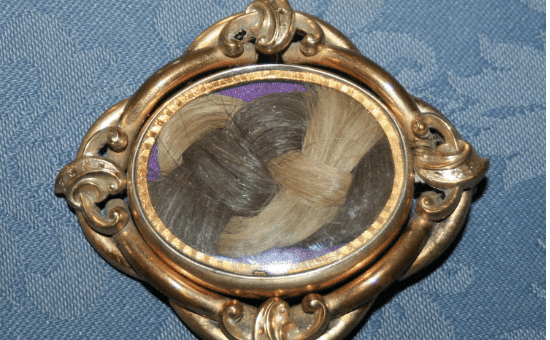
Hair had many uses. It was also utilised to create intricate pictures housed within rings. For example, a hair ‘painting’ showing a ship sailing away represents the journey in the afterlife. Sometimes a simple coil of hair would be housed under crystal.
Black was inevitable a key colour in mourning jewellery. If white enamel was used it meant a woman had died before marriage while pearls indicated the loss of a child.
However, it was Queen Victoria who really led the trend for mourning jewellery. After the loss of her beloved husband Prince Albert at the age of 42 in 1861, she wore black for the rest of her life and mourning jewellery was part of her attire.
She commissioned a memorial ring to honour her husband in gold and black enamel. The bezel contained a microphotograph of the Prince Consort and the initials V and A in white enamel was set into the shanks. The ring never left Victoria’s finger for the rest of her life.
Such is the power of a piece of jewellery. Today we usually buy a necklace, ring or brooch to mark the happiest events in our life, such as an engagement, wedding, landmark birthday or Christmas.
It’s unlikely a trend for mourning jewellery will ever return but the interest among collectors is growing, particularly for the rarest and oldest pieces.
Whatever jewellery you have at home, be it mourning, modern, antique or vintage, we can assess it. Helen Smith is available for free jewellery and watch valuations every Monday and Friday, 10am-4pm. Drop by to see her at Hansons, Heage Lane, Etwall, DE65 6SL. Free general valuations also available on Wednesday, 5-7pm, Fridays, 10am-4pm, and Saturdays, 9am-noon. The Judith Howard Mourning Jewellery Collection will be sold on September 27. To find out more, email [email protected].