







A man who dug up a 200-year-old set of false teeth while out metal detecting says he hopes the quirky find will be his unusual claim to fame.
Peter Cross, 59, a bricklayer from Brill, near Aylesbury, Buckinghamshire, has found numerous objects during his 40 years of metal detecting but says the ancient set of upper dentures, made out of gold and possibly hippo ivory, is his most interesting find to date.
It’s set to net him a modest windfall too. They will go under the hammer at Derbyshire’s Hansons Auctioneers on November 25 with an estimate of £3,000-£7,000. The proceeds will be split with 50% going to the landowner and 25% each to Mr Cross and fellow metal detectorist Diana Wild who was with him when he made the discovery.
Mr Cross said: “I found them in March (2019) in a field near Waterstock Mill. Though that village is in Oxfordshire, I found them on a track across the river in neighbouring Buckinghamshire.
“I know this sounds crazy but when I first pulled them up out of the ground, I thought they were sheep’s teeth. When I began to clean off the mud and clay, I could see there was a gold plate – and that they were human false teeth.

“They would have belonged to a very wealthy person. They date back to between 1800 and 1850 and would have cost a fortune at the time. A dentist friend said the owner would have paid between £200 to £300 in the 1800s and that would have bought half the houses in Brill back then – a very affluent village.
“I’ve shown the teeth to many people and consulted the British Dental Association and the British Museum. Everyone’s amazed – and everyone wants to take a photo of them. They’re unique.
“I’m only aware of one other slightly similar set of false teeth and they belonged to American president George Washington and date back to the late 1700s. They’re on display in the States.”
A combination of ivory and gold have been fashioned to create the hardy dentures, which are missing the bottom set.
Mr Cross said: “A dentist told me that bottom dentures would have been attached to this upper set. I’ve been back to the same area two or three times and searched a 20ft area around where I found the teeth but had no luck locating the other section. That’s because there’s no metal in the bottom section of the dentures, so it could never be found with a metal detector.
Mark Becher, metal detector finds consultant at Hansons, said: “The outer part of the dentures is made of ivory, possibly from a hippo or walrus, and would have been carved by hand. The curve of the tusk cleverly fitted the shape of the mouth.
“The front six teeth have retained the enamel of the tusk to give the effect of the surface of a tooth – though I doubt they’ll be in a Colgate advert anytime soon.
“But they are white in colour to resemble real teeth while the tusk around them is brown to resemble gums. It’s very cleverly done.
“At the back of the dentures, the teeth are not so detailed but there are incised lines and cross hatchings to give the illusion of real back molars.
“On the side of the dentures is a spring attached to a circular rivet which would have been attached to lower dentures.
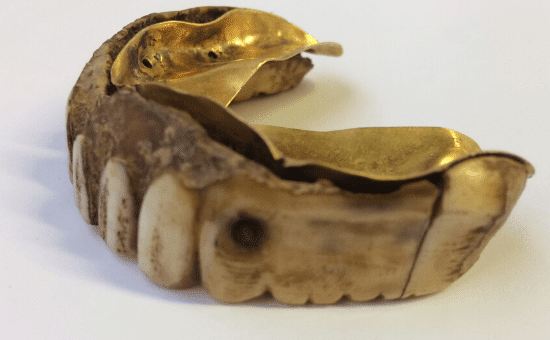
“The denture plate itself is made of gold and bears the initials ‘WSF’ and ‘N 435’. It’s likely the gold base would have been swaged by hand onto a plaster model of the upper jaw. The dentures were incredibly advanced for the period and an amazing find for any metal detectorist to get their teeth into.”
Mr Cross has done a huge amount of research to find out more about his discovery and tried to ascertain if the initials WSF relate to a wealthy former inhabitant of the area. But, so far, he hasn’t been able to match a name to the teeth.
“Whoever they belonged to probably dropped them by accident,” he said. “I found them on ground where there is slight incline. If he was riding a horse they could have fallen out of his pocket. At that time people didn’t wear false teeth all the time – they just popped them in when they were eating.
“It’s difficult to value the teeth because they are unique but dental experts tell me they’re potentially very valuable and should be in a museum. Everyone has a claim to fame and I’d like to think this is mine.”
The false teeth will be sold on November 25 at a Historica and Metal Detecting Finds Auction at Hansons, Heage Lane, Etwall, Derbyshire, DE65 6LS. To arrange a free valuation of an antiquity or metal detecting find, or to find out more, email: [email protected].