







Chinese ceramics make headline news and impressive results at Hansons every year, so I’m particularly excited about a major collection coming to auction this spring, writes Charles Hanson.
A 50-lot group of Chinese ceramics from the Warring States Period (475–221 BC) to the Qing dynasty (1644 to 1911) will be offered at Hansons’ Derbyshire saleroom thanks to the excellent eye for quality of a private collector from Bristol. Over a period of 50 years, he purchased pieces from a number of sources including London dealers such as Bluett & Sons and Robert McPherson.
CLICK HERE TO VIEW THE APRIL 29 ASIAN AUCTION
Oriental works of art spark huge interest thanks to the unrelenting demand from wealthy Chinese buyers keen to secure quality pieces and repatriate them to their homeland. China is extremely proud of its artistic heritage and rightly so. Porcelain was a Chinese invention, hence the use of the word china in everyday English.

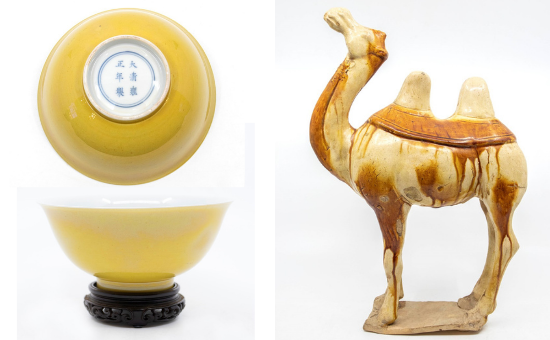
When we talk about Oriental ceramics an image of a blue and white vase may spring to mind but one of the most interesting lots in our April 29 Spring Asian Auction couldn’t be more different. It is a striking 8th century Tang Dynasty amber and straw-coloured pottery model of a camel, above. It stands four-square on a rectangular base with long neck raised, estimate £2,000-£3,000.
Though the camel is not native to China, representations of the two-humped Central Asian camel are frequently found in Chinese ceramic tomb sculptures. This pack animal was an indispensable carrier of goods on the Silk Road that linked China with the regions to her west.
Chinese ceramics have been in continuous development since ancient times and are one of the most significant forms of Chinese art and ceramics globally. The first pottery was made during the Palaeolithic era 2.58 million years ago.

They range from construction materials such as bricks and tiles to hand-built pottery vessels fired in bonfires or kilns, to the sophisticated Chinese porcelain wares made for the imperial court and export.
Every piece has a story to tell and plays an integral part in China’s rich ceramics heritage. For example, the collection includes a rare 15-16th century Ming Dynasty Longquan reticulated stand from the Zhejiang Province, above. The body is pierced with a peony scroll and circles and it’s covered with a crackled celadon glaze, estimate £1,500-£2,000.
Longquan celadon is a type of green-glazed Chinese ceramic produced from about 950 to 1550. The kilns were mostly in Lishui prefecture in southwestern Zhejiang Province in the south of China, and the north of Fujian Province.

Then there’s the 13th century AD Southern Song Dynasty Jian Hare’s Fur Bowl, with its rich brown- streaked black glaze, above. Brown and black hues used in ceramics were considered among the best colours to enhance the chartreuse colour of tea that had been whisked into white foam.
Another important lot is an Imperial Yongzheng (1723-1735 AD) yellow glazed bowl, below, a colour to conjure up spring daffodils. Its rounded sides rising from a straight foot to a slightly everted rim features a consistent deep yellow glaze on the outside and a white interior.

The base bares with the six-character mark of Yongzheng. It has a hairline crack to the rim but damage rarely deters buyers.
Only last year a Chinese blue and white nine-dragon bottle vase, previously dismissed as worthless, made £40,000 at auction despite a long arcing crack and other damage. It bore a Jiaqing mark from the period 1796-1820 making it around 200 years old. I spotted it by chance during a routine home visit, languishing on a glass cabinet.
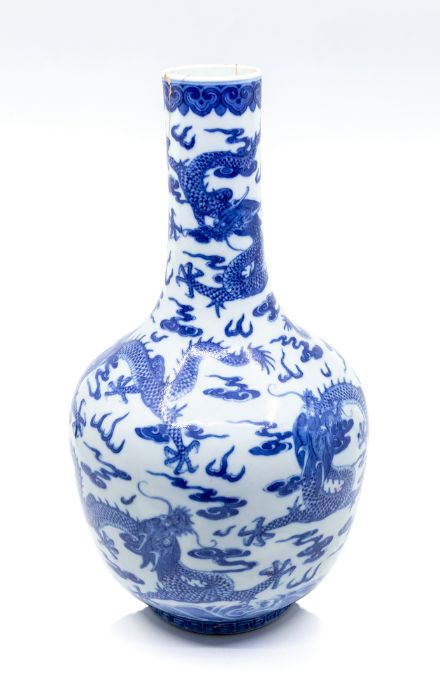
And in 2020 a badly broken blue and white Chinese vase – which had been glued back together – stunned at auction when it sold for hundreds of thousands of pounds. The vase, which was spotted under a table at a Leicestershire home, made £200,000 at Hansons despite cracks aplenty and visible repairs.
The Chinese Qianlong (1735-1799) copper-red and underglaze blue deer lantern vase, with Qianlong seal mark, went to auction with an estimate of £15,000-£25,000 due to its condition. However, the price soared beyond all expectation thanks to fierce competition from 11 phone bidders and online bidders. It eventually sold to a private phone bidder in China. But for its damage, it could have fetched around £700,000.
Over the years, Chinese finds have consistently achieved record-breaking prices at Hansons. For example, a Chinese vase used as a doorstop made £650,000, below. It dated back to the reign of Emperor Qianlong, 1735-1799. The seller inherited it from a great aunt who acquired it in Cornwall in the 1920s.

Another inherited piece was a Chinese Emperor Yongzheng plate dating back to the 1700s which was found in a Derbyshire kitchen cupboard. After it emerged it had a replica in the National Museum of China, the pre-auction estimate rose to £150,000. The hammer finally fell at £230,000.

And I will never forget the lockdown find of 2020 – an Imperial Chinese wine ewer, above, which sold for £390,000 following its discovery in a South Derbyshire garage. Like so many people who bring items to Hansons for assessment, the owner thought it might be worthless. To arrange a free valuation of Oriental ceramics or works of art email: [email protected].
Free valuations
If you have something tucked away at home you’d love to have valued, and which you are considering selling at auction, please get in touch. Book a free valuation at Hansons, Heage Lane, Etwall, Derbyshire , by emailing [email protected] or calling 01283 733988. Free home visits also available and free quotations for downsizing/house clearance.