




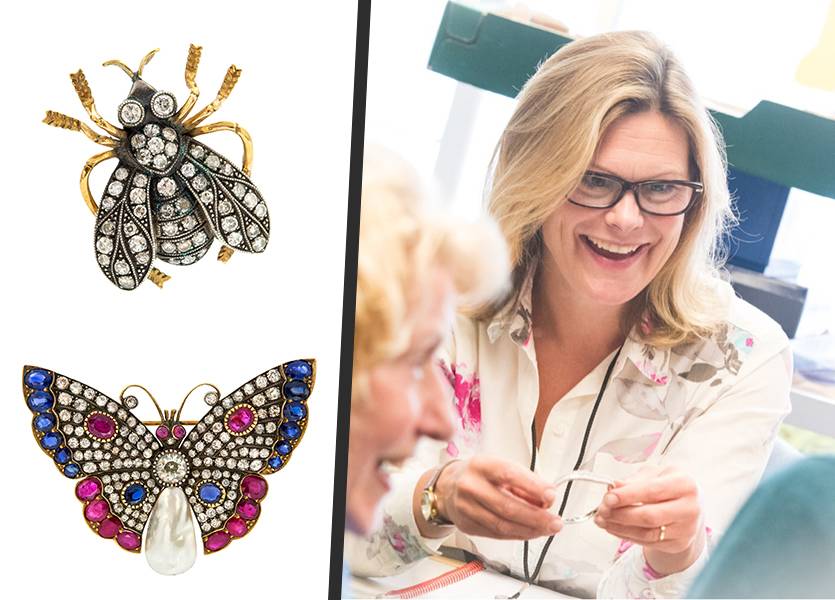
In a summer destined to go down as the year of the mosquito, you may be surprised to learn that it’s fashionable to wear an insect on your lapel – but not a live one of course.
You may be even more surprised to learn that mosquito brooches exist. Though if you’ve been heavily bitten this summer your preference could be to swat it even if it’s bursting with diamonds.
Brooches celebrating nature have long been popular. The Victorians loved them as did the late Dowager Duchess of Devonshire, Deborah Cavendish, one of the famous Mitford sisters. She was the public face of Chatsworth House for decades and a hugely popular Derbyshire personality.
She was known for many things including her love of brooches and wore glittering insect-inspired examples such as butterflies and dragonflies.
Her husband Andrew, the 11th Duke of Devonshire, sometimes gave her brooches as gifts and one beautiful example, a diamond and ruby brooch, circa 1880, sold for £62,500 at Sotheby’s in 2016.
Designed as a butterfly set with circular-cut yellow diamonds and eyes set with cabochon rubies, it was an exquisite piece. Insects can be beautiful, perhaps none more so than the butterfly. Dragonflies, ladybirds and bumblebees also have their charms.
But, believe it or not, fly, spider and moth brooches are popular too – though these particular insects look considerably more attractive when inanimate and adorned with precious stones such as rubies, sapphires, emeralds or tanzanite.
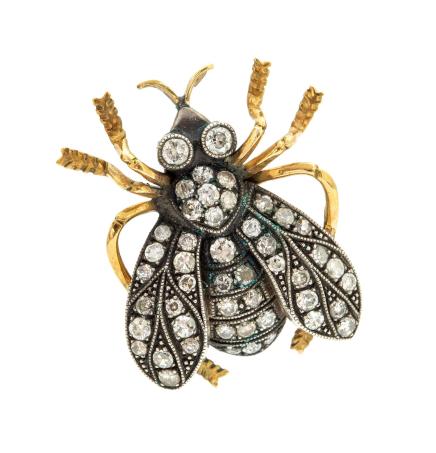
A 19th century bee brooch has flown into our October Fine Jewellery Auction and it’s quite a beauty with gold legs and more than 50 sparkling diamonds shimmering in its wings, body and eyes. It has an estimate of £800-£1,000.
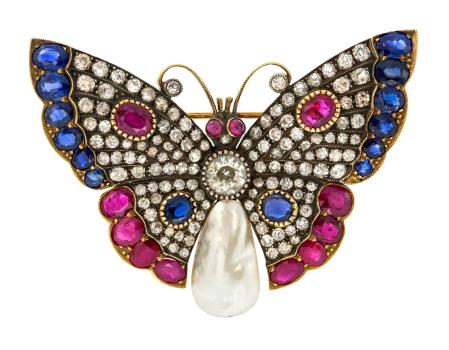
In the same auction we have a colourful 19th century butterfly brooch awash with diamonds, blue sapphires, red rubies and a pearl. Its guide price is £5,000-£6,000.
We have the Victorians to thank for jewellery inspired by nature. The Victorian era was one of immense change. The industrial revolution had a huge impact on people’s lives, heralding a move from rural life to working in new factories springing up in towns and cities.
However, this created feelings of nostalgia for the countryside which was often romanticised in the form of insect jewellery.
This renewed respect for rural life sparked by rapid urbanisation led to women seeking motifs plucked from nature to decorate their outfits. Insects were seen as gentle creatures. I’m sure Sir David Attenborough would have approved.
By the 1860s stylish Victorian women were wearing beetles and other insect motifs on their clothes and accessories such as parasols, shawls and hats as well as bracelets, earrings and rings.
The jewellery created to fit this new trend included a rich array of precious gems in their designs. Their colours enhanced the vividness of the pieces and added value.
Insect’s bodies were often represented with large gemstones or pearls or were sometimes crafted in precious metals which were then encrusted with smaller gems.
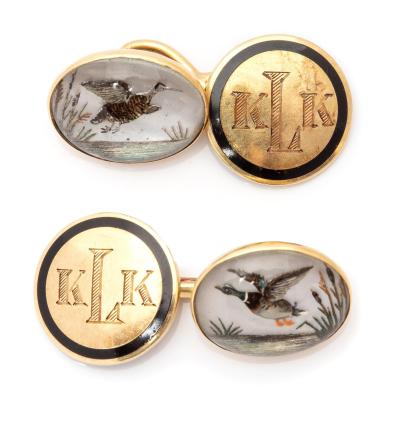
The insect jewellery in vogue during the Victorian era is still desirable today, with the value of the precious stones enhancing the curiosity and uniqueness of the designs. Animals make an impact on jewellery too. Another wonderful piece consigned to our October jewellery sale is an Edwardian 9ct gold enamel brooch featuring two painted terriers. Estimate £300-£500. They’ve already proved a hit with dog lovers on Titter. Personally, I’m rather taken by a pair of Essex crystal cufflinks painted with flying mallards, estimate £200-£300.
We’re always delighted to items such as these emerge in a vibrant jewellery market. In times of political uncertainty investors like the strength and reliability of investing in gold and diamonds, consequently prices are buoyant.
Free valuations with Kate Bliss at Hansons
If you have some jewellery to sell, we’d love to help you maximise your profit at auction. TV’s Kate Bliss, a specialist in jewellery, silver and watches, will be with us at Hansons in Etwall on Thursday, September 12, 10am-3pm, to do free valuations. No appointment necessary.
Plus, on Mondays and Fridays, you can drop by between 10am-4pm for a free valuation courtesy of Hansons’ jewellery team, Helen Smith and Isabel Murtough. Entries are invited until October 4 for our Autumn Fine Jewellery, Silver and Watches Auction.
If you’d like to treat yourself to a piece of jewellery, then join us at Hansons on Thursday (Sept 12) for the start of our September 12-19 Antiques and Collectors sale. As always, day one boosts an eclectic mix of jewellery, silver and watches, many at surprisingly affordable prices. And if an insect brooch has taken your fancy, some mixed lots of jewellery contain a spider and a beetle.