











An ancient gold ring found by a metal detectorist – possibly hidden by the Sheriff of Nottingham centuries ago – has smashed its auction estimate.
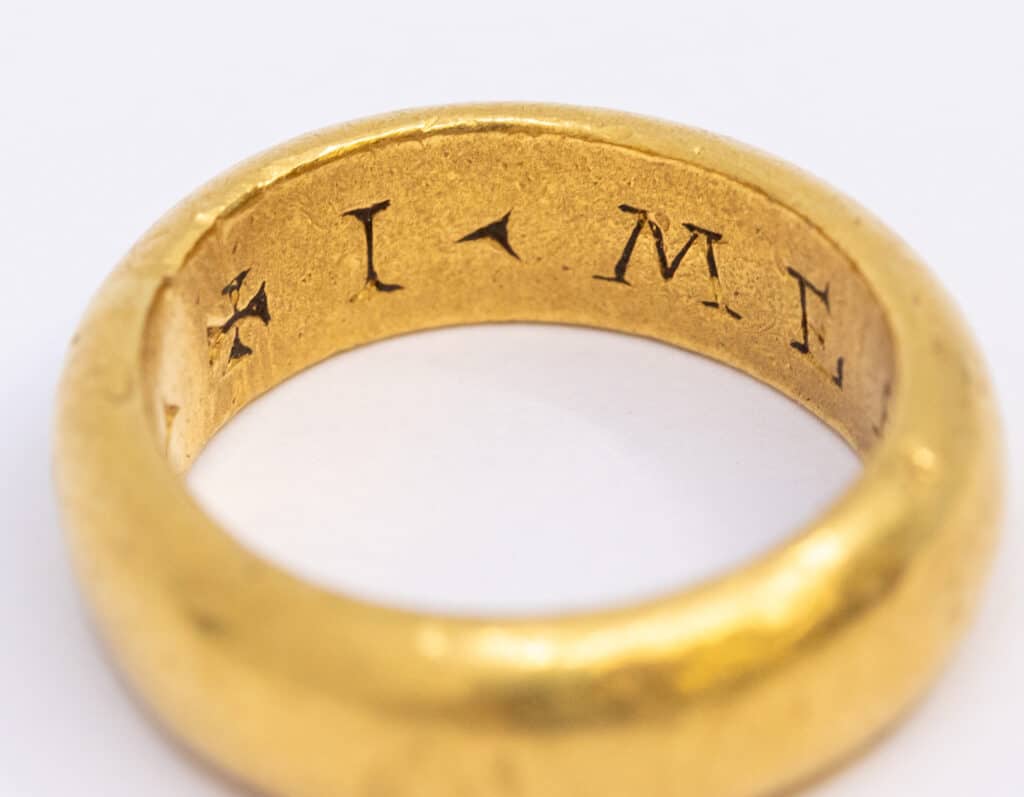
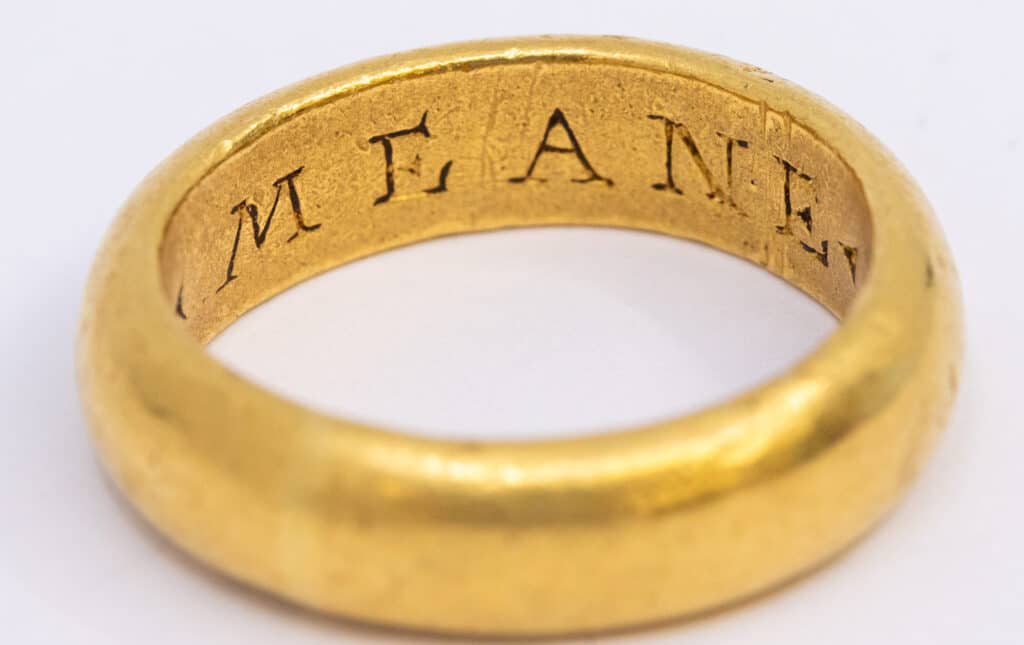
Interest was intense from the United States and London to secure the circa 1560 posy ring, a 16th century love token inscribed with mystery message ‘I Meane Ryght’. Due to circumstances surrounding its discovery, the finder thinks it may have belonged to a Sheriff of Nottingham or a member of his family.
The 460-year-old ring weighing almost 15g was unearthed during a metal detecting club event. Lincoln’s Andy Taylor, 57, dug up the posy ring and – five minutes later – Graham Harrison, a 65-year-old retired merchant navy engineer officer, found a signet ring believed to belong to a former Sheriff of Nottingham.
Graham’s find bore the crest of the Jenison family who served as Sheriffs of Nottingham. It sold for £8,500 at Hansons Auctioneers in March 2022. However the posy ring fetched even more. Two phone bidders battling against the interest sent the price soaring to £10,500 – triple the £2,500-£3,500 estimate – in Hansons’ October 6 Fine Arts sale. A private online international buyer paid a total of £13,776 to secure the buried treasure – much to Andy’s amazement.
The water company worker said: “The result surpassed anything I could have imagined. I hope the new owner is pleased with their purchase of such an amazing piece of history. I would like to thank auctioneer Charles Hanson and everyone at Hansons for doing such a fantastic job. I think the amazing publicity sparked by the ring helped it gain the exceptional price.”
Legend has it the Jenisons gleaned great wealth from valuables left in their safekeeping during the Civil War which were never reclaimed. This theory was seemingly corroborated when a buried hoard of Civil War silver coins was unearthed from the same field where both rings were found.

Andy, a metal detectorist for eight years, said: “I found the ring on a sunny July day in 2020. I was on a dig with around a dozen people from a metal detecting club. We were on farmer’s land at Radcliffe-on-Trent in Nottinghamshire.
“It was so hot, I decided to go back to my car to fetch my drink. I was lucky. Just as I turned back, I picked up a lovely strong signal. I dug a divot in the sandy soil and there was the ring, just looking at me.
“It was an exciting find. When that signal goes off you never know whether it will be a ring-pull or ancient treasure. Within five minutes of me finding it, Graham dug up the Sheriff of Nottingham ring nearby. Some coins were discovered in the area on the same day.
“I’m 95% certain both the rings and coins belonged to the same person. They were all found within 10 square metres of each other. The land had been disturbed by a pipe being laid at some point, otherwise they might have been closer together.
“In my opinion it was a stash of valuables buried at the same time. Legend has it the Sheriff of Nottingham’s family hid valuables. I think the ring may have belonged to him or someone close to him. It appears to be a man’s posy ring, which is unusual. It’s the second largest ring of its type ever seen according to a report I received from the British Museum.
“I have never sold any of my metal detecting discoveries before but the ring would just have been stuck in a pot forever with my best finds. I wanted it to go to someone who would appreciate its historical value.”
Charles Hanson, owner of Hansons Auctioneers, said: “The posy ring generated an intense auction battle and a phenomenal result. Historical finds like this, buried for centuries in English soil, fascinate bidders all over the world. The ring was awash with intrigue thanks to its mystery message and possible connection to the Sheriff of Nottingham or Jenison family.
“The Nottinghamshire branch of the Jenison family first appeared as aldermen of Newark in 1580. Each generation served as aldermen and, after the 1626 charter, as mayors. I suspect the posy ring was lost, or buried for safekeeping, in the mid-16th century, perhaps in the reign of the short-lived Edward IV or in the early years of Queen Elizabeth I’s reign (1558 to 1603). The font reflects the Roman capitals used until around 1560. After that time italics started to make an appearance.
“Posy rings were often used as betrothal or wedding rings centuries ago. The weight of the ring sold indicates its owner was wealthy. The messages inscribed inside were a secret to all but the wearer and giver so we can never be certain what ‘I Meane Ryght’ meant.
“Mention of the Sheriff of Nottingham reminds us of Robin Hood but the signet ring sold in 2022 related to a later sheriff. Tales of Robin Hood emerged in English folklore as early as the 13th and 14th centuries. Nevertheless, these finds still evoke those memories and remind us of Nottinghamshire life during the turbulent times of the 16th and 17th centuries.”
The posy ring, which has been processed through the Portable Antiquities Scheme, sold in Hansons Auctioneers’ October 6 Fine Art Auction. To find out more, email [email protected].
Antiquities invited for auction
To discuss a possible Historica consignment, email: [email protected]