







Letters from a Derby weather expert offering fresh insight into Scott’s ill-fated Antarctic Terra Nova Expedition in 1910-1913 have been snapped up at auction.
Two letters from Sir George Simpson (1878-1965), a former Derby School pupil who was meteorologist on the trip led by Captain Robert Falcon Scott, were discovered in a scrapbook by Hansons Auctioneers.
And thanks to their important historical context, the lot was contested to £1,900 in Hansons’ Library Auction on Tuesday, June 15. They sold to a private international buyer.
The letters were sent more than a century ago to electrical engineer W P Granville, a man who appears to have assisted Simpson and, ultimately, the expedition team. And they reveal spirits – and hopes – were high ahead of the trip into the unknown.

One letter, written on a British Antarctic Expedition Terra Nova letterhead and dated November 27, 1910, reads: ‘Dear Mr Granville, the small case of [weather] balloons reached us safely in Christchurch. I thought it best not to open it before absolutely necessary, but I have no doubt that the balloons will be in good condition.
‘We are now really on our way south although we call at Duneden tomorrow to take 100 ton of coal on board. We have had a splendid passage so far and we are a real happy party. Everyone has the highest hopes of a successful expedition and I am sure that there will be a lot of good scientific work done.
‘Please let me again thank you most heartily for all the valuable help you and your firm have given us. Yours very sincerely, George C Simpson’.
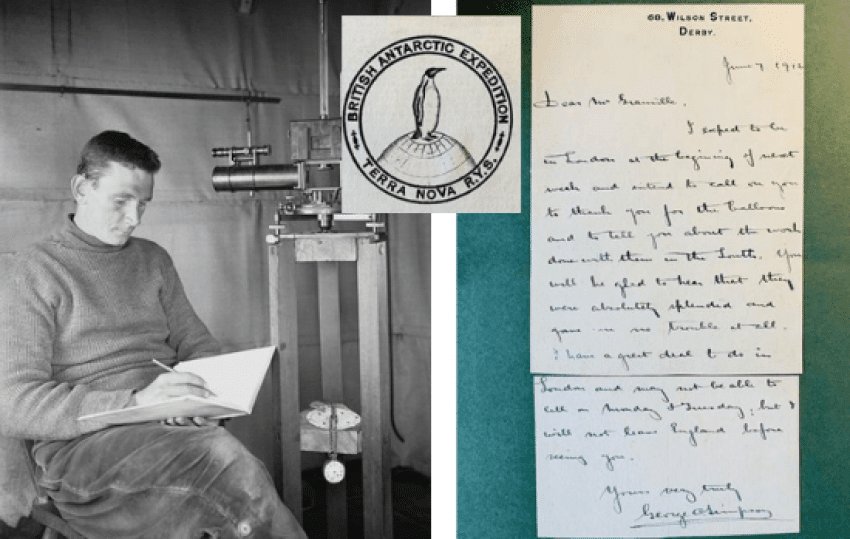
During the trip, Simpson conducted balloon experiments to test the atmosphere and determine how altitude affected temperature. Consequently, the letters are accompanied by two mounted photographs showing experiments with a balloon during the expedition. Simpson also constructed one of the continent’s first weather stations to provide weather information to aid the explorers.

Simpson, who rose to become president of the Royal Meteorological Society in 1940/41, recorded temperature and wind observations at Cape Evans base camp. He also held command of this station for several months when Scott and his party left to journey to the South Pole in November 1911. Scott died in Antarctica on March 29, 1912.
A few months after Scott’s death, Simpson wrote another letter to Mr Granville. On a 68 Wilson Street, Derby, letterhead and dated June 7, 1912, it reads: ‘Dear Mr Granville, I expect to be in London at the beginning of next week and intend to call on you to thank you for the balloons and to tell you about the work done with them. You will be glad to hear that they were absolutely splendid and gave me no trouble at all. I have a great deal to do in London and may not be able to call on Monday & Tuesday, but I will not leave England before seeing you. Yours very truly, George C. Simpson’.
Jim Spencer, head of books and works on paper at Hansons, said: “It’s wonderful to make finds like this, andrewarding to see them do well at auction. It means their historical importance has been recognised. Scientific weather observations would have been crucially important to the Terra Nova Expedition team. These letters and images provided an important insight into how that was achieved.”
The Terra Nova Expedition, officially the British Antarctic Expedition, was an expedition to Antarctica which took place between 1910 and 1913. It was led by Captain Robert Falcon Scott who wished to continue scientific work he had begun when leading the Discovery Expedition from 1901 to 1904. He also wanted to be the first to reach the geographic South Pole.
He and four companions reached the pole on January 17, 1912. However, a Norwegian team led by Roald Amundsen had preceded them by 34 days. Scott’s entire party of five died on the return journey.
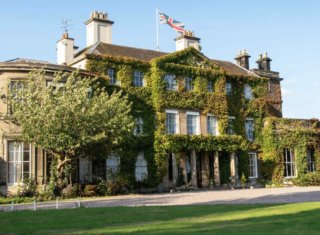
The letters and other works on paper, some dating back as 1873, sold in Hansons’ June 15 Library Auction at Bishton Hall, Staffs, lot 117, guide price £1,000-£2,000. To find out more, email [email protected]. Catalogue: www.hansonslive.co.uk