









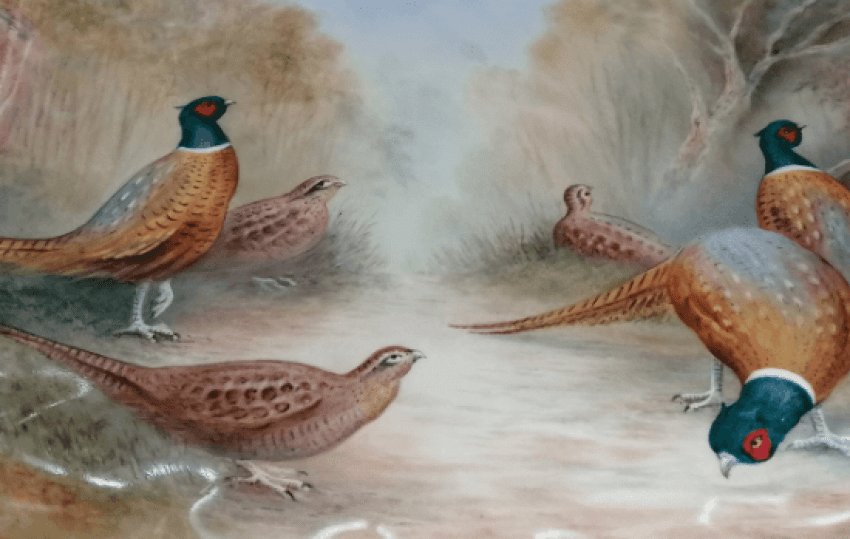
Regal russet-red pheasants in every size imaginable have flown into the saleroom thanks to one of the most extraordinary porcelain collections we have ever seen.
More than 100 examples of these striking game birds, their magnificent plumage painted with great skill on Royal Worcester porcelain and plaques dating from 1898 onwards, are set to fly to new homes in July.
And it’s all down to one woman, a Derbyshire collector with an eye for artistic beauty and an appreciation of the cock pheasant. Thanks to their magnificent tails, gleaming blue-green necks, bright-red faces and dazzling white collars, they are a bird you simply can’t ignore, especially when seen strutting their stuff in a Derbyshire country lane in spring and summer.

Our keen collector started buying porcelain adorned with pheasants in the early 1960s. And, as is generally the case, it all started with one piece – an early 20th century Royal Worcester oval game dish awash with beautifully painted pheasants.
She spotted it in a shop round the corner from her home. Her pheasant pottery collection was born. That single piece has an auction estimate of £150-£200 and, such is the quality of the ornaments on offer, the entire collection could sell for £10,000.
Her love for pheasant-decorated pottery never faded. It blossomed with each passing decade. She travelled the length and breadth of the country from London’s Alexandra Palace in the south to Harrogate in the north scouring antique fairs for her favoured porcelain.

She got to know antique dealers who, recognising her passion, started to look out for pheasant-related ornaments for her. Consequently, over the course of the next 60 years she added to her collection on a regular basis. And each newly-acquired piece found a spot in her display cabinets or, if a plate or plaque, on walls in her Derby home.
Sadly, this avid collector is no longer with us but her legacy lives on. Her pheasant porcelain is now destined to inspire Royal Worcester collectors the world over when it goes under the hammer on July 16. And I’m confident they will treasure her patiently-sourced pieces as much as she did.
Right now, her lifetime’s collection is in Hansons’ care and Victoria Sheppard, the antiques consultant cataloguing the pheasant porcelain, describes it as ‘quite extraordinary’.

She has been casting her expert eye over everything from vases, bowls and miniature tea services to ornamental figures of pheasants, jugs, cups, saucers and much more. Some items are more than 120 years old, others fairly recent. All show a rich array of Worcester artistic flair and design through the decades and some feature the work of one of Royal Worcester’s most famous artists, James Stinton.
If you have an interest in this pottery you will be aware of the Worcester Stinton dynasty, artists renowned for their famous Highland cattle and gamebird scenes. They’re arguably the best known of all Royal Worcester artists. That’s because members of the family painted at Worcester factories over the course of 160 year

The Stinton dynasty started with Henry Stinton who worked at the Grainger factory, which from 1805 became part of the Royal Worcester marque. Several Stintons followed in his footsteps with skills passed from father to son.
James Stinton, born in 1870, became one of the best-known Worcester Stinton painters. He joined the Grainger factory with his father and brother shortly before they were taken over by the Royal Worcester works in 1902. Then, for nearly 50 years, he brought his immense talent to bear until his retirement in 1951.
Items coming up for auction on July 17 include a Royal Worcester cylindrical vase with pierced stylized border and pheasant within landscape signed by James Stinton, 1909. Then there’s the pheasant-adorned Royal Worcester posy vase made in 1920 and a squat vase from 1937, both signed by James Stinton. Other Worcester artists are plentiful in this enormous collection, too, including R Austin and E R Booth.

The collector’s family have no idea why our collector liked pheasant pottery so much but we’re glad she did. The colourful male bird, so often seen in great British countryside, can’t help but impress thanks to their striking plumage.
I very much hope the ceramic versions will impress at auction too. The entire collection, catalogued into more than 100 lots, are due to go to auction on July 16, ceramics day in our July 15-20 Derbyshire Antiques and Collectors Auction. Catalogue www.hansonslive.co.uk.
Book a free valuation
If you have ceramics, antiques of any kind, jewellery, silver, clocks, watches, coins, toys, paintings, fine furniture, wine, militaria, whisky or music memorabilia you are considering selling, do get in touch to arrange a free valuation or free home visit. Email [email protected] or contact your nearest Hansons saleroom.