










One of the greatest pleasures of travelling around the country hosting valuation days is that you never quite know what will walk through the door next.
Whether I’m in Derbyshire, Cornwall, London or, as I was recently, Bicester, every valuation day has the potential to uncover something completely unexpected. That’s one of the things I love most about this job. Every owner has a story, every object has a history and every now and then a seemingly modest item captures everyone’s imagination.
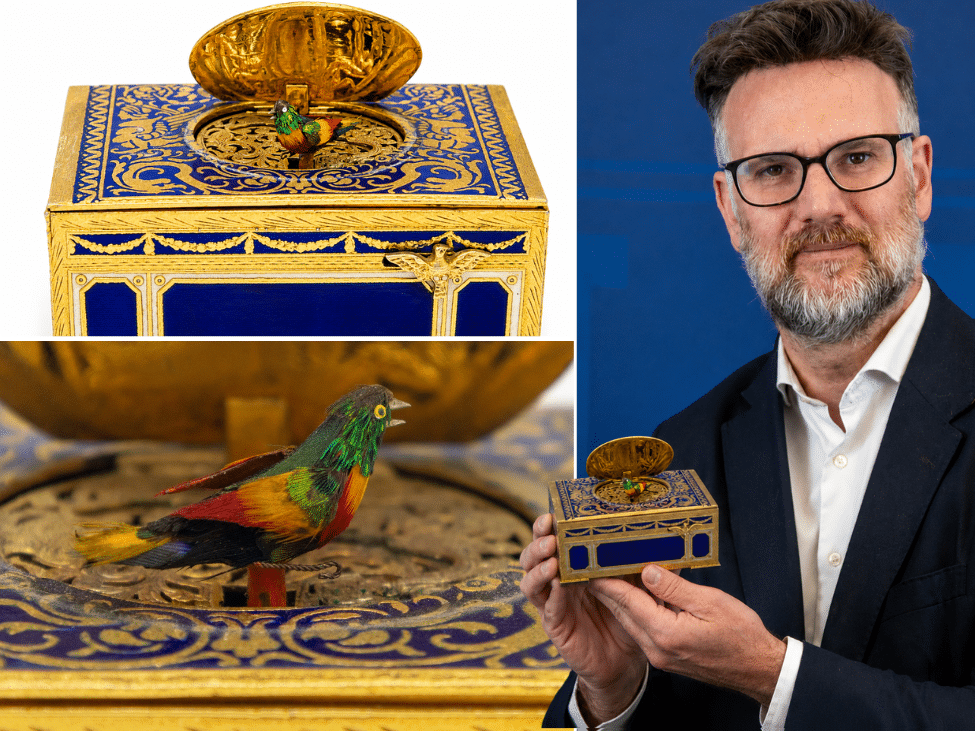
That was exactly what happened when a client arrived at one of our valuation days in Bicester carrying a small gilt metal and enamel music box.

At first glance it was undoubtedly attractive. Decorated in rich royal blue enamel with elegant gilt detailing, it had all the hallmarks of a beautifully made mid-20th century decorative piece. But it wasn’t until we wound the key and gently lifted the lid that its true charm revealed itself.
Suddenly a tiny feathered bird emerged, turning, singing and fluttering away while the music played beneath it.
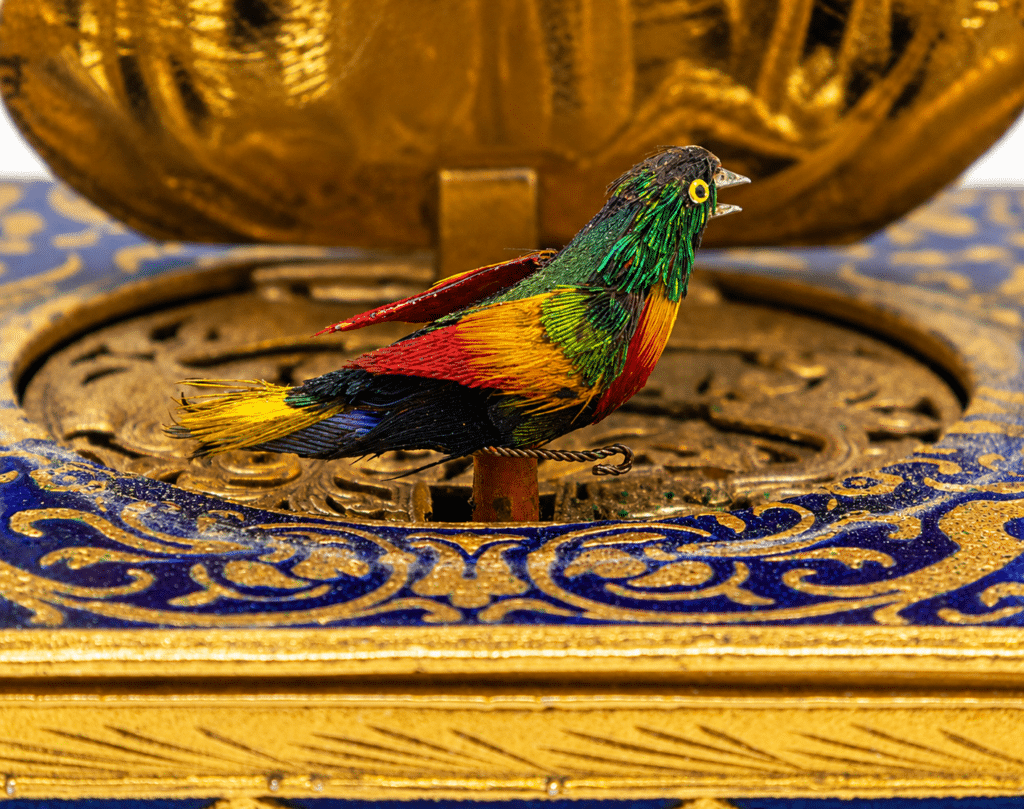
It’s almost impossible not to smile when you see something like that.
For just a few moments, everyone in the room stopped what they were doing to watch this delightful little mechanical bird performing its routine. It transported us back to an age when craftsmanship wasn’t simply about making something functional — it was about creating wonder.
These enchanting singing bird automata have fascinated collectors for centuries. Their origins can be traced back to the great Swiss makers of the eighteenth century, whose extraordinary mechanical creations blurred the line between engineering and artistry. Long before electricity or computers, craftsmen were producing intricate mechanisms capable of remarkably lifelike movement.

While our music box was a much later example dating from the mid twentieth century, it carried that same magical appeal. It reminded us just how captivating clever mechanical engineering can be.
Collectors love these pieces because they combine so many different disciplines. There is the clockmaking expertise required to power the movement, the delicate engineering needed to animate the bird, the artistry involved in the enamel decoration and, of course, the sheer nostalgia that these charming objects evoke.
In today’s increasingly digital world, there is something wonderfully reassuring about a mechanism powered simply by springs, gears and human ingenuity.
Naturally, we were delighted to include the music box in our recent Derbyshire Antiques & Collectors Auction.
After careful consideration we placed an estimate of £200-£300 on the lot. It felt like a fair guide based on comparable examples, but as every auctioneer knows, estimates are only ever educated opinions. The market always has the final say.
As bidding opened it quickly became apparent that this charming little bird had captured the attention of collectors around the world.
Telephone bidders joined online buyers while those following the auction in the room watched with growing excitement as the bids continued to climb.
Eventually the hammer finally fell at an impressive £1,350.
Moments like these never lose their thrill.
Of course, the final price reflected far more than the object itself. Buyers recognised the quality, condition and enduring charm of the piece. More importantly, they understood that objects like this are becoming increasingly difficult to find.
For the vendor, it was a wonderful surprise.
For us, it was another reminder that remarkable discoveries are still being made every week.
People often assume that only paintings worth thousands or glittering diamonds can create excitement at auction. In reality, some of the most memorable moments come from beautifully made, quirky objects that simply make people smile.
If you have inherited something unusual, tucked away a decorative object years ago or have a curiosity you’ve always wondered about, it really is worth having it looked at.
You never know when a forgotten treasure sitting quietly on a shelf could turn out to be the star of the auction.
After all, that delightful little singing bird certainly had plenty left to sing about.