










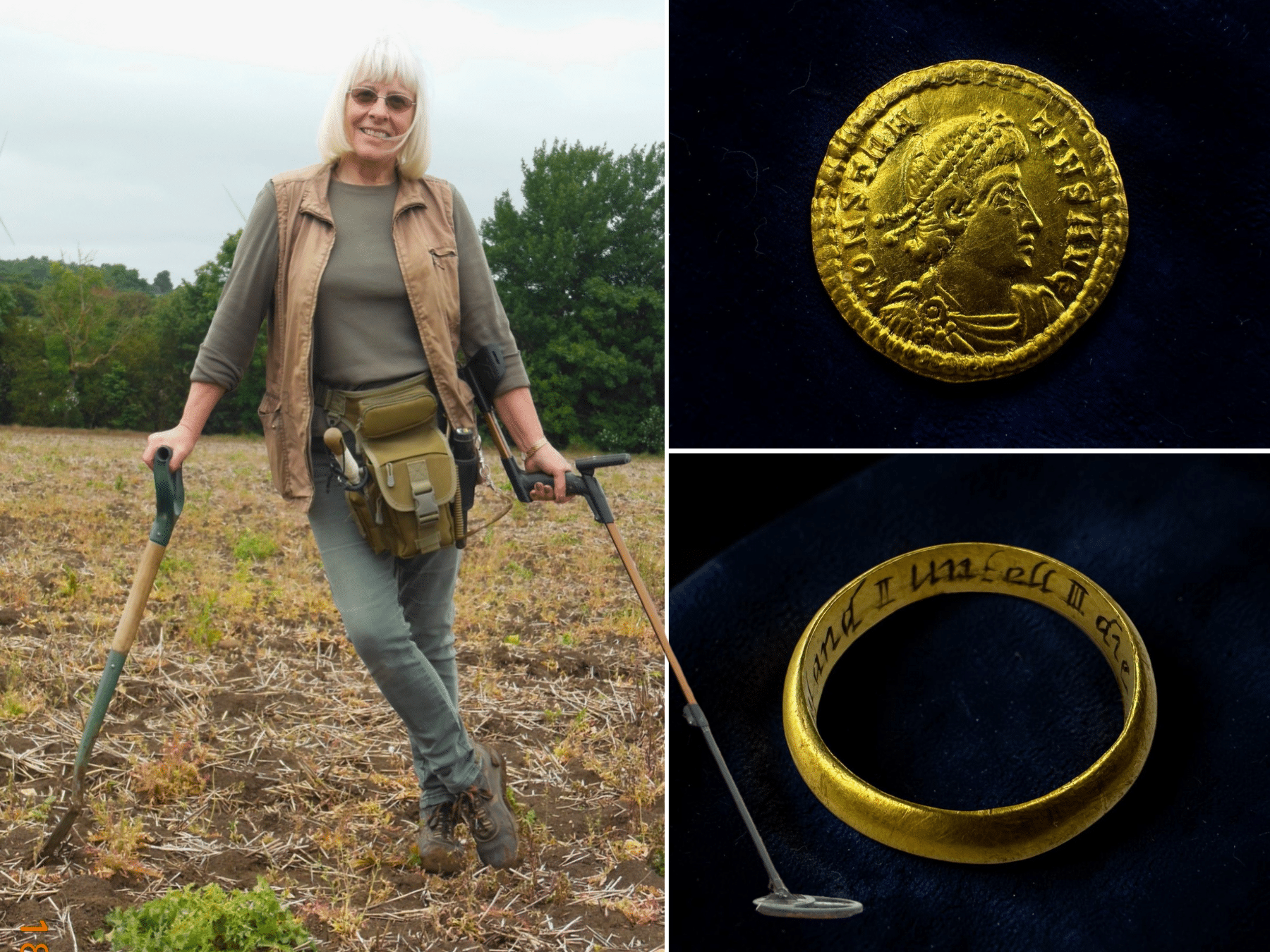
If there was an Olympic medal for metal detecting, the woman scooping gold would have to be Bedfordshire treasure seeker Nettie Edmondson.
While many hobbyists dream of finding one piece of gold in their career, she has found at least one golden treasure every year for the last 12 years.
Known among her fellow detectorists as the “golden girl”, now her collection is going under the hammer at Hansons Ross’s auction at Woburn Hotel on May 16 expected to make up to £11,000.
Nettie started the hobby in 2005 after quizzing a detectorist scouring fields around her Wilden home.
Buying the same model as the treasure seeker – a Minelab – she was soon hooked, using the absorbing activity as an antidote to her stressful job at the police control centre in Bedford.
21 years later and with hundreds of finds under her belt, including a rare medieval brooch, Roman gold ring and an 18th-century posy ring, she is selling her collection.

She said: “I am keeping a couple of bits back but other than that it is all going under the hammer. I had health problems a couple of years ago and realised I wouldn’t be doing this forever. My daughter isn’t interested, so I want my finds to go to a collector who shares my love of history.”
Now she has pledged to rebuild a new collection from scratch.
Nettie puts her success down to patience and the rich history of Bedfordshire, Lincolnshire, Northamptonshire and Norfolk.
She said: “It is exceptional – but I have been lucky. The counties I visit – are really rich in finds because they were home to so many Viking, Saxon and Roman settlements and still have so many fields not built on.
“I’m also into history so researching about Romans, Vikings and what they did had also helped a lot. For example, many people would assume Roman Villas would be up on hill tops for the views, but actually they’d be on the side of the hill. I can definitely look at the land and it talks to me and I’ll be like – ok I’m heading over there.”
Nettie, who found her first medieval hammered coin just a month after she started detecting, said: “I take it really, really slow, in fact some people say I almost go backwards.”
One find was even made in a friend’s garden in 2016.
She said: “She had acquired a strip of land at the bottom of her garden when I saw it had been levelled ready for planting fruit trees I asked if I could run my detector over it. After five minutes I heard the ping and saw a glint of gold from a ring.”
When the soil was brushed away, she saw a rare gold posy ring dated 1550-1700 with inscribed My hart and I untell I die.
She said: “I had just dug the find of a lifetime and flopped down staring at the exquisite object. I was in genuine shock. My friend came down to see if I was okay.”
Other pieces in her golden haul include a gold Roman intaglio ring, expected to make £1,000-£1,500, a medieval gold annular brooch guided at £600-800, a rare 4th-century Roman coin, with the posy ring expected to make £800-£1,200.
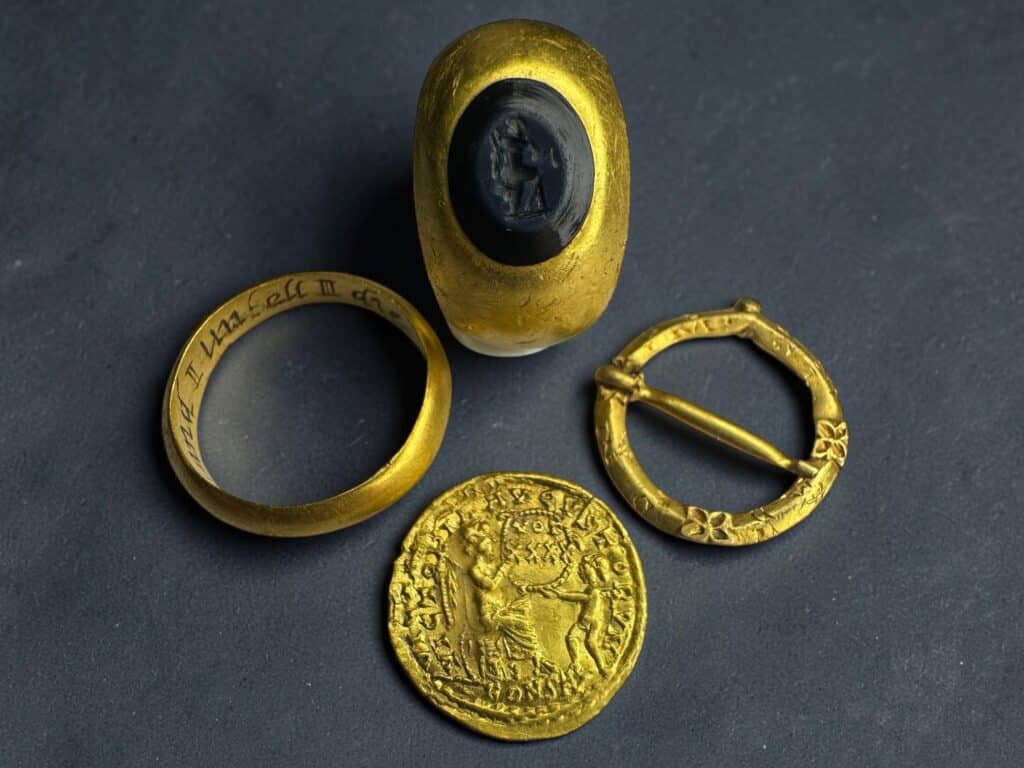
Describing finding the Roman ring, Nettie said: “It was another of those fantastic moments when you see the glint of gold. But there was a bit more than a glint with this one – I could see a chunk of gold.
“After washing the mud off I saw what I thought was a Roman ring and even more exciting was the fact that a lovely intaglio was still in situ and in good condition.”
Hanson Ross’s director, Amanda Butler, said: “The collection is nothing short of jaw-dropping – many detectorists go an entire career without finding gold but something about Nettie just seems to attract it.”
Nettie who is tight-lipped about the exact locations of the finds, with several being around the nearby village of Bolnhurst, said: “It’s hard to describe what it’s like when you find gold. You are looking at something that has been buried for 2,000 years and there it is as shiny as when it went into the ground.
“I remember every site where I found gold – of course I always do the gold dance even if there’s only a cow watching me.”
Sale highlights:
A gold posy ring dated 1550-1700 with the inscription My hart and I untell I die.
Popular from the 16th to 18th centuries, posy rings were exchanged as love tokens or friendship symbols and include a sentimental “secret” inscription on the inside that only the wearer knew about. Discovered in 2016, the ring is expected to fetch £800-£1,200.
A rare Roman gold coin from the reign of Constantius II (337-361). The 1½ scripulum(nine-siliquae) was struck at Arles, between the years 355-360, as part of his reform of the gold coinage. Why a coin of fractional denomination was issued remains a mystery, possibly it had a ceremonial role. The coin has a guide price of £2,000-£2,500.
A 2nd-century gold Roman intaglio ring set with an oval blue nicolo gemstone showing Hercules with a lionskin over his shoulder. The ring possibly crouching and holding the end of a transverse club that rests on the ground. The ring has an estimate of £1,000-£1,500 at the same sale.
A 13th-century gold annular brooch which Nettie found in 2019. Circular ring brooches like this were used by the wealthy elite in Europe in the 13th–14th centuries to fasten cloaks and tunics. Made of solid gold and often gem-set, they were fashionable indicators of wealth. The brooch is expected to sell for £600-£800 at the same sale.
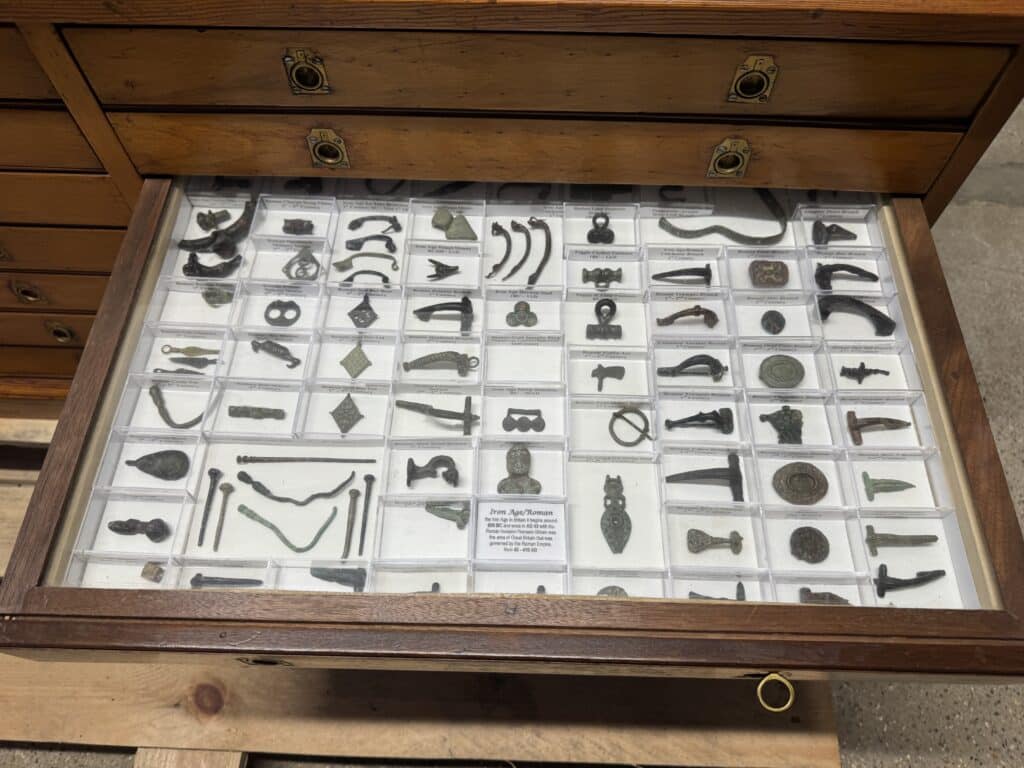
With Nettie’s gold finds highlighting of the sale, the majority of her collection is housed in a well-documented multi-drawered collectors’ cabinet.
Auction Details
Auction: The Hanson Ross Jewellery, Fine Art & Collectables Auction
Auction date: 16th May 2026 | 10am
Location: The Woburn Hotel
Auction contact: [email protected]
Catalogue/bidding: www.hansonslive.co.uk | www.the-saleroom.com