





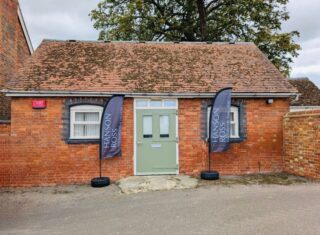


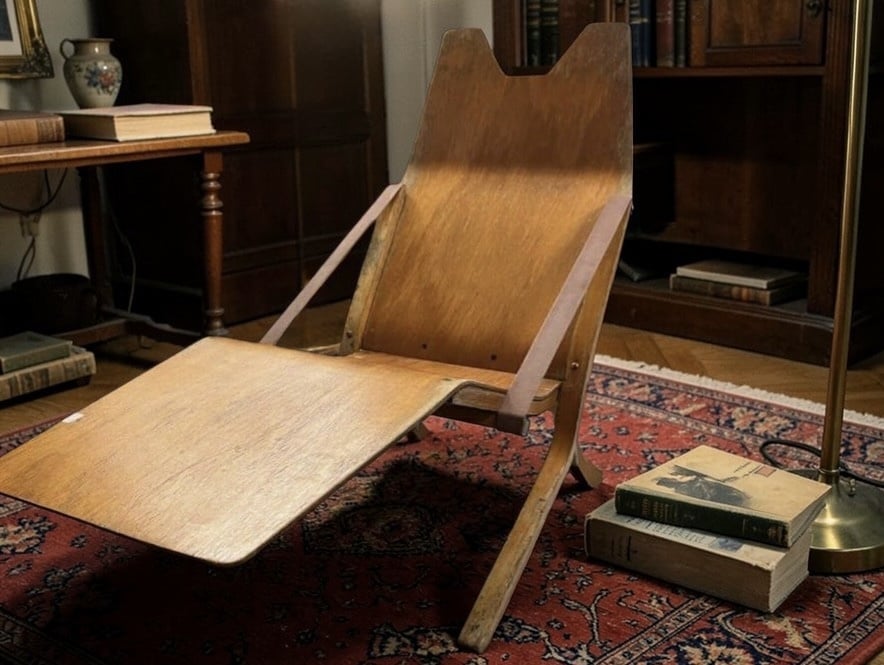
A folding wooden chair from a house clearance in Stanstead Abbotts, which turned out to be a museum-quality, 20th-century classic, has sold for thousands.
The chair, designed for the decks of ocean liners of the 1950s, sold for £2,600 – more than five times its low estimate at Hansons Auctioneers’ Hertfordshire saleroom last week <Mar 6>.
It was the work of the celebrated modernist designer Ernest Race (1913-1964) whose creations can be found in the V&A and the Museum of Modern Art in New York.
Hansons Auctioneers’ director, Miles Wheeler, said: “How the chair found its way from the deck of an ocean liner to a Hertfordshire home we may never know, but we do know it is one of the iconic designs of the 20th century.”
The beech-veneered folding chair, known as the Neptune was designed by Race in 1953 for the P&O Orient Line.
After the war, Race applied the new technologies pioneered in the conflict to come up with cost-effective and stylish designs.
While light, the ingenious Neptune was durable enough to withstand long sea-going voyages.
Added to which it could be folded to a height of 12cm, making it easily stackable or movable on deck.
It may even have graced the decks of the SS Canberra, one of P&O’s flagship liners which went on to play a role in the Falklands War in 1982.
Wheeler continued: “In the 1950s, ocean liners in the 1950s faced intense and growing competition from airlines. To fight back, the Orient Line, as it was then known, was intent on modernising its post-war cruise ships to embrace new levels of comfort and modern design to appeal to more fashion-savvy customers.”
Under the directorship of Sir Colin Anderson, a fan of the Bauhaus, ships’ interiors were transformed from stately ballrooms and antique-heavy cabins, into modern and airy interiors.
Employing leading furniture designers, architects and even muralists, Anderson revamped everything on the flagship vessels from to cabins to glassware.
The modernisation continued on deck with traditional steamer chairs demanding a redesign.
Race’s Neptune chair was as cost effective as it was stylish, requiring only two moulds to make – one for the seat and back, and the other for the legs.
The original covering was made of woven plastic, ideal for a marine environment, with nylon capped screws replacing earlier brass and copper fittings.
After studying interior design at the Bartlett School of Architecture, Race founded Ernest Race Ltd. in 1945.
His first his first real success, in 1946, was the BA3 dining chair, made from repurposed aluminium from British warplanes, which gained him international recognition.
Six years later one of his iconic chairs – the Antelope – chair was used on the South Bank terraces of the Festival of Britain in 1951 later earning him a silver medal at the 10th Triennale in Milan. He died in 1964 aged 49.
Wheeler continued: “Race’s career was short but his contribution to 20th-century design was huge. We were delighted to be able to deliver such a wonderful result to the vendor.”
Hansons Auctioneers’ next auction, at its saleroom at The Power House, Lumen Road, Royston, is on April 10.
Auction Results
Auction: Hertfordshire Jewellery Auction: including Antiques & Collectables
Auction date: 6th March 2026 | 10am
Location: Hansons’ Hertfordshire Saleroom
Auction contact: [email protected]
Catalogue/bidding: www.hansonslive.co.uk | www.the-saleroom.com