
With the price of silver at an all-time high now is the time to seek out overlooked teapots and spoons, writes Charles Hanson - Hansons Auctioneers
Etwall, Derbyshire

Located in the heart of Derbyshire, Hansons Derbyshire Saleroom in Etwall is not only the headquarters of our operations but also the vibrant auction house for a wide range of specialist auctions. This is where we host an exciting array of sales, from collectibles and antiques to Toys, Militaria, Coins, and much much more.

Find out more
Bishton Hall

Situated within beautiful landscaped gardens in Staffordshire, Bishton Hall, a grade II listed Georgian mansion, creates the period setting to assess and showcase antiques.

Find out more
London

Hansons Richmond builds on the success of monthly London Fine Art & Antiques sales led by a dedicated team since 2018. Situated in a highly regarded area of the capital, it offers a complete range of auction services.

Find out more
Hansons Newark

Welcome to Hanson's Newark, where we honour the timeless tradition of the classic auction experience. Formerly known as Northgate Auction Rooms, we continue to uphold the old-school values of live, in-person bidding, bringing the excitement and authenticity of traditional auctions to the heart of Newark.

Find out more
Hansons Cornwall

Nestled in West Cornwall, Hansons Auctioneers in Penzance offers a warm and welcoming environment for buyers, sellers, and collectors alike. As part of the renowned Hansons Auctioneers network, our Penzance saleroom provides a unique and personalised auction experience.

Find out more
The Old Post Office Leicester Square

Hansons’ Kent is located close to the market town of Tonbridge in the picturesque village of Penshurst on the Kent/Sussex border. Situated in the beautiful grounds of the Penshurst Estate, we are ideally located to welcome you for valuations and sale days.

Find out more
Banbury, Oxfordshire

Hanson Holloway’s operates from the longest-established saleroom in the historic market town of Banbury. As well as Oxfordshire, it serves the neighbouring counties of Buckinghamshire, Warwickshire and Northamptonshire.

Find out more
Royston, Hertforshire

Hanson's Hertfordshire is based in Royston and operates jewellery, fine art & collectables auctions and valuations throughout Hertfordshire and surrounding areas, including Cambridgeshire, Essex, Suffolk and North London.

Find out more
Beds/Bucks

Based in Woburn and Aspley Guise we hold jewellery, silver, fine collectable auctions from the Woburn Hotel. Valuations throughout Bedfordshire, Buckinghamshire and Northamptonshire.

Find out more
Hansons Auctioneers | Norfolk

Hansons Norfolk is based in Roughton, North Norfolk. Just 5 miles from the seaside town of Cromer, Hansons Norfolk holds jewellery, silver, fine art and collectables auctions and valuation days as well as free home visits for larger collections.

Find out more
Lichfield, Staffordshire

Hansons Auctioneers is pleased to work with Rare Book Auctions in Lichfield, managed by Jim Spencer. Rare Book Auctions hold dedicated monthly sales of antiquarian books, modern firsts, manuscripts, autograph letters, photographs, ephemera, prints & caricatures, and maps & globes.

Find out more

News

With the price of silver at an all-time high now is the time to seek out overlooked teapots and spoons, writes Charles Hanson

 |  By Kirsty Myatt

It’s not often a “newsflash” comes along in the stately world of antiques. 

But these are unprecedented times – so much so I felt the need to comment.

In almost 30 years in the business, I have rarely seen anything like it. 

I am referring to the booming price of silver. Today I am selling silver teapots for £1,000 that were selling for £200 just six months ago. 

Teaspoons that would hardly trouble a valuer a year ago are selling for hundreds. 

From the antique shops of Mayfair, to silver bullion traders there is only one topic of conversation – what the heck is happening to silver?

What had once been considered gold’s upstart “little brother” is now the strongest-performing major commodity of the past year.

Earlier this month the price of silver reached unprecedented levels, briefly trading more than $95 (£70) per troy ounce, eclipsing its nominal all-time high.

Why? Well President Trump’s late-night tweets aren’t helping. When global politics look insecure, precious metals act as a hedge against financial instability.

Plus silver is unique in that is both an industrial metal and a store of value so it is sought after by investors and sectors hungry, many in China, for its electrical and thermal properties.

But what does all this mean to someone with even a modest cache of silver in their dining room cabinets, including anything from Victorian flatware to Georgian tea services?

Should you sell, or hang on?

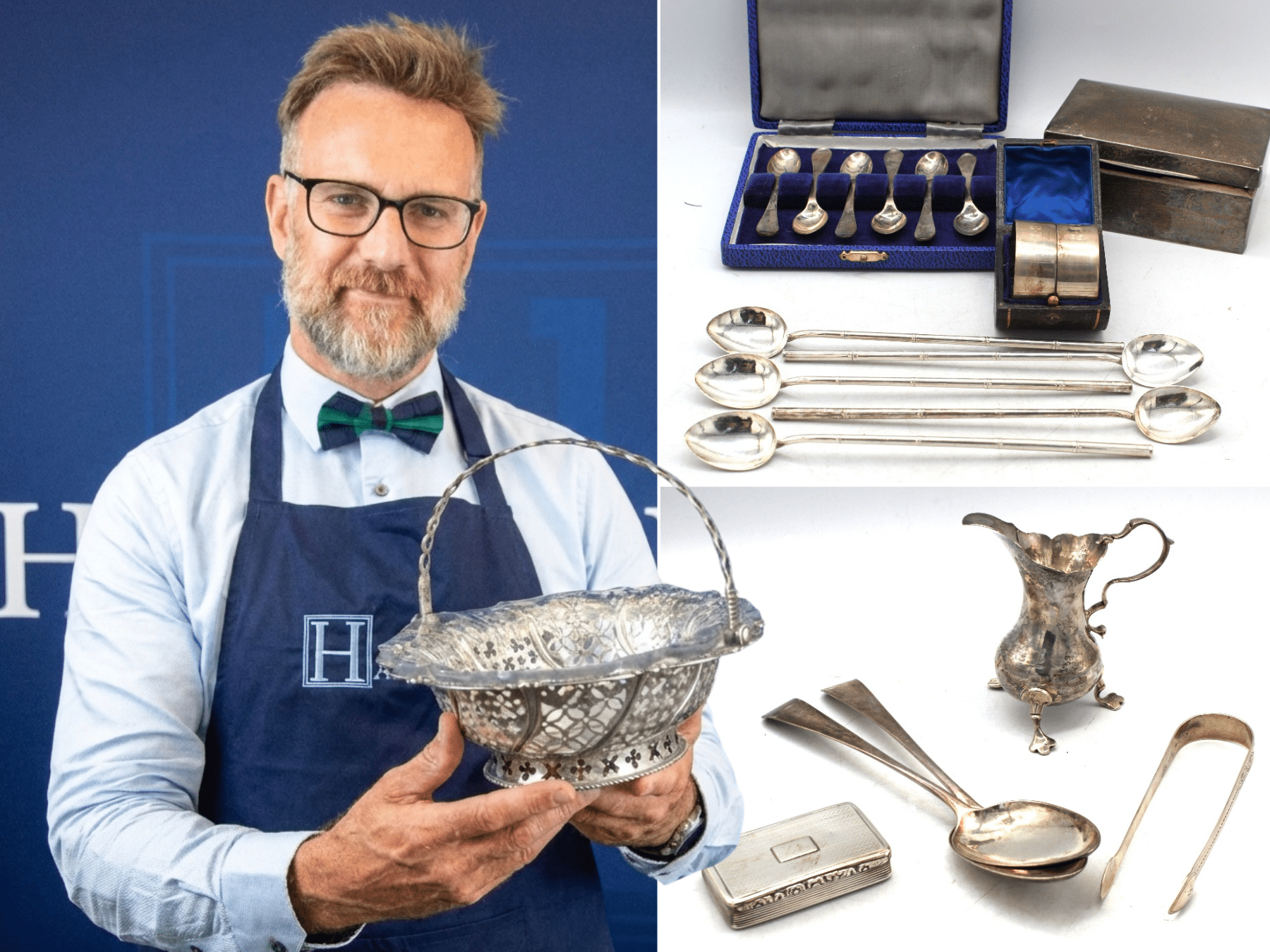
A collection of silver including teaspoons, a mustard pot and a Birmingham silver match book had been expected to make ££150-£250 at this month’s antiques and collectors’ auction but sold for £580
A haul of silver including a George V silver cigarette box, five matching modern silver milkshake spoons; a pair napkin rings, beat its estimate of £50-£80 at our recent sale in Etwall to sell for £230
A group of silver made up of a George III silver cream jug, George IV silver snuff box, a pair of George III silver table spoons and a pair of George III silver sugar tongs beat its guide price of £140-£180 to sell for £400

Melt price

In periods of rising bullion prices like now, silver with little historic or artistic value is often sold on the strength of its silver content alone.

This is where the “melt” price comes into play. This refers to its scrap value – the value of an object if it were melted down and sold purely for its silver content.

To calculate it, we multiply the weight of the item by both its purity and the current silver price. 

For example, antique coins and flatware made of sterling silver (.925 fineness) would be valued the market price per gram of fine silver once impurities are factored out.

In the UK current scrap silver prices for .925 sterling are high – in the region of £1.60–£2.20 per gram for fine and pure silver respectively. 

At these levels, a “basic” piece of silver is likely to realise near-record returns on the melt value alone, compared to even six months ago.

So if you own any unremarkable silver — ubiquitous candlesticks, flatware patterns produced in millions — now is the time to monetise at near-peak bullion valuations.

Of course, collectable silver is worth much more than its melt because of its inherent beauty, rarity, condition, provenance or design. 

Well-documented pieces with exceptional craftsmanship or significant collectors’ appeal will always command premiums above melt. 

As an auctioneer and lover of antiques in all forms, I am a custodian of material culture. 

I will always extol the elegance of a Queen Anne teapot, the craftsmanship of a Paul Storrtureen, or the social history embedded in a Georgian sauceboat. 

To destroy such objects for scrap runs counter to everything my profession stands for.

But not all silver is created equal, and the destruction of mass-produced late-19th-century cutlery is not the same as melting a rare 17th-century porringer.

Truly important silver — early, rare and by celebrated makers — is almost never sacrificedeven in boom markets like these. 

Its numismatic and historic premiums remain resilient, even when the melt price is spiralling.

If you are struggling to work out whether now is the time to sell your silver, or hold on to it,we have experts on hand to help. 

Our silver specialist Daniel Armstrong will advise on the best course of action and help you maximise your investment whether today, or in the future. To find out more or arrange a free valuation, email him on [email protected]