










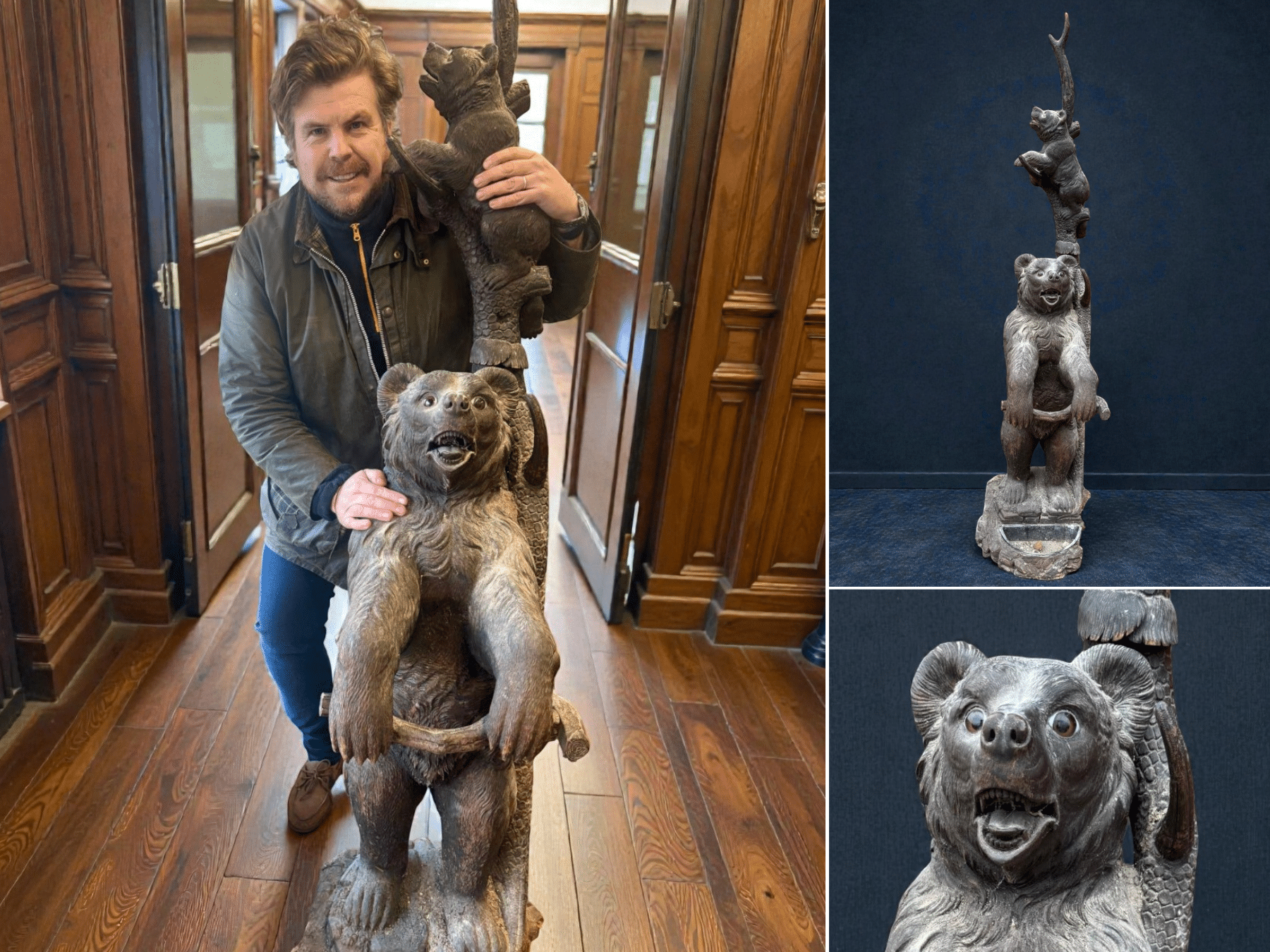
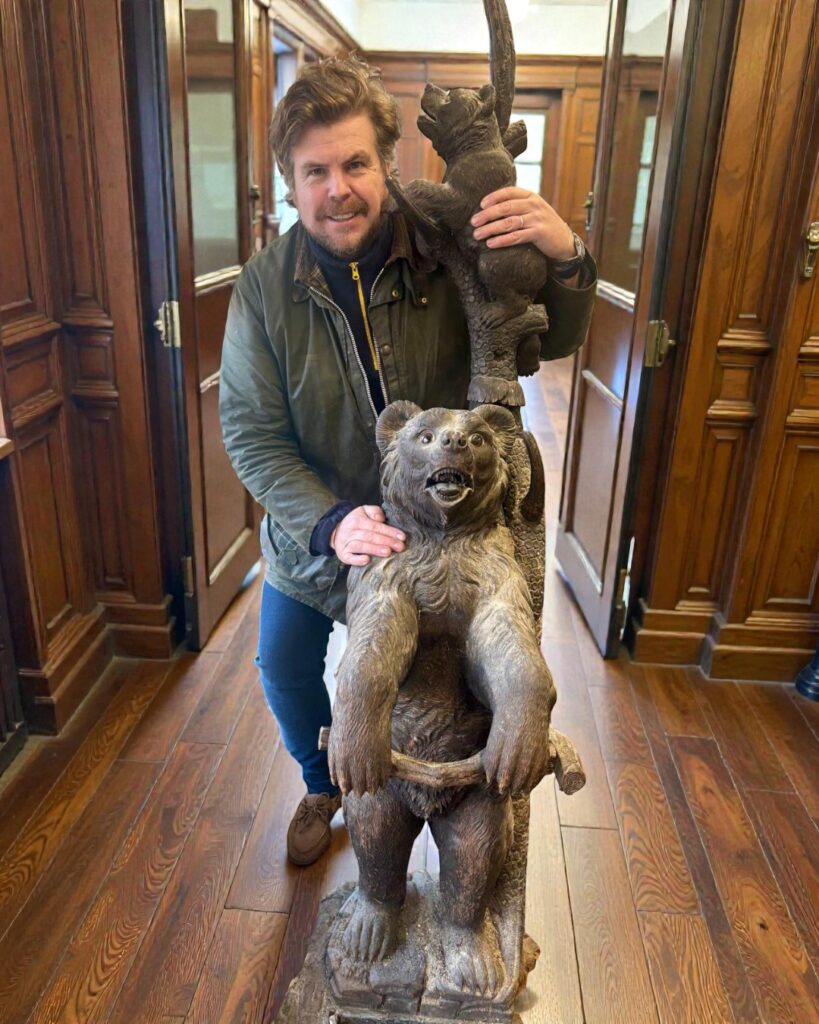
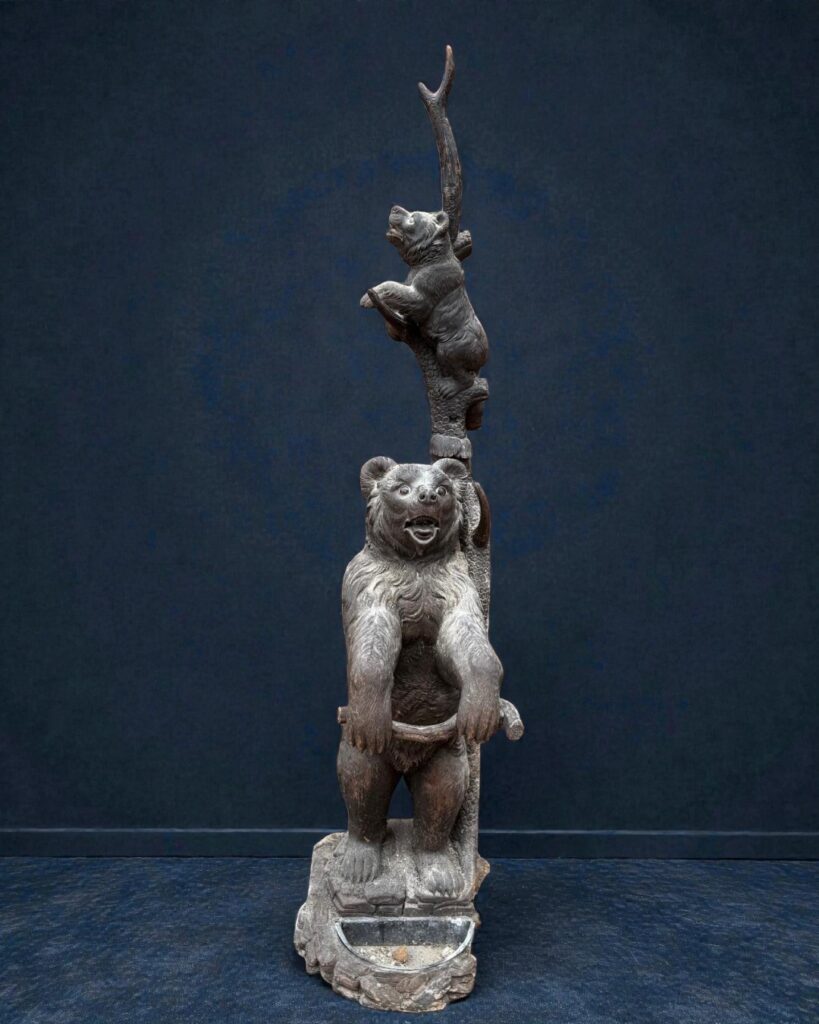
A mother bear and her cub, modelled as hall stand, could roar past its guide price of £800-£1,200 at auction in London this week <nov 28>.
The highly collectable pair, discovered ‘hibernating’ in a Suffolk lock up, was carved more than 100 years ago in Switzerland.
Known as Black Forest wares, animals – especially bears – are prized for their life-like poses and whimsical expressions.
Chris Kirkham, from Hansons Auctioneers’ London saleroom in Richmond, said: “Black Forest carvings like these have grown in interest in recent years, with strong demand from interior designers and private collectors seeking distinctive statement pieces.”
While named after the Bavarian Black Forest in southwest Germany, the carvings in fact originated in the picturesque town of Brienz, in Switzerland in the early 19th century.
Centred around the scenic Lake Brienz with its breath-taking mountain views, Brienz was a highlight for wealthy Victorian tourists on the European Grand Tour.
But when the Swiss town faced a devastating famine in 1816, destitute workers had to find new ways of making money.
Ambitious woodturner Christian Fischer (1790-1848) decided to expand his repertoire of domestic carved bowls into intricate animals and foliage to appeal to the tourist market.
Soon Fischer was teaching other local artists to satisfy the booming demand.
Chris continued: “By the mid 1800s, Black Forest carvings became synonymous with wealth and luxury the world over and examples of the craft were even featured in the Great Exhibition in London in 1851, Chicago World’s Fair in 1893 and the Exposition Universellein Paris in 1900.”
By the turn of the 20th century, the wood carving industry was at the heart of Brienz’s economy, becoming the major employer in the region.
It even establishing the Brienz School of Woodcarving in 1884, which is rumoured to have maintained a private zoo on site for students to study animals’ anatomical details up close.
Many pieces are not marked, but the most popular makers included Johann Huggler (1834-1913), Fritz Abplanalp (1907-1977) and Albert Mäder (1901-1989).
Black forest carvings can be purely decorative or have more practical uses in the form of furniture and home accessories, ranging from small items such as ashtrays, inkwells and nut crackers to grand statement pieces such as benches and hall stands.
Chris said: “Carvings usually take inspiration from the wildlife found in and around northern Europe. Bears are synonymous with the art form and this pair, carved from linden wood, features exceptional detail and character including deeply-cut fur, expressive posture, and original glass eyes which are a hallmark of higher-quality Black Forest carvings.”
Auction Details
Auction: London November Jewellery & Gifts Auction
Auction date: 28th November 2025 | 9:30am
Location: Hansons London Saleroom
Auction contact: [email protected]
Catalogue/bidding: www.hansonslive.co.uk | www.the-saleroom.com