







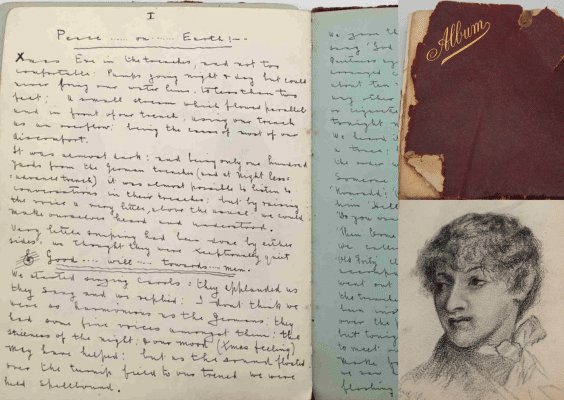
A forgotten nurse’s album packed with memories from First World War soldiers – including a famous 1914 Christmas truce – has sold for thousands at auction.
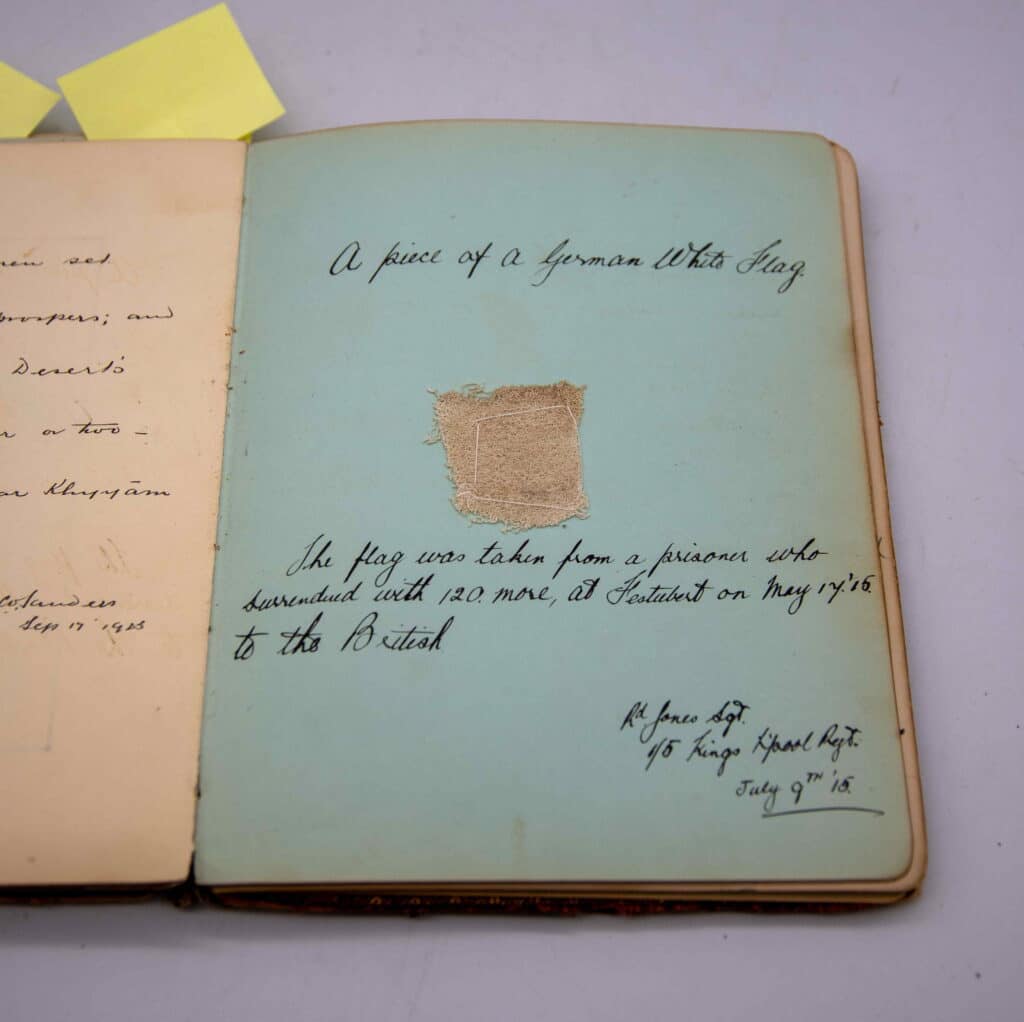
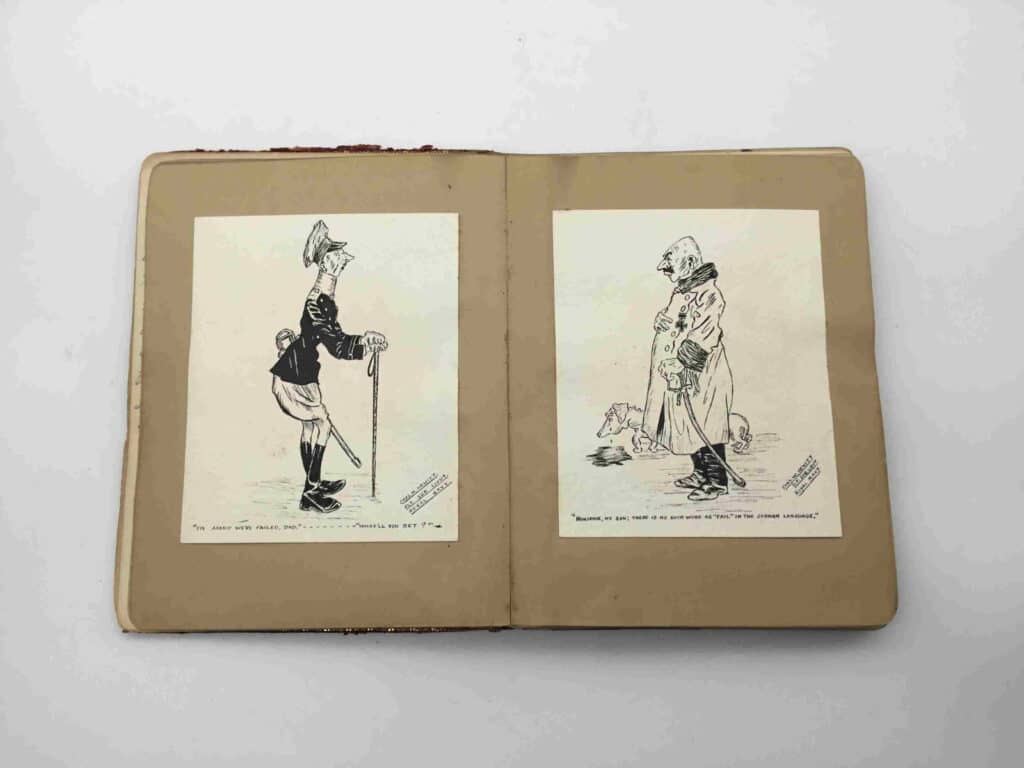
The scrapbook – found in a house clearance – belonged to WW1 Voluntary Aid Detachment nurse Maude Alice Lineham (1883-1965) from Derby. Around 90 wounded serviceman contributed as part of their recuperation. As well as a first-hand account of the truce which led to German and British troops playing football, a soldier described the sinking of hospital ship Anglia in 1915. Another emotive page displays a fragment of a white German surrender flag taken from a soldier in France in 1915.
Maude worked at Derby’s Spondon House Hospital, Derbyshire Royal Infirmary (DRI) and Leicester Royal Infirmary during the 1914-18 conflict. Her album was guided at £600-£800 but the hammer fell at £3,400 at Hansons Auctioneers. The premium-inclusive total paid by an online Canadian bidder was £4,685.
Matt Crowson, head of militaria at Hansons’ Derbyshire saleroom, said: “It was an amazing result and deservedly so. We had plenty of pre-sale interest so we knew it would do well but it achieved even more than anticipated.
“The album is an extraordinary document giving the reader a real snapshot in time.
It speaks of triumph, despair, hope, courage and, ultimately, the sacrifice a generation of young men and women, some paying the ultimate price.
“The 1914 Christmas Day truce is described in detail by a soldier who helped to instigate it. When the guns stopped, men laid down their arms, sang carols and exchanged gifts, wishing goodwill to all men. Men who only hours earlier had been trying to kill each other came together in a celebration of humanity.
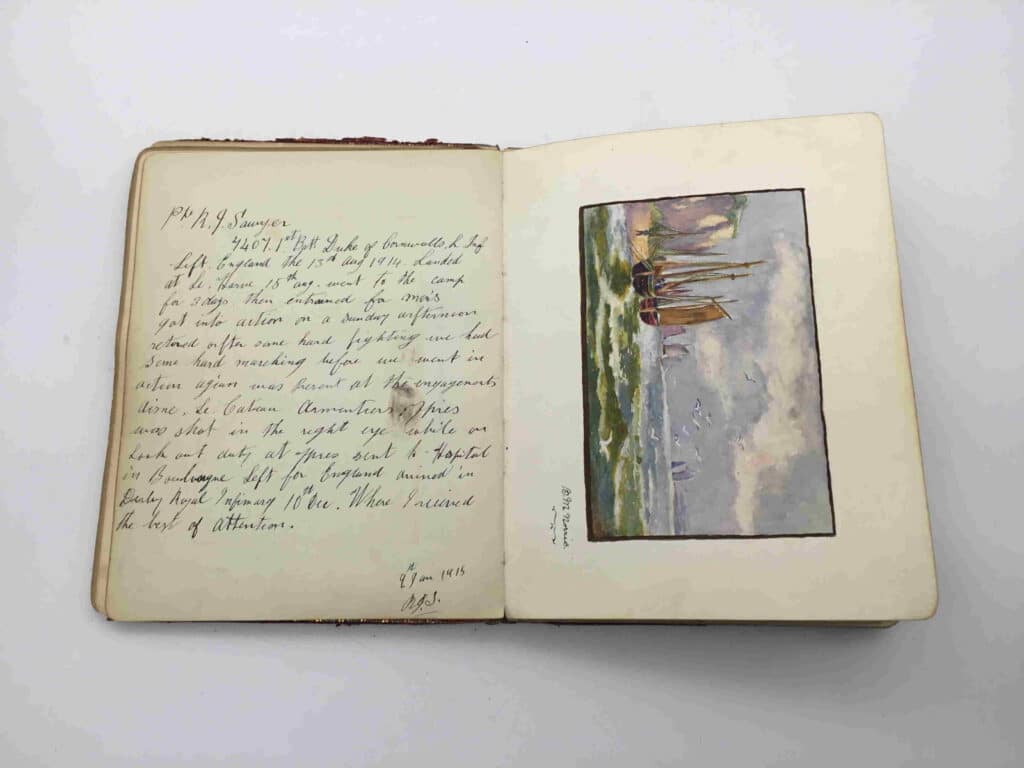
“It’s clear Maude was held in high esteem by the wounded servicemen in her care. This fascinating album stands as testament to that. Like many nurses of the era, she was somewhat of an unsung hero. Were it not for this item coming to light, her dedication would have been forgotten.”
An eight-page account of the 1914 festive truce was written by Scottish solider John J Ferguson from the Seaforth Highlanders under the title ‘Peace on Earth’. John, who was wounded at Messines, Belgium, on December 26, 1914, wrote: “Xmas Eve in the trenches and not too comfortable. Pumps going night and day but could never bring our water line to less than two feet, a small stream flowed parallel and in front of our trenches, using our trench as an overflow; being the cause of most of our discomfort.
“It was almost dark and being only 100 yards from the German trenches it was almost possible to listen to the conversations…very little sniping had been done by either side, we thought they were exceptionally quiet. Good … Will … Towards … Men.
“We started singing carols. They applauded us. They sang and we replied. I don’t think we were as harmonious as the Germans. They had some fine voices among them. The stillness of the night, our mood (Xmas feeling) may have helped but as the sound floated over the turnip field to our trench we were held spellbound.
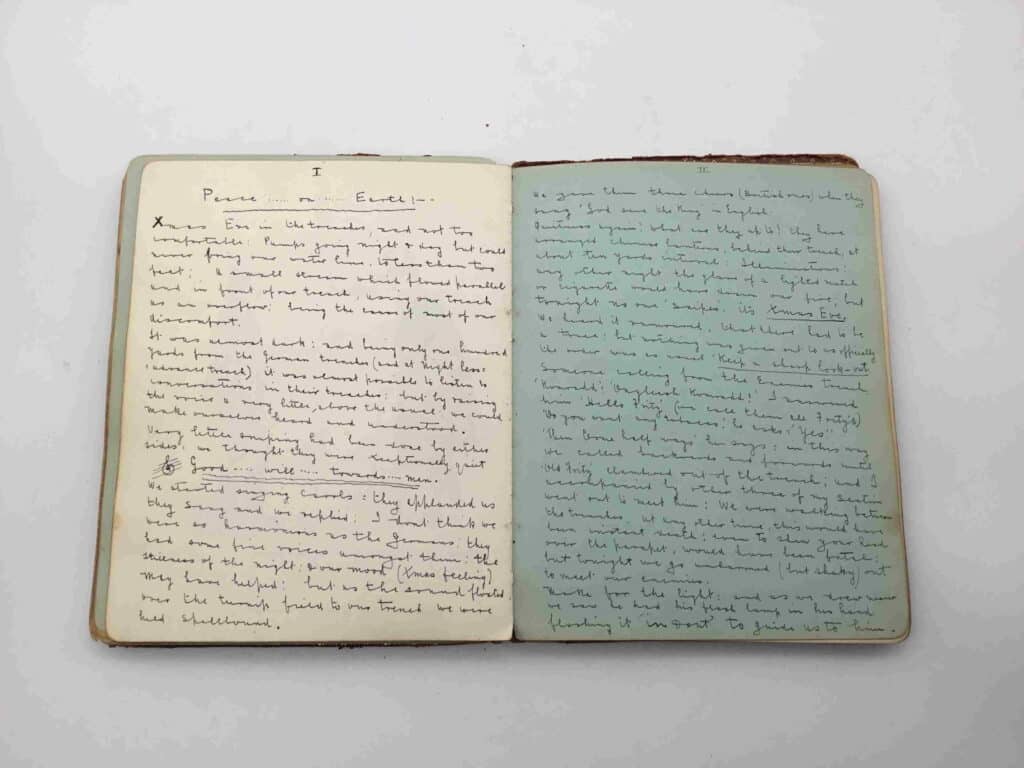
“We gave them three cheers (British ones) when they sang ‘God Save The King’ in English. Quietness again. What are they up to? They have arranged Chinese lanterns behind their trench … Illuminations any other night would have drawn out fire but tonight no-one snipes, it’s Xmas Eve.
“We hear it rumoured that there had to be a truce but nothing was given out to us… Someone calling from the trenches ‘Ongleesh Komadd’. I answered him ‘Fritz’ ( we call them all Fritz). ‘Do you want any tobacco?’ he asks. ‘Yes’. ‘Then come half ways’, he says. In this way we called backwards and forwards until Old Fritz clambered out of the trench and I, accompanied by another three from my section, went out to meet him. We were walking between the trenches. At any other time this would have been instant death, even to show your head above the parapet would have been fatal. But tonight we go unharmed (but shaky) to meet our enemies.
“Make for the light and as we drew near we saw he had a flash lamp in his hand… We shook hands, wished each other a Merry Xmas and were soon talking like old pals, standing in front of their wire entanglements and surrounded by Germans …
“We stood in the circle of Germans like street-corner orators. Soon most of my company, hearing I had gone, followed us. In my regiment they call me Fergie for short and, in the darkness, they kept calling Fergie. The Germans coming to meet them, hearing this call of Fergie and thinking it was a greeting in English, answered every call of Fergie.
“What a sight it was, little groups of Germans and British extending almost the length of our front. Out of the darkness came laughter and talking, lighted cigarettes and the flash of matches. Germans and Seventh lighting each other’s cigarettes and exchanging souvenirs… Here we were laughing and talking to men whom only a few hours earlier we were trying to kill.
“I was surprised at the good English, especially of Fritz. He told me he had been doing business in Edinburgh and west of Scotland and only left in August when called up. He knew our regiment well and had seen them in Edinburgh Castle…
“They had arranged not to fire for 48 hours but warned us the Prussians on their left would still be sniping. They kept their word and neither of us fired for two days. It was like being in a different world. Here we were, Christmas Day in the trenches and able to walk about with our heads up. Some of our men even left the trench to play football – a party from our ‘B’ went over and were photographed with the Germans… We had made friends with the enemy and all day kept calling and joking across the trenches.
“Dec 26 … a shell struck me. Left arm amputated at elbow and shrapnel wound left thigh. In all I had six pieces of shrapnel and two bullets removed but I knew it was not our new friends, the Bavarians, who shot me but the artillery of the Prussians.
“From 26th Dec to 5th March I was in hospital in Boulogne [France]. I am at present in the DRI. Words fail me in trying to express my appreciation for the attention and kindness of our sister and nurses of Ward 6. I wish I was a woman … I’d be a nurse… They’re champion. 16.6.15.”
The contribution describing the sinking of hospital ship Anglia on November 17, 1915, sheds new light on the tragedy. The vessel carrying 390 injured soldiers from Calais to Dover struck a German U-boat mine. It sank in 15 minutes and 134 men died. The wreckage was declared an official war grave.
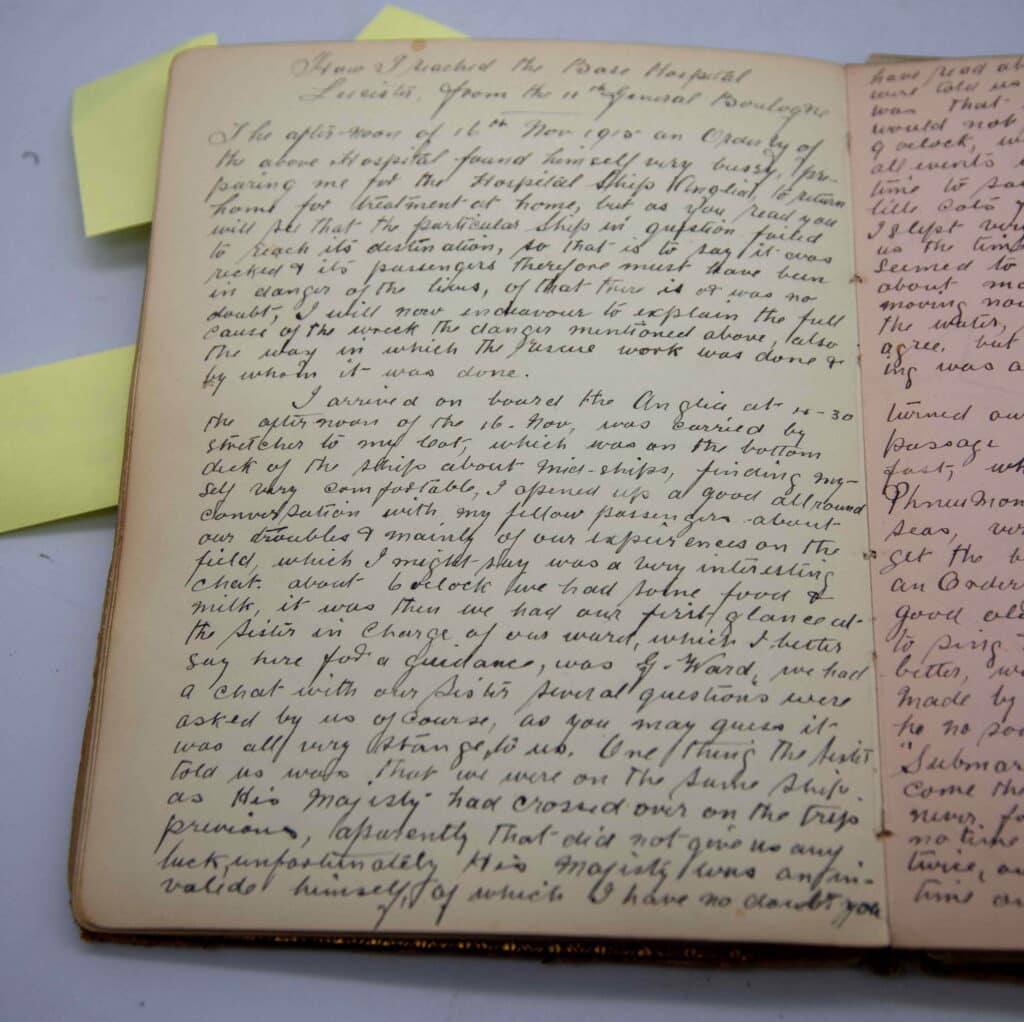
Survivor C Gordon, 9th KRR, who boarded the ship by stretcher, wrote, ‘All the life boats were full of men, the men from below. No one seemed to give any instructions. No one seemed to know what to do. The ship’s crew were not to be seen anywhere. The men in the lifeboats didn’t know how to lower the boats’. Though incredibly weak Mr Gordon managed to swim to safety and was transported to Leicester Base Hospital.
Maude lived at 260 Burton Road, Derby. In 1911 her occupation was recorded as ‘School Teacher, Private’ but by November 1914 she’d volunteered as a nurse within the Voluntary Aid Detachment under the umbrella of the Red Cross.
The 75-year-old Derby vendor, who is unrelated to Maude, said: “My mother did a few house clearances in the 1960s and progressed to having an antique shop in Derby. I think this is how the book came to be among mum’s things when she died in 2012. I came across it in a box of old books when we were clearing her bungalow. I tried to find any relatives of Maude’s as I knew they would appreciate it, as I did. I discovered Maude died in Derby having lived with her sister, neither of them having married. I believe this was the case for so many young women who lost sweethearts during WW1.
“WW1 nurses encouraged patients to write about their experiences as part of their recuperation. Maude’s album is particularly delightful as it is so complete and she showed such diligence in making sure the young men in her charge recorded something, either by the written word or a beautiful picture. I was so impressed by how articulate and talented they all were.
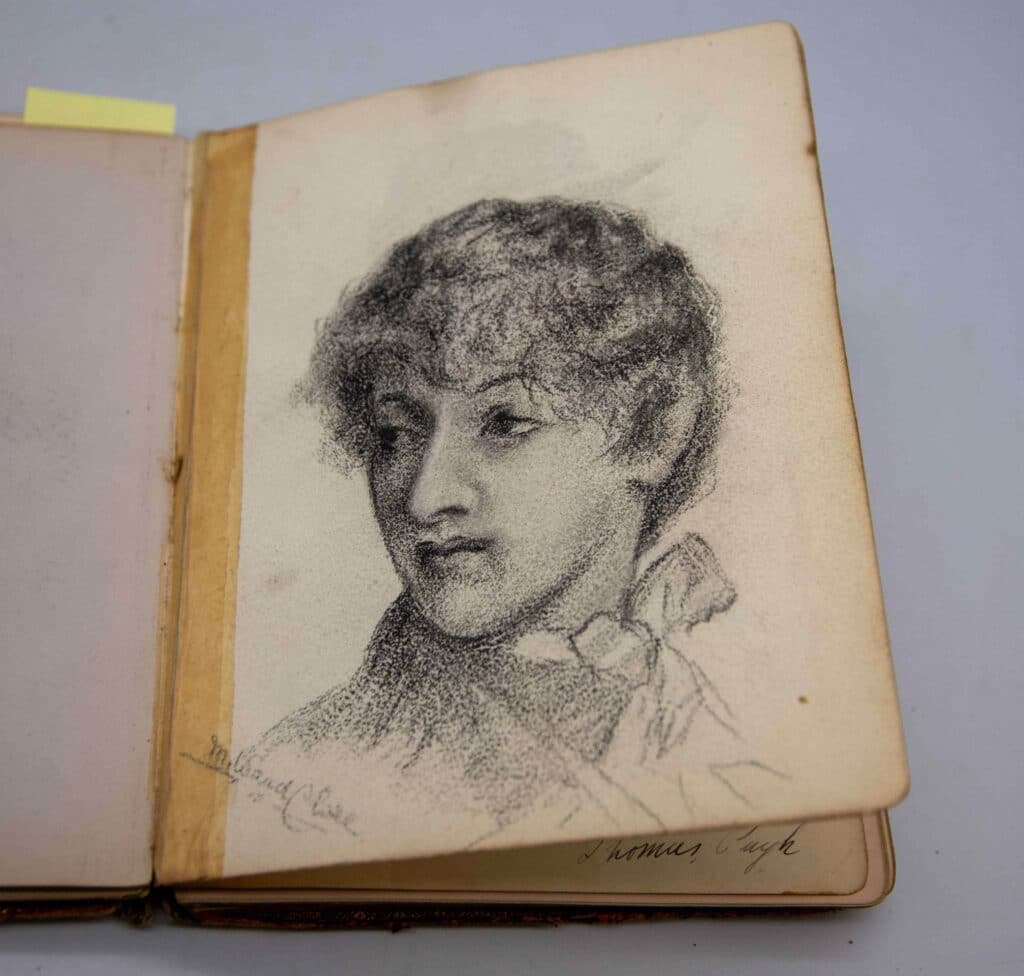
“Maude and her boys became part of my life when I transcribed the album. I persuaded myself a charcoal drawing in the album was Maude and the ‘Forget me not’ poem by R W S Arthur, Oct 1916, which finishes with the line ‘Forget me not is all I ask, but should remembrance prove a task, Forget me!’, was for her. Perhaps he was her sweetheart who had to return to the front. How heartbreaking for her.
“Maude was an accomplished pianist as J M Hockney, 8th Surrey, 30 June 1917, wrote, ‘In memory of happy days, many chorus’s etc with Miss Lineham at the piano surrounded by her noisy boys’. How they must have dreaded being sent back to the front.
“Maude became very special to me. I wanted to make sure her book would never be forgotten. The stories it contains are so poignant and heartbreaking, written by such brave young men.”
Auction: The album sold in Hansons Auctioneers’ November 13 Militaria Auction, held at the firm’s Derbyshire saleroom.
Militaria entries invited
Hansons is inviting entries for its next Medals and Militaria sale. For advice/valuations, please contact Matt Crowson: [email protected] or call 01283 733988.