








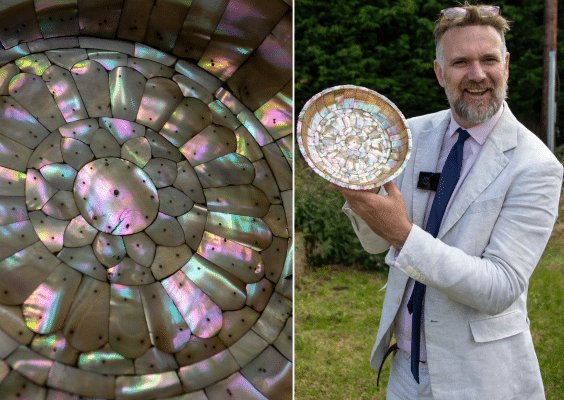
A decorative dish – spotted on a sideboard – could achieve a five-figure sum at auction after turning out to be a centuries-old antique treasure.
The intricate bowl, thought to be of little value by its owner, took the eye of antiques expert Charles Hanson during a routine house call near Lichfield, Staffordshire. His instincts proved correct because it’s been identified as a valuable Elizabethan mother-of-pearl Indo-Portuguese object of cultural significance.
Believed to have been crafted in Gujarat on the western coast of India in the late 16th or early 17th century, it’s thought to be a rare survivor of wares popular with the wealthy elite and royalty during the days of the Portuguese Empire.
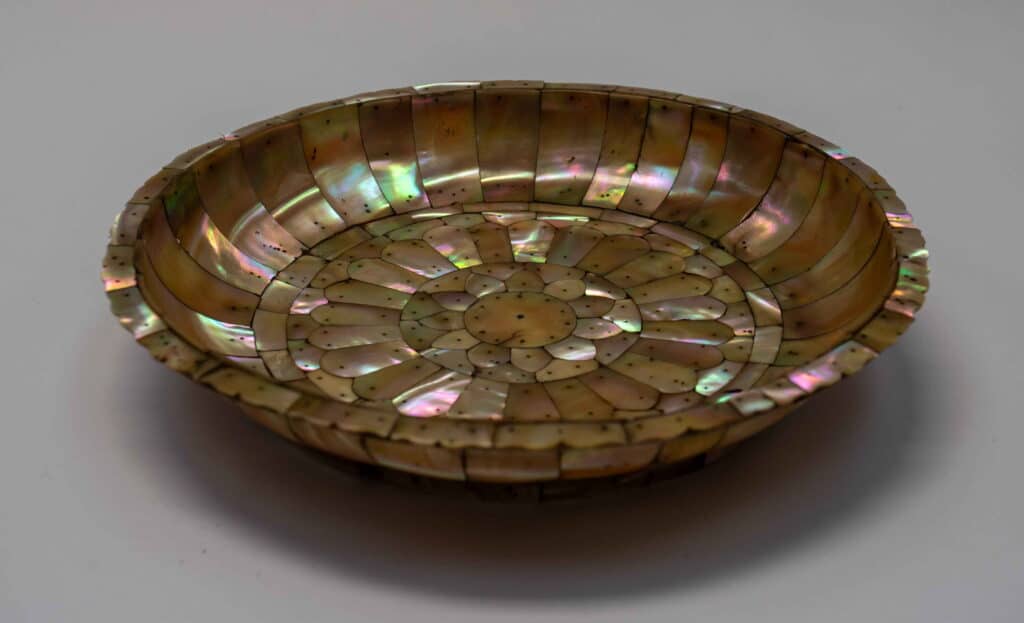
Charles, owner of Hansons Auctioneers, who spied the item by chance, thinks it likely it was brought to the UK by a British merchant for a royal or noble household around 400 years ago. Henry VIII was among royals who liked ornate wares ‘from the Indies’ and similar mother-of-pearl overlayed items can be seen at London’s Victoria and Albert Museum. Such is its scarcity it could achieve £10,000-£15,000 under the hammer in September.
Charles said: “I’d been called in to inspect some French glass and jewellery but spotted the dish out of the corner of my eye sitting on a sideboard. The owner was a little dismissive. Her husband acquired it in London in the 1970s. She had no idea of its potential value and was shocked by its importance. I was excited because I knew it was potentially Elizabethan, dating back to the reign of Queen Elizabeth I (1558-1603).
“It was a scarce luxury object then and now. Items like this were deemed so exotic they were gifted to royalty. And we have the Portuguese to thank for this trend because when their country’s empire was at its height, its people commissioned mother-of-pearl wares.
“In 1498 Portuguese explorer Vasco da Gama became the first European to reach India by sea and in 1505 Portuguese India was founded. It was da Gama who may have sparked the passion for these decorative objects. Gujarat is first mentioned as the centre of mother-of-pearl work in 1502 when the King of Melinde, on the East Coast of Africa, presented da Gama with a gold and mother of pearl bedstead. Indo-Portuguese mother-of-pearl objects were brought to Europe by merchants from around 1525.
“Many 19th century art historians assumed these items were European due to their Western shape. Little did they know the rich history behind them. Mother-of-pearl wares are listed in 16th century royal inventories. In France, the courts of Francis I (1515-1547) and England’s Henry VIII (1509-1547) were charmed by exotic goods from ‘the Indies’, and mother-of-pearl objects were presented as New Year gift in Tudor times.
“In 1534 Thomas Cromwell gave Henry VIII a mother-of-pearl ewer set in gold and Queen Elizabeth I (1558-1603) was presented with a ewer and basin embellished with mother-of-pearl. In 1529 the King of France received a mother-of-pearl bed and in 1602 an inlaid coffer was noted in the collection of the Elector of Saxony, the leader of a territory of the Holy Roman Empire which existed from 1356-1806.
“The inspiration for Gujarati mother-of-pearl objects remains unclear but the influence appears to be Korean. Najeonjang, or mother-of-pearl inlaying, is a traditional Korean method of decorating objects with strips of mother-of-pearl.
“The fragility of items like this mean few survive but a Staffordshire sideboard has proved to be a safe haven. A similar example, circa 1540, can be seen in the Green Vault, a museum in Dresden, Germany. We expect the dish to make between £10,000 and £15,000, such is the desirability of Indian and Asian artefacts.”
Auction: The mother-of-pearl dish, which is 26cm in diameter, will be offered in Hansons Auctioneers’ September 26-27 Fine Art Auction in Derbyshire. Further entries invited.
Enquiries: [email protected]
Valuations: [email protected] | 01283 733988