










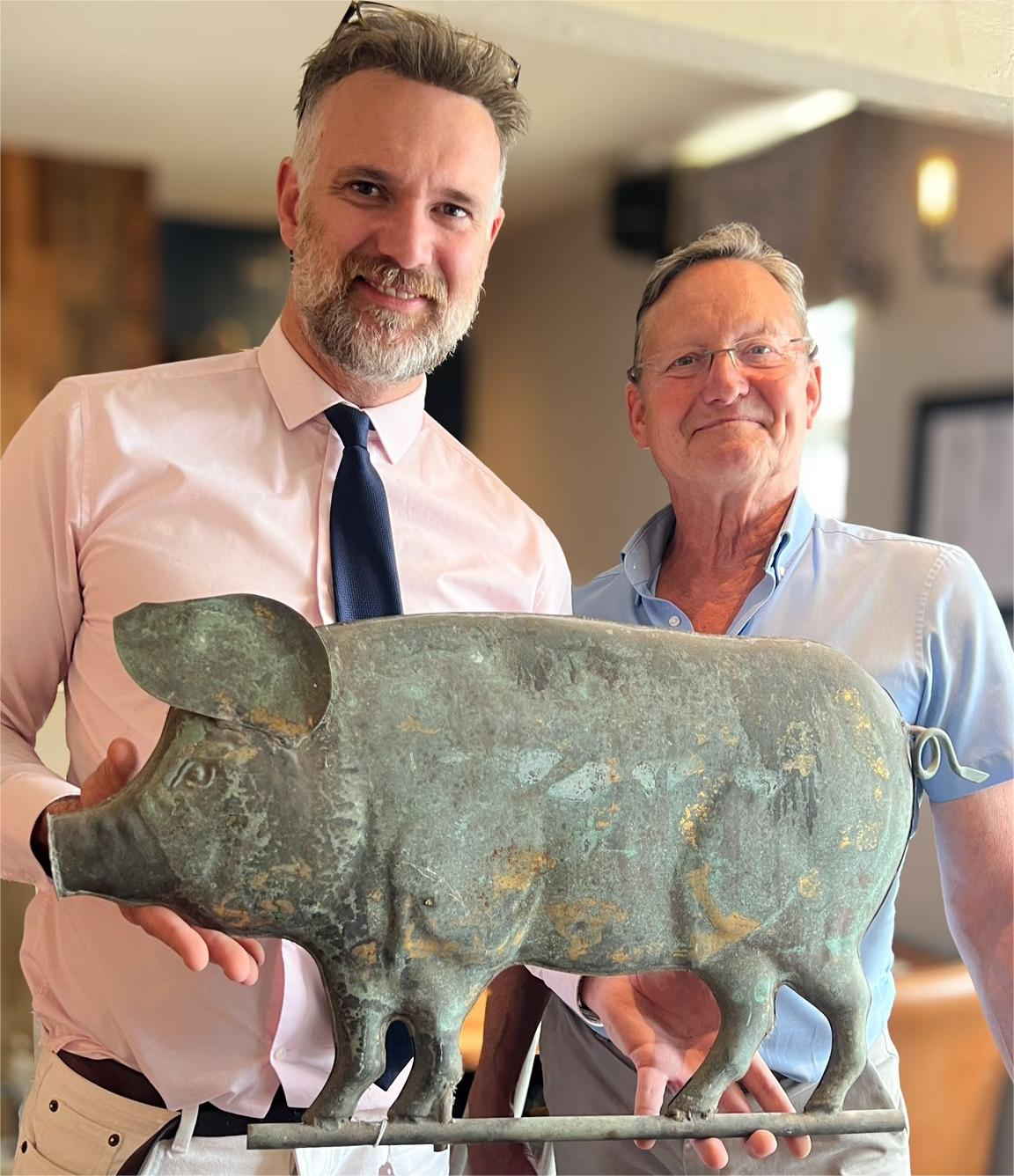
By Adrian Kinton (pictured with Charles Hanson)
This early 20th century weathervane set for auction on July 23 reminded me of a rhyme from my childhood and a song from my youth – This Little Piggy Went to Market and You’re So ‘Vane’?
The weathervane is a regular sight on buildings in England, particularly on church towers and spires, yet their origins lie in the distant past – when wind direction was of significant importance – but the richness of their abundant designs is full of symbolism and folklore.
Lot 3122 in Hansons’ July 18-23 Antiques and Collectors Auction provides a reminder of this, a weather vane in the form of a cheerful pig, brimming with character from snout to tail. Its hollow copper body still bore (no pun intended) remnants of gold paint from yesteryear, rendering the porcine piece a picture-perfect patina.
And yet the first weathervanes, originating in the second century BC in China, were called hou feng shin and were little more than ribbons. It was left to the Ancient Greeks some 80 years later to instal the first character – that of a huge, bronze Triton, some eight metres high, pointing in the direction of the wind as it crowned the agora in Athens.
Later characters emerged, notably the ubiquitous cockerel favoured by successive Popes who regarded the creature as being emblematic of St Peter. Indeed, the Bayeux Tapestry emphasises their wide usage showing, as it does, a man securing a cock upon Westminster Abbey.
Returning to our perky porker, who knows which building he adorned? Stuffing he may be missing and his joints may squeal a little but, rest assured, as he trots off to market with an estimate of £80-£100, he may yet bring home the bacon.