








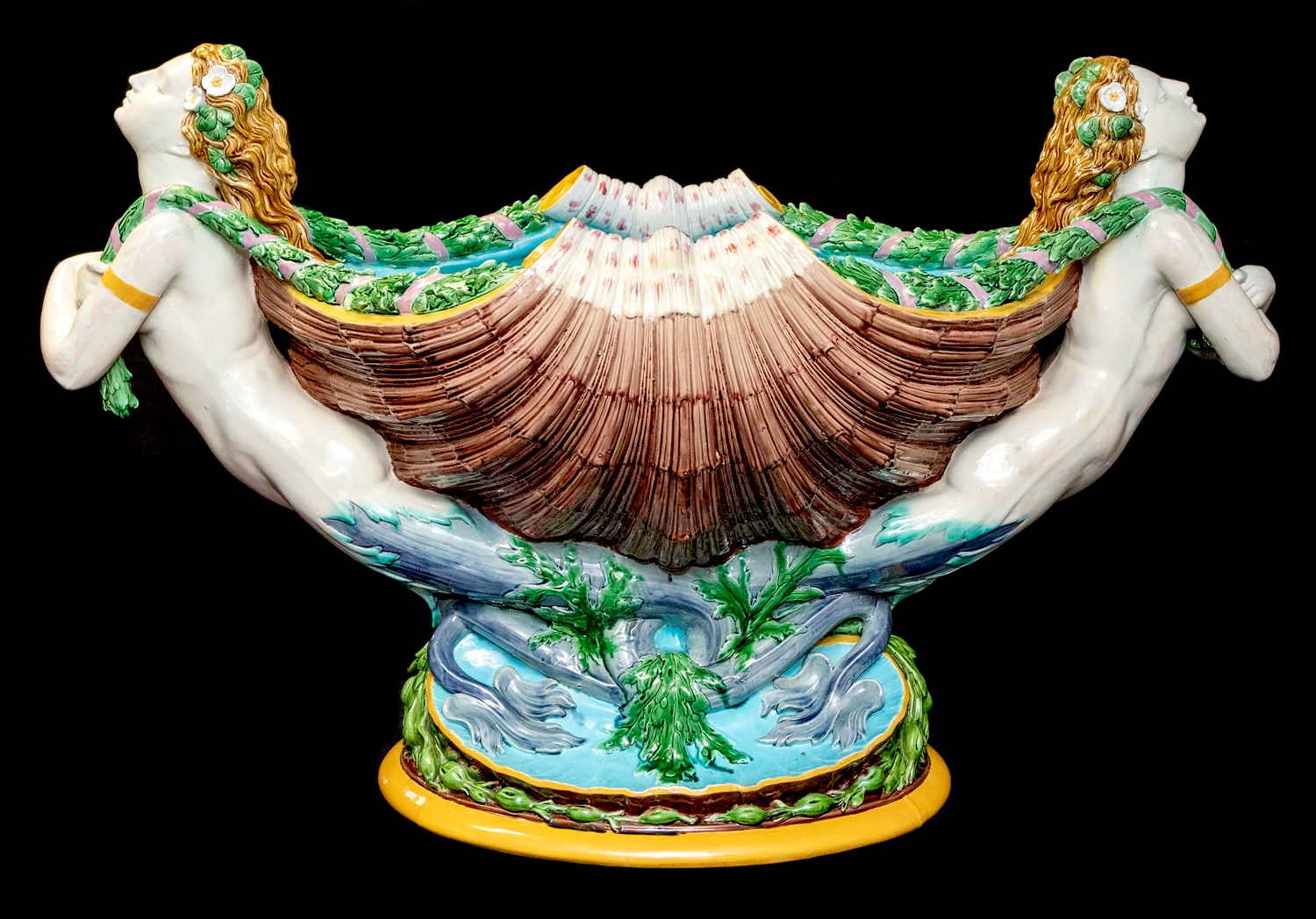
One of the biggest Minton majolica centrepieces ever seen – bought for a few pounds decades ago – has sold for thousands at auction.
In 1950 factory worker Anne Pincher paid £25 for the ‘Shell Flower Bearers’ exhibition piece made by Minton & Co of Stoke-on-Trent, Staffordshire, in circa 1875. Measuring a whopping 99cm wide, it’s modelled as two mermaids supporting a scallop shell.
The 150-year-old antique used to take pride of place in Anne’s front room in Darlaston, near Walsall, West Midlands – but later stored tights and bric-a-brac on her landing! It sparked a bidding battle at Hansons Auctioneers’ Derbyshire saleroom in March (21st) and sold to a private UK buyer for a premium-inclusive total of £6,560. (£5,000 hammer price)
Gillian Finney, connoisseur ceramics consultant at Hansons, said: “I’m delighted this Minton majolica marvel achieved the price it deserved. It’s extremely rare. The design is listed in the 1871 Art Journal and a similar example was displayed at London’s Victoria and Albert Exhibition in 1873. Minton was Europe’s top ceramics factory during the Victorian era, so this spectacular object is an important part of England’s history.”
Anne’s daughter, Marilyn, a retired legal secretary from Walsall, said. “When mum first bought her Minton she put it in the front room for everyone to see. In later years it had to be moved upstairs and she put it on the landing. Due to its shape and size, it ended up being filled with bric-a-brac and the odd pair of tights.
“Mum loved antiques and filled her house with them. It’s likely she put a small deposit on the Minton and paid for it in full when she could afford it. She bought it from some antique-dealer friends in Walsall. Goodness knows how she transported it the few miles to her home in Darlaston. Probably by horse and cart.
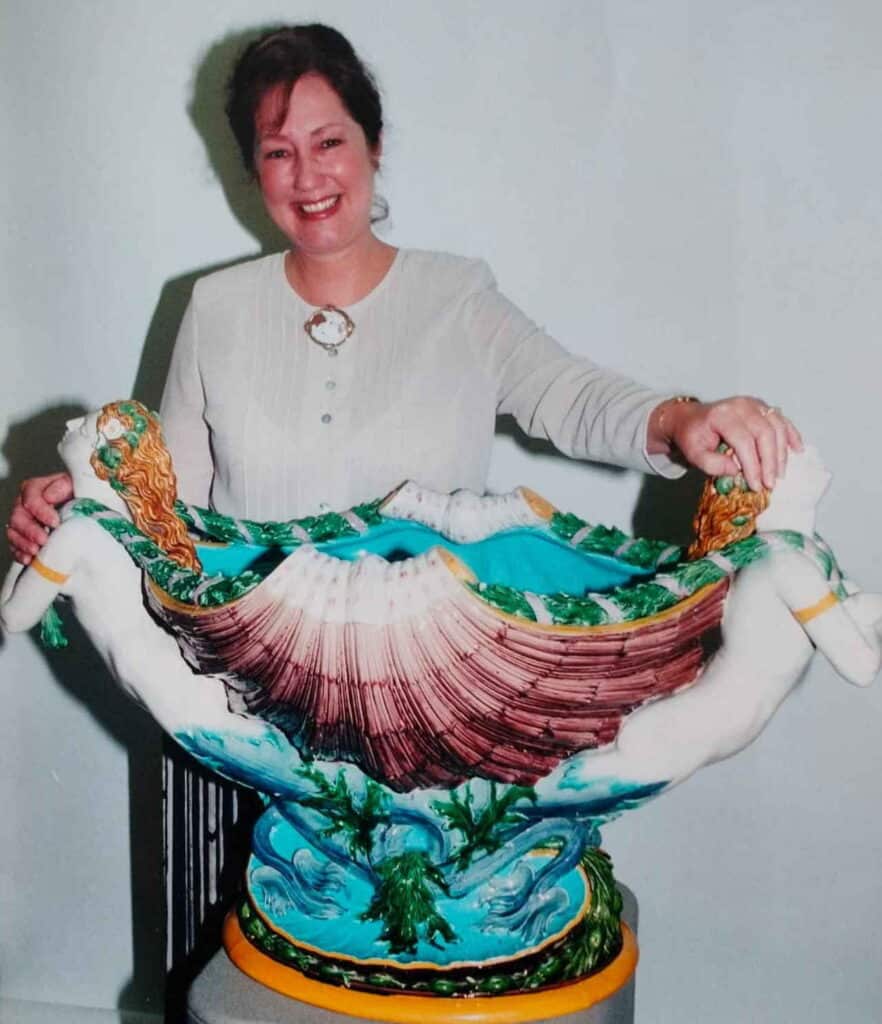
“I inherited the piece when mum passed away at the age of 83 in 1995. It’s scarce because of it’s size. It’s twice as big as a smaller piece which Minton manufactured known as the ‘Flower Holder’ .
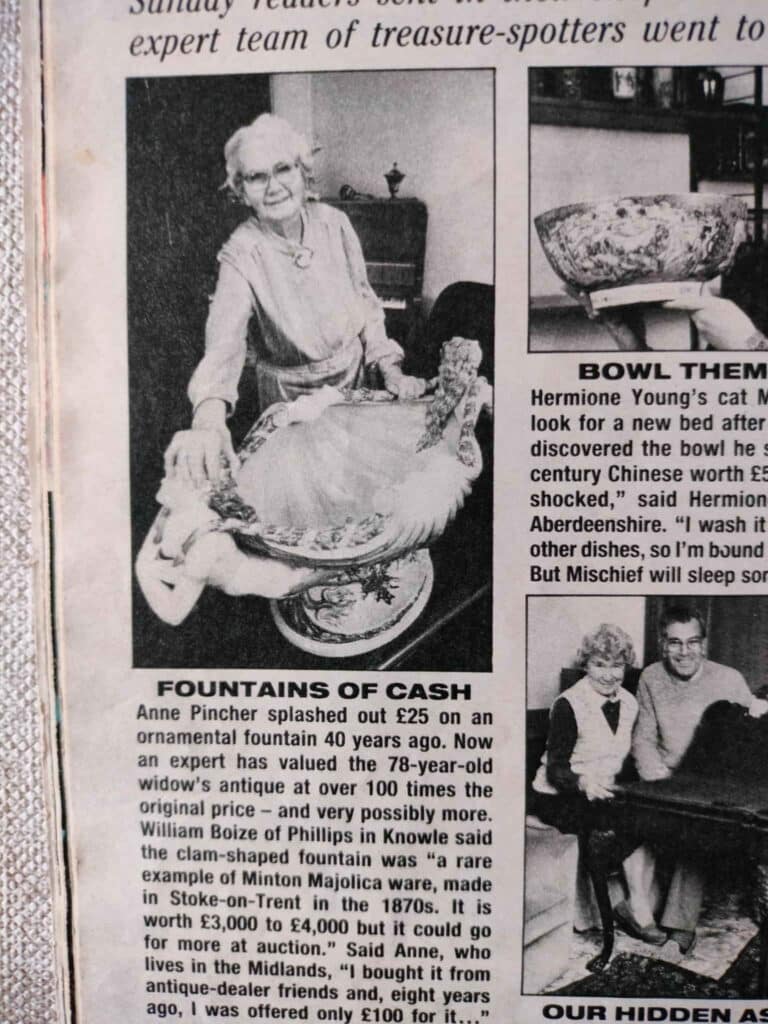
“In 1990, when mum was 78, the News of the World ran stories about finding a fortune in the attic and included her Minton. The article said it had been valued at £3,000-£4,000 but that someone had offered mum a meagre £100 for it!
“In 1997 Antiques Roadshow came to Walsall and I got in touch with them. They asked one of their experts, the late Henry Sandon, to interview me. Henry said mum’s Minton was worth £10,000 but to get it insured for £15,000.
Hansons said: “Minton antiques dropped in value after that but quality can’t be ignored. The price achieved is not so far away from Henry’s assessment 27 years ago.”
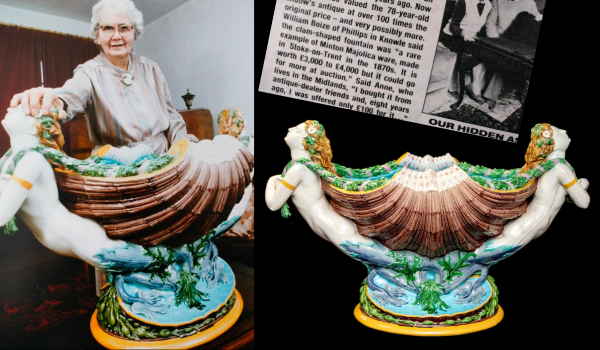
Marilyn said: “I’ve enjoyed owning it. It used to be proudly displayed in the front room on a table. But, because of its value, it’s been covered in sheets and blankets in a spare room for the last couple of years. I’m decluttering at the moment and decided it was time to let go. It’s a shame to have it hidden away.
“It’s been nice to see it getting some love and attention in the press again. It must have star quality because a similar Minton Majolica piece was used in Daddy Warbucks’ mansion in the 1982 film Annie, starring Albert Finney.”
The roots of majolica pottery date back to the mid-15th century when maiolica, its original name, reached Italy from Spain, Majorca and beyond. This pottery was made with a tin-glaze process. From the mid 19th century majolica made by a simpler process emerged. Coloured lead silicate glazes were applied directly to an article, then fired. This resulted in brightly coloured, hard-wearing, inexpensive wares that were both useful and decorative.
This type of majolica was introduced at the 1851 Great Exhibition in London, and Minton and Co, founded in 1793 by English potter Thomas Minton (1765–1836), led the way.
Auction: The Minton majolica centrepiece sold in Hansons Auctioneers’ March 21 Derbyshire Fine Art Auction.
Auction entries invited
Entries are invited for Fine Art and Ceramics auctions.
E: [email protected] | T: 01283 733988.