











By Eric Knowles, Decorative Arts Consultant
I love the arrival of spring and this small vase encapsulates the joy of new life, nature and all things bright and beautiful.
Thanks to its splash of bold yellow, pink and floral decoration it heralds the end of winter. It’s also an important antique. Decorative art is my forte so I was excited to learn of its discovery. Found nestling in a cabinet during a home visit, this circa 1900 cameo cut glass vase bears the signature of a creative genius, French artist and designer Émille Gallé (1846-1904).
Gallé only lived for 58 years but he made an enormous impact. He was an innovator when the industrial age and advances in science presented ever increasing possibilities in technology and materials. Noted for both his Art Nouveau glass art and furniture, he founded the École de Nancy (Nancy School) in 1901, a design movement in the French city of his birth.
Consequently, this petite, crocus-inspired vase, measuring only 5ins high, is big on importance. It may also be big on price. It could make as much as £1,500 at Derbyshire’s Hansons Auctioneers in March.
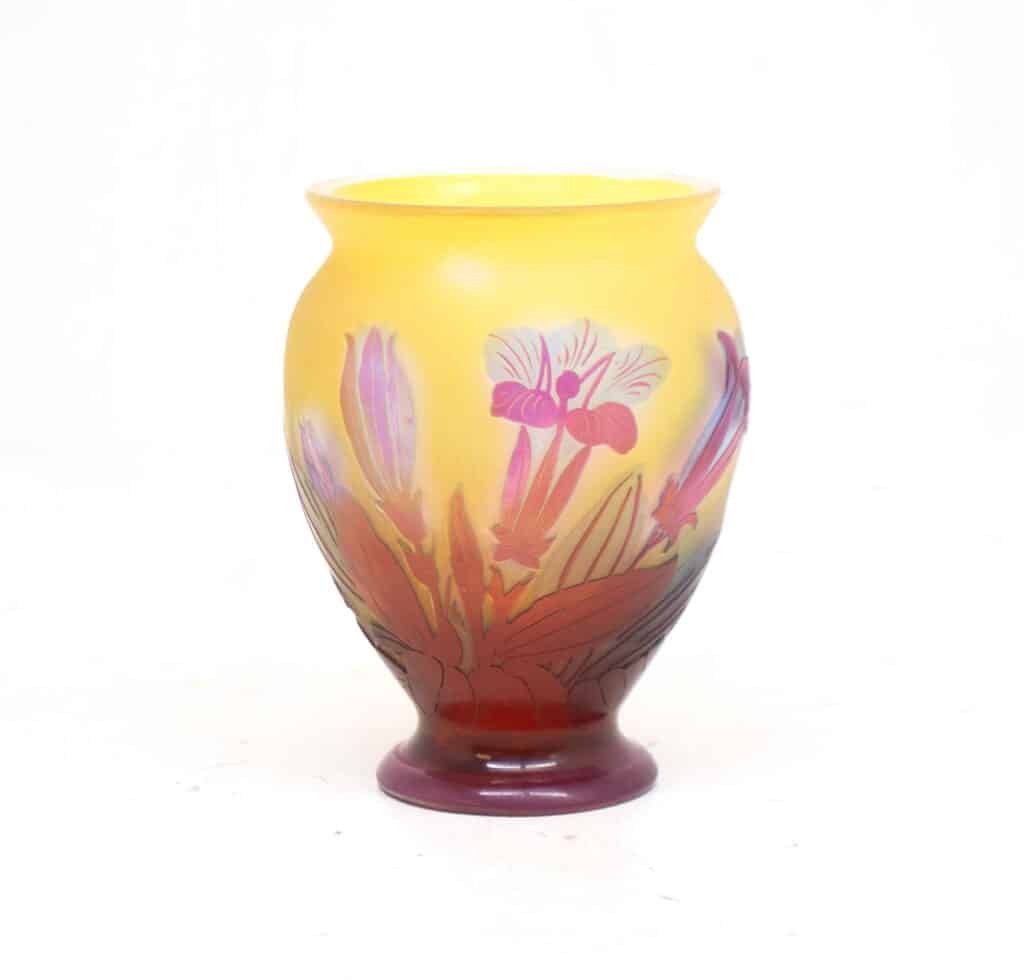
It demonstrates the importance of flowers, colour and technical innovation in Gallé glass works, especially vases. He was a dedicated botanist and, in this example, flowers in varying degrees of bud and blossom curve upwards as if growing out from the base of the vase.
Gallé had an extensive flower garden as a source of models. He also required his artists to use plants as models. For him flowers had a strong symbolic appeal. He wrote in 1893 that, according to Saint Paul, each flower and fruit has a particular symbolic meaning. The olive leaf is peace, wheat is charity and goodness, the grape is the symbol of the Eucharist, the fig is generosity, the Veronica flower is fidelity, the myrtle is joy, the narcissus is springtime in nature, and so forth.
He developing innovative techniques to showcase his love of nature – cased glass and cameo glass. Cased glass was created by using heat to fuse together two layers of glass of different colours. This could be repeated for multiple layers of glass. Cameo glass was a means of decorating cased glass by using a diamond saw or etching it with acid. This allowed colours from the layer beneath to become visible.

The vase features these techniques. The yellow-bodied glass has a blue and pinkish layer of glass applied over. Gallé has cut away the top surfaces of the pink and blue to reveal the yellow ground, in turn creating a floral design.
As early as 1878 he coloured glass with a small quantity of cobalt oxide to make a delicate sapphire tone which he called ‘Clair de lune’, or ‘moonlight’. He sometimes covered this with a glaze of cobalt blue. It was widely imitated by other glassmakers, particularly in Germany and England.
However his most original and characteristic colours were a deep violet made with manganese, a pink made with selenium or copper, which he created in 1889, and a green made with chromium, which he used to case pieces in three or four layers, giving an exceptional depth of colour.
His talent was nurtured through family businesses. His father, Charles Gallé, was a merchant of glassware and ceramics who settled in Nancy in 1844, while his father-in-law owned a mirror factory. His father began to manufacture glassware with a floral design. He also took over a struggling faience factory.
The young Gallé studied philosophy and natural science at the Lycée Imperial in Nancy. At 16 he became an assistant to his father, making floral designs and emblems for faience and glass. In his spare time he became an accomplished botanist, studying with D A Godron, director of the Botanical Gardens of Nancy. He collected plants from as far away as Italy and Switzerland. He also studied art and made numerous drawings of plants, flowers, animals and insects, which became the subjects of decoration.
Some of his early glass and faience works for the family factory at Saint-Clémont were displayed at the 1867 Paris Universal Exposition. At the Paris exhibition of 1878 Gallé won the Grand Prix gaining recognition for his exquisitely decorated glass. He was also awarded a gold medal at the 1900 Paris exhibition. He left an indelible mark in the history of decorative glass.
The vase will be offered in Hansons’ March 7 Decorative Art and Iconic Design Auction.
Auction entries invited
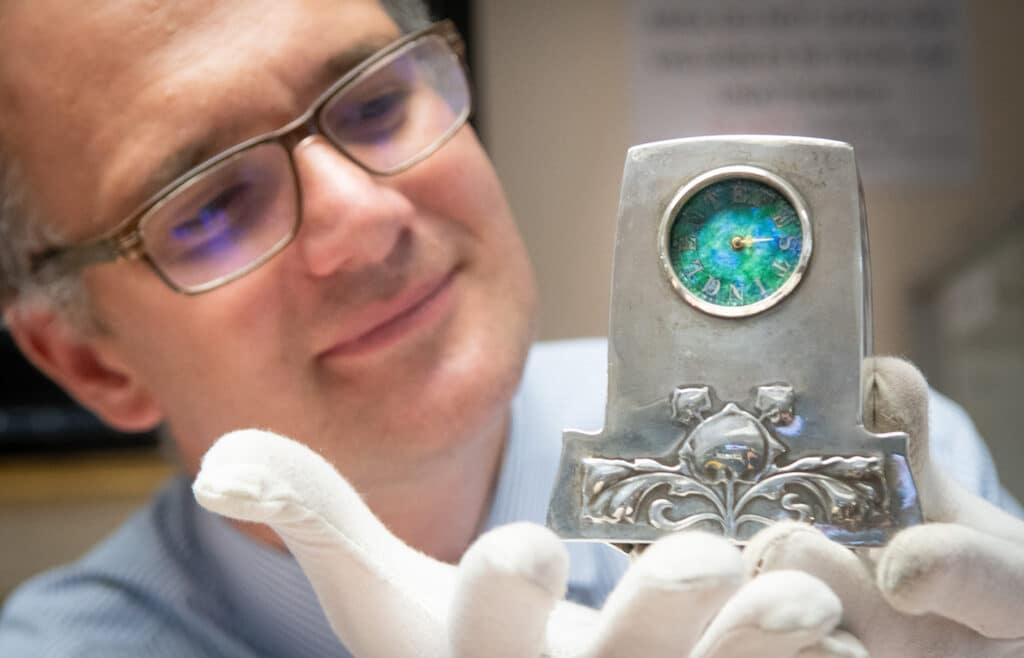
Entries are invited until February 15 for the March 7 Decorative Art and Iconic Design Auction. A special free valuation event will be held on February 14, 10.30am-4pm, at Hansons, Etwall, Derbyshire.
Objects sought include Liberty, artwork, studio pottery, art glass, sculpture, metalwork, Arts & Crafts, Art Nouveau, Art Deco, Modernist, Brutalist, contemporary, textiles such as Vivienne Westwood, ceramics including Troika, Clarice Cliff, exhibition posters, limited edition prints, silverware, jewellery, floor and wall coverings.
To book an appointment, discuss a consignment or arrange a free valuation at a different time, please email [email protected] or call 01283 733988.