









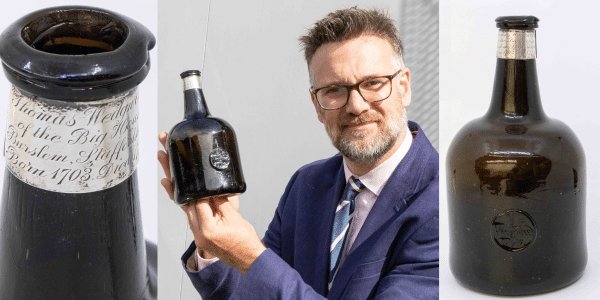
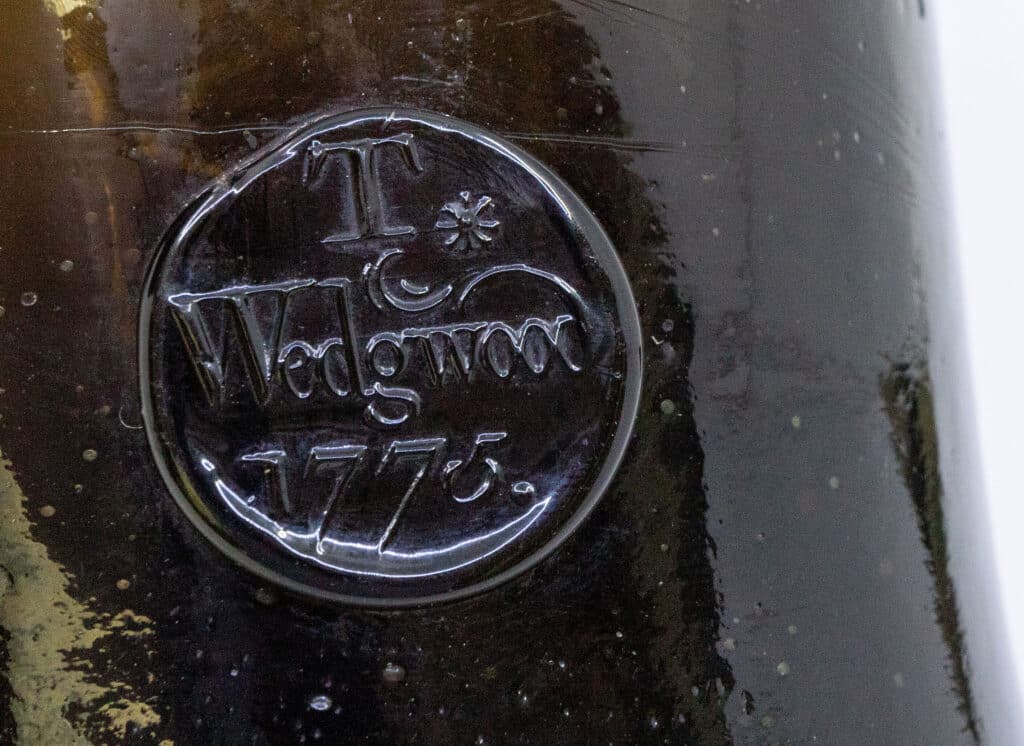
An 18th century glass wine bottle honouring a giant in the world of Wedgwood pottery has been uncovered.
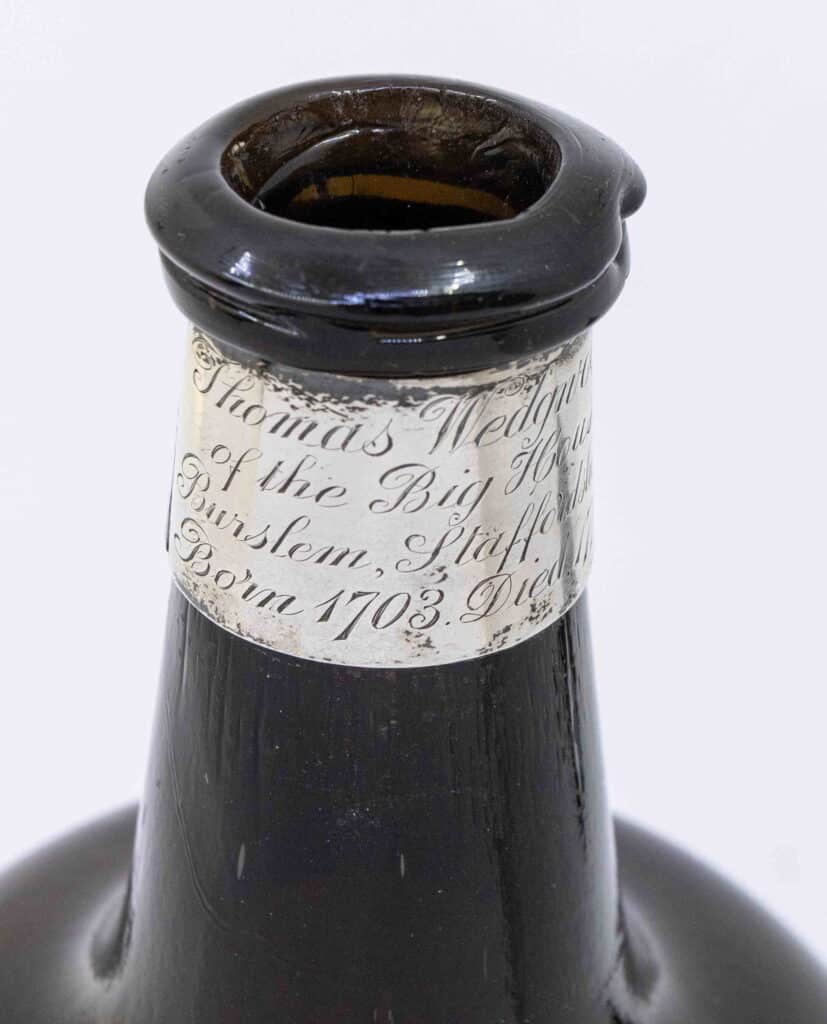
The bottle, with silver collar and inscription, marks the life of Thomas Wedgwood, part of the family dynasty that includes Josiah Wedgwood, world-renowned potter, entrepreneur and founder of the Wedgwood company in 1759.
Thanks to Josiah’s talent and ambition, he led the industrialisation of European pottery manufacture during the Industrial Revolution. But an entrepreneurial spirit ran in Wedgwood veins – particularly Thomas’s, who we believe was Josiah’s uncle.
Consequently, the bottle’s historical significance could see it achieve £6,000 to £8,000 at auction. We hope it does, and we would be even more delighted if it found its way into a museum.
The inscription, etched on the collar, states:
‘Thomas Wedgwood of the Big House, Burslem, Staffordshire. Born 1703. Died 1776’.
But that gives no indication of the impact he made after he and brother John (1705-80) took over their father’s pottery factory in Burslem, Staffordshire, in 1743. At the time Josiah would have been 13. It’s hard to imagine that he would not have been influenced by their success.
Various branches of the Wedgwood family put the Stoke town of Burslem on the map for pottery production. In the mid-18th century it was time for Thomas and John to make their mark.
They were more enterprising than most. Thanks to experimentation, they improved the quality of their pottery, sparking a rapid increase in demand. They also traded directly with Liverpool and London rather than supplying goods to hawkers.
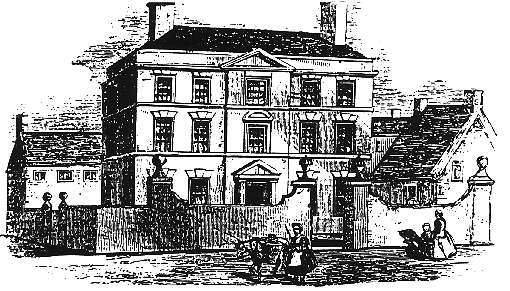
Success prompted the use of Derbyshire-born engineer James Brindley to construct a windmill to grind flint. But more expansion was necessary in the shape of a new factory and Georgian property, which was so extravagant it was called the ‘Big House’.
The brothers’ rent book shows that between 1740 and 1767 they spent £13,000 on the acquisition of land, houses and buildings. That would have been equivalent to spending around £1.5m today. At the time £13,000 could have bought you 1,897 horses or paid 130,000 days’ wages.
Simeon Shaw in his History of the Staffordshire Potteries, 1829, states:
“The excellent productions they now sent forth were so much in demand, that they erected a new manufactory, and incurred general censure because of their extravagance in erecting so large a manufactory and covering it with tiles, (all others being covered with thatch,) and for erecting three ovens, (subsequently increased to five.)
“Of the White Stone ware they now made dishes, plates, and common vessels, also some elegant fruit baskets, bread trays, &c glazed with salt, and probably cast in moulds… The White Stone ware was varied into a better Tortoiseshell, by rubbing manganese upon the vessels before they were glazed; for a different kind of ground zaffres were applied with either a sponge or hair pencil; and similar application of calcined copper, iron, and other metals, produced Cauliflower, and Melon ware, &c.
“In 1750, the Brothers erected near their manufactory a Dwelling House, below, so durable, and on so scale of extent, and a stile of magnificence, so far excelling all in the district, that it was called the BIG HOUSE. These Brothers continued their manufactures until 1763; when they retired to enjoy a very large property, the reward of their industry and integrity.”
It’s a story of hard work and ingenuity combining to build success. One can only wonder what advice they may have given Josiah in those early days of the ceramics industry. He went on to achieve even more but they must surely have inspired him.
Josiah (1730-1795) was born in Burslem, the 11th and last child of potter Thomas and Mary Wedgwood. By the age of nine, he was proving to be a skilled potter. He survived smallpox to serve as an apprentice under his eldest brother Thomas. However, Josiah was left with a weakened knee which made him unable to work the pottery wheel pedal. As a result, he concentrated on design.
In his early 20s, Josiah began working with renowned English pottery-maker Thomas Whieldon. Josiah also began to study the science of chemistry to understand how fire, clay, and minerals could produce better clays and glazes.
Inspired, Josiah leased the Ivy Works in Burslem. From 1768 to 1780 he partnered with Thomas Bentley, a businessman with sophisticated tastes. Over the next decade, Josiah’s experimentation transformed the artisan works into the first major pottery factory. His expensive goods were in demand from the upper classes, while he marketed cheaper sets for the rest of society.
Every new Wedgwood invention – green glaze, creamware, black basalt, and jasperware – was quickly copied. Having enhanced production, he sought efficiencies in sales and distribution. Showrooms in London showcased tableware, always in tune with current fashions.
He was an early adopter of transfer printing which gave similar effects to hand-painting at low cost. He also pioneered direct mail, money-back guarantees, self-service, free delivery, buy-one-get-one-free, and catalogues.
He created huge success though ingenuity and experimentation, just like Thomas and John. Genius ran in Wedgwood veins.
The Thomas Wedgwood bottle will be offered in Hansons’ Autumn Fine Art sale.
Further auction entries invited. To discuss a potential consignment, please email [email protected] or call 01283 733988.