







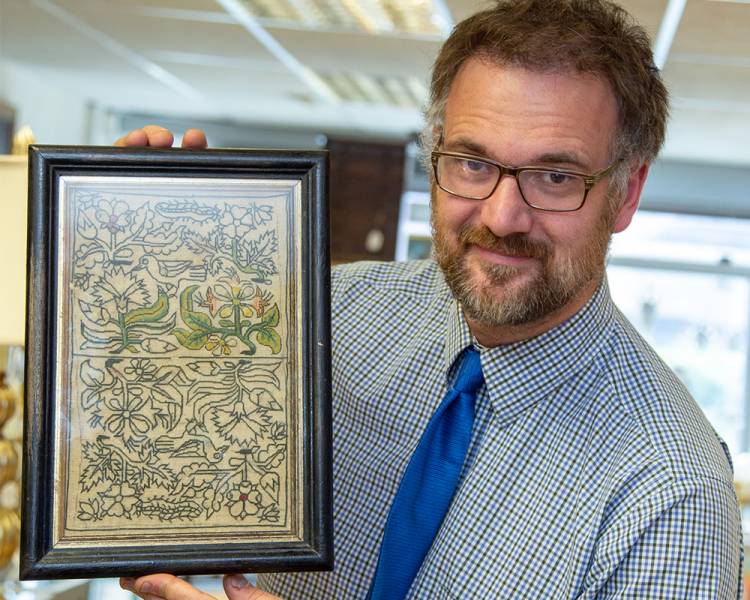
A small fragment of material sold for thousands of pounds in our July Derbyshire Fine Art Auction– and proved the power of history.
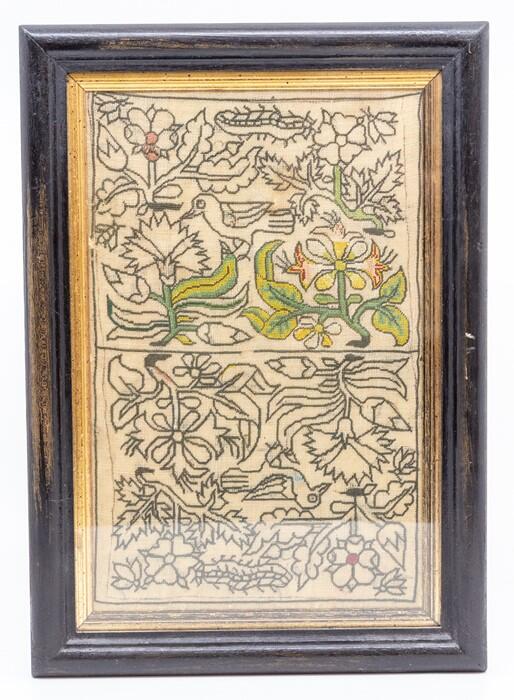
Every object tells a story and that’s certainly true of lot 634, a framed needlework sample which smashed its £60-£80 estimate to make an impressive £2,800.
You could say history was woven into its very fabric. It was believed to be a fragment of a 1640s purse, originally forming part of a collection of textiles belonging to Emma Henriette Schiff von Suvero (nee Reitzes).
Emma was born in 1873 to a well-to-do family in Vienna, Austria. She married into the banking family of Schiff von Suvero, Jewish aristocrats. Her family owned Vienna’s Palais Reitzes.
But wealth cannot protect you from conflict. Difficult days were ahead. The Second World War and the rise of the Nazi regime in neighbouring Germany changed everything for Emma and her family. On March 12, 1938, German troops marched into Austria to annex the German-speaking nation for the Third Reich. Emma stayed in Vienna after the Nazi invasion but her art collection was officially inventoried by the Reich.
Nothing appeared to be immediately confiscated. However, when Emma died of natural causes in 1939, her nephew was forced to negotiate the sale of the collection to the Kunstgewerbemuseum, now the MAK, the Austrian Museum of Applied Arts. More than 100 pieces of textile art entered the museum from her collection.
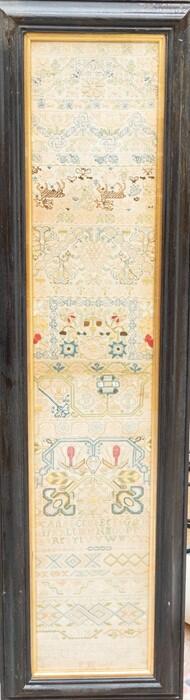
Samplers from centuries ago are highly collectables right now. Another item to soar way above its £150-£250 estimate was lot 404, a 17th Century silk and linen needlework sampler, dated 1664. This elegant, much larger example displaying rows of alphabet, geometric flowers, figures and fauna sold for £3,800.
Then there was lot 393, an 18th Century silk and linen needlework sampler, worked with rows of geometric flowers and figures. It was contested to £1,400. Crafts from the past had our top-selling lots all sewn up and it was wonderful to witness their popularity with collectors.
Embroidery and needlework were important skills that flowered into an art form during the 16th and 17th centuries and being skilled with a needle and thread was important to people from all walks of life.
Back then, most young girls were taught to work with a needle. Poorer families would produce their own garments and household textiles and were able to make a living from their craft using plain and practical sewing techniques. Meanwhile daughters of the gentry and nobility practised elaborate, decorative stitches to prepare for future roles as mistresses of large households.
At a time when all textiles were made and decorated by hand, needlework skills were necessary at all levels of society. High praise was given to young women who excelled in embroidery and in period dramas it is common to see a lady of the house practising the skill.
Bearing all that in mind, it was wonderful to see two examples of stumpwork achieve strong prices at auction. Stumpwork is a style of embroidery in which the stitched figures are raised from the surface of the work to form a three-dimensional effect.
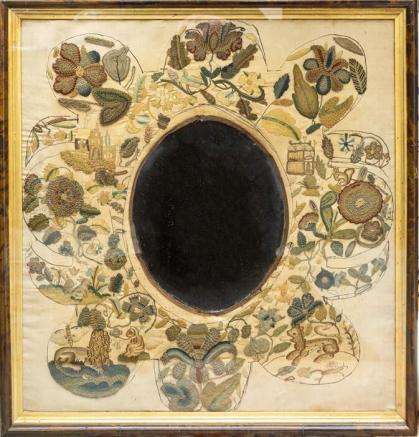
Lot 403, a 17th Century stumpwork framed mirror, the oval plate within a cream silk panel, worked with a lobed border of flowers, foliage and buildings, populated by a recumbent lion, a monkey and other exotic and domestic fauna, made £3,600.
And I particularly liked lot 405b, a 17th century stumpwork embroidered egg, the white, probably duck egg, worked with raised leaves. It sold for £2,400.
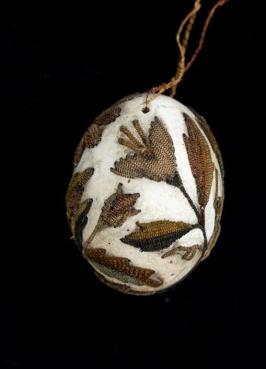
Every object would have been lovingly made, swallowing up countless hours of concentration. It’s good to know their makers’ endeavours are appreciated so warmly by collectors today.
But they were far from the only objects to shine in our Derbyshire Fine Art Auction, which included the contents of a Littleover, Derby, home filled with an extraordinary collection of fine antiques.
A fine example of furniture was lot 63, a mid-18th Century Dutch walnut marquetry and rosewood inlaid lowboy, the moulded and dished top inlaid with a flower vase, birds and butterflies. It made a well-deserved £1,500.
The same hammer price was obtained by lot 21, an atmospheric oil on canvas by British artist David Payne (1843-1891). He captured the rural magnificent of a country house with lake and figures.
For me, items like this celebrate the best of British artistry, quality craftsmanship and life and it is a privilege to bring them to market.
We are now gathering items for our September Derbyshire Fine Art Auction. Free valuations are available in our airy and spacious marquee, at Hansons, Heage Lane, Etwall, DE65 6LS, Monday to Friday, 9am-5pm, Wednesdays, 5-7pm, and Saturdays, 9am-noon. Covid rules strictly respected. To arrange a virtual valuation or home visit, please email: [email protected]