











Sometimes you walk into a home and immediately feel mesmerised – such is the feast of antiques and curios on display, writes Charles Hanson.
Your eyes flit from one object to another as you try to take it all in. A lifetime of treasures fills every nook and cranny, all accumulated with a collector’s passion.
Such was the case when I strolled into an English country cottage packed to its beamed ceilings with wonders galore, both modernist and antique. There was too much to take in at first glance – ornaments, vases, plaques, paintings, statues, furniture and figurines assailed my eyes.

Everything was compellingly different – antique and contemporary – but all gelled together in a vibrant mix of curios through the centuries. It reminded me why so many people love to collect – including me. It is a very British hobby.
These eclectic objects are now being catalogued for Hansons’ January 9 Fine and Contemporary Art Auction, and there is much to research and fascinate our team of valuers.
Among many items I like are a fine pair of centuries-old Italian gilded iron wall sconce candelabra, circa 1770-90. They were acquired from the estate of English actor the late Sir Christopher Lee (1922-2015), best known for his role as Count Dracula in Hammer Horror films.
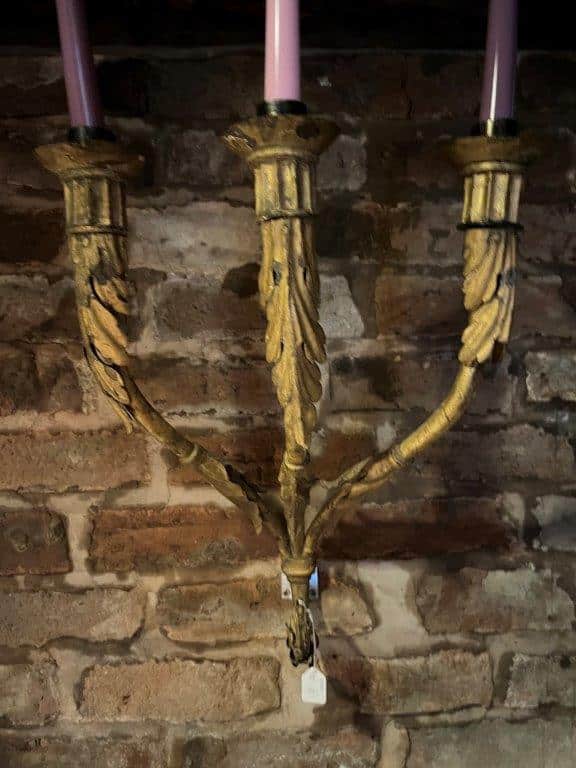
The beautiful candelabra are worthy of starring in a movie themselves. Each one is in stunning original order, cast with foliate decoration and iron mounting brackets. They date back to the last quarter of 18th century Italy making them around 250 years old.
The gilding is beautifully aged and the patina is well established with green verdigris showing through in parts. The bronze sconces are all present, as are the original metal bracket hooks for wall mounting. The overall patination is outstanding.
When first introduced in France towards the end of the 17th century the torchiere, a tall stand for a candlestick, mounted only one candle. When the number was doubled or tripled the improvement was regarded almost as a revolution in the illumination of large rooms. Three-sconce candelabra were part of this revolution and this pair may be Venetian.

From candelabra that held flickering candles in an Italian property centuries ago, a glance to my left took me back to the future. On display was a contemporary object by creative powerhouse Tom Dixon. His ingenuity emerges in the curvaceous structure of a purple modernist bowl.
He founded luxury British designer brand Tom Dixon which specialises in furniture, lighting and accessories. He rose to prominence in the mid-1980s as a maverick, untrained designer with a line in welded salvage furniture. While working with Italian giant Cappellini he designed an acclaimed ‘S’ Chair. In the late 90s he was creative director at Habitat, rejuvenating the brand.
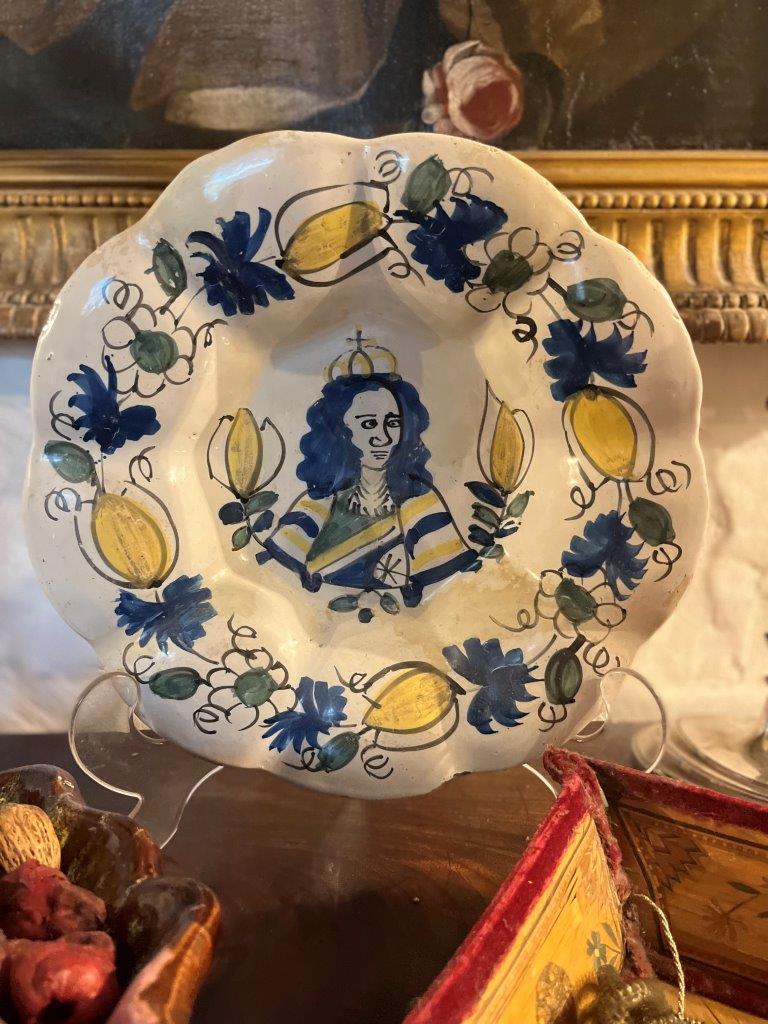
However, such is the eclectic cottage mix of collectibles I am soon stepping back in time again to admire a delft King William of Orange dish. Delftware or Delft pottery is a term used for Dutch tin-glazed earthenware, a form of faience. Most of it is blue and white pottery, and the city of Delft in the Netherlands was the major centre of production. However, the term covers wares with other colours made elsewhere and is also used for similar pottery, English delftware.
Delftware forms part of the worldwide family of blue and white pottery, using variations of the plant-based decoration first developed in 14th-century Chinese porcelain. It includes pottery of all descriptions such as plates, vases, figurines and tiles.
The style originated around 1600, and the most highly regarded period of production is between 1640–1740. In the 17th and 18th centuries the manufacture of Delftware was a major industry, with products exported all over Europe.
William of Orange features as a painted figure on the centre of the dish surrounded by decorative floral touches. To put this into historical context, William III (1650-1702), also known as William of Orange, was the sovereign Prince of Orange, Stadtholder of Holland, Zeeland, Utrecht, Guelders, and Overijssel in the Dutch Republic from the 1670s, and King of England, Ireland, and Scotland from 1689 until his death in 1702.
His father died a week before his birth, making William III the Prince of Orange from the day he was born. A Protestant, he participated in several wars against the powerful Catholic French ruler Louis XIV. Many Protestants heralded William as a champion of their faith and his appearance on this dish demonstrates his importance. Similar examples have sold for around £1,000.

Completely different yet again, a rather sombre curio on a wall is a small coffin plaque engraved with the words, ‘J Young Undertaker’. Perhaps it was made to display in the undertaker’s office years ago.
Unusual ceramics abound, too, and include a fearsome lion, one paw resting on a ball-like object.
A sticker on the back connects it to John Howard, a ceramic specialist in antique English, Scottish and Welsh pottery. The firm handles the rarest examples of British pottery from the 17th to the 19th century including London and Bristol Delft, early English slipware and Staffordshire pottery.

It’s a privilege to see items such as this and we very much welcome more.
Entries invited for Fine & Contemporary Art Auction
Entries are invited for the January 9 Fine and Contemporary Art Auction including silver, jewellery, gold, watches, ceramics, art, furniture and more. To arrange a free valuation, please email Head of Fine Art Isabel Murtough [email protected] or call 01283 733988.