







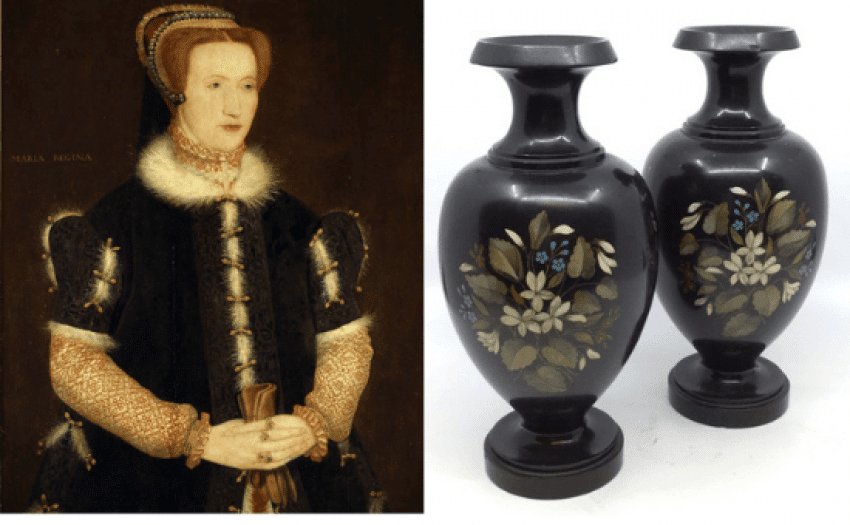
Bess of Hardwick, a powerful member of Elizabethan nobility and one of the wealthiest women in Britain, built up a collection of artworks still treasured to this day – and her taste for the best included Derbyshire’s Ashford Black Marble.
In 1580 Bess was the first recorded customer to buy objects made out of the dark limestone mineral quarried from mines near the picturesque village of Ashford-in-the-Water.
And that rich heritage will be celebrated on Monday, November 2 when an array of ornamental objects made out of Ashford Black Marble go to auction in Hansons’ Fine Art sale.
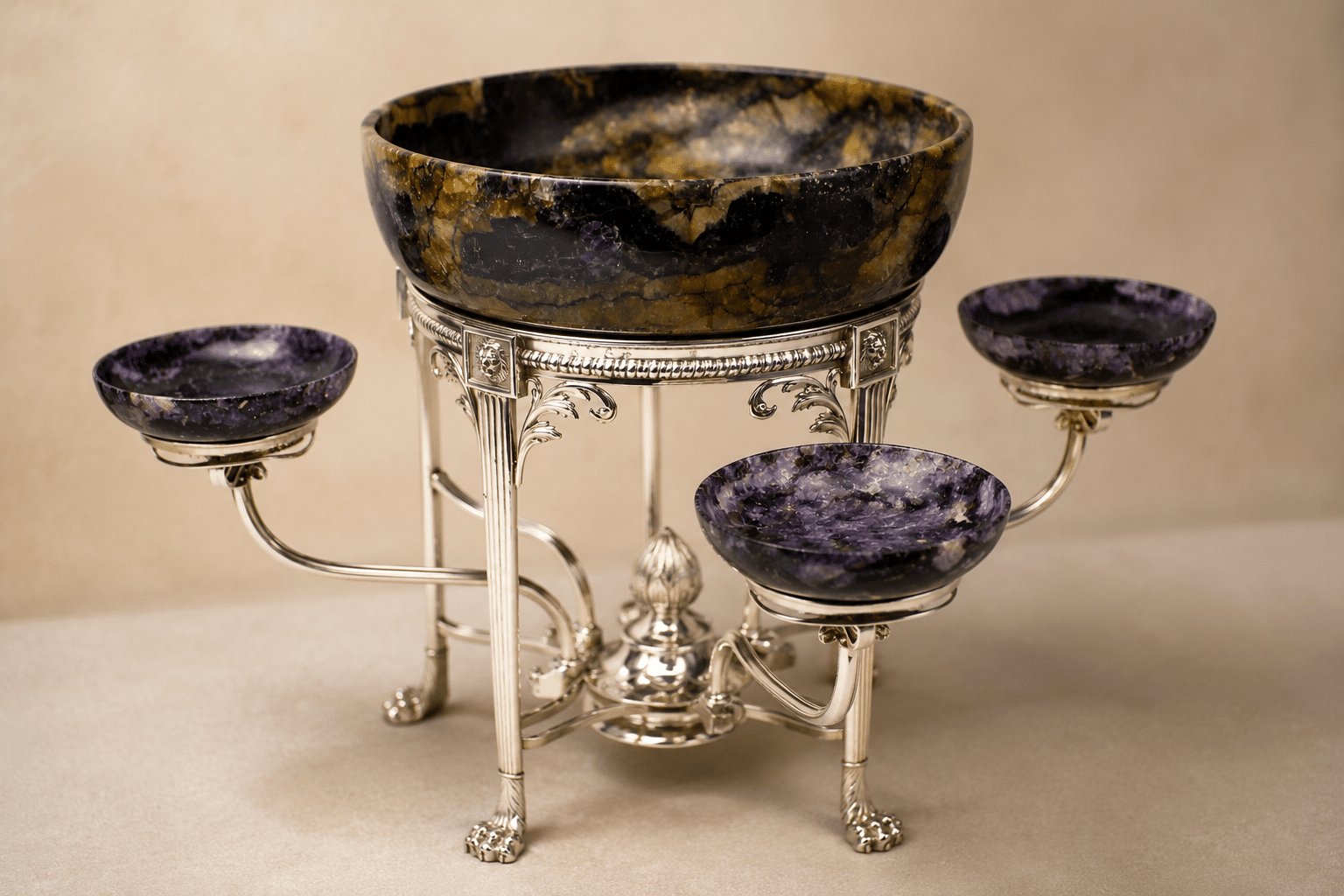
It’s not a true marble in the geological sense but a fine-grained sedimentary rock. However, once cut, turned and polished, its shiny black surface is highly decorative – and it resembles marble. It can be inlaid with decorative stones and minerals using a technique known as pietra dura.
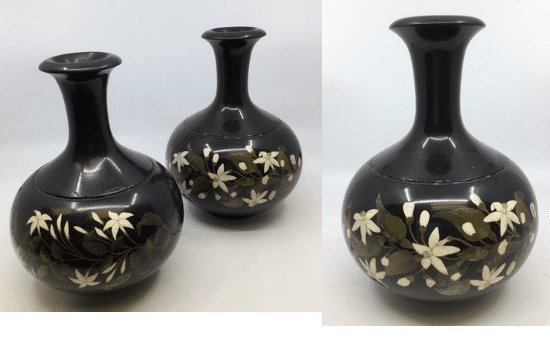
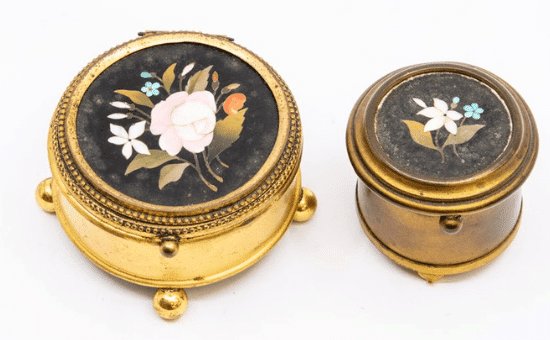
Objects going under the hammer demonstrate this skill admirably. Vases, plaques, an urn and trinket boxes feature striking inlaid decoration. For example, two 19th century gilt metal circular boxes are decorated with floral sprays of roses, jasmine and forget-me-nots.
These flowers, typically represented on the ‘marble’, were created from a rich array of Derbyshire minerals. Coloured rocks used included grey, blue and purple minerals from Monyash, ‘rosewood’ from Nettler Dale, Sheldon, Castleton Blue John which could create purple, and yellow flourspar from Crich. The rarest mineral, known as Duke’s Red, was so valuable it was stored at Chatsworth House.
CLICK HERE to view Derbyshire Ashford Marble Lots
In the late 1780s Derbyshire geologist White Watson began to create explanatory geological tablets using Ashford Black Marble into which other local rocks were inlaid to display the strata of the rocks in different parts of the county.
William Martin, who at one time worked with Watson, wrote the first scientific study of fossils. His Petrifacta Derbiensia recounts that White Watson’s uncle and workers at the Black Marble quarry called some of the fossils crocodile tails as they thought they were the remains of crocodiles.
This thirst for knowledge inspired by the rocks under our feet is just one reason why Ashford Black Marble has enormous historical value. Its connection to Bess of Hardwick is another.
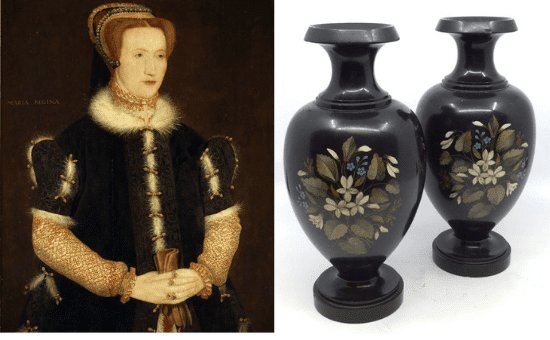
She owned Derbyshire’s Hardwick Hall, now a National Trust property, as well as Chatsworth. Originally known as Elizabeth Cavendish, she rose to the highest levels of English nobility thanks to a series of high-profile marriages.
Bess, who lived from 1527 to 1608, was a shrewd business woman, increasing her assets with business interests including mines and glass-making workshops. In 1601, she ordered an inventory of household furnishings, including textiles, at her three properties – Chatsworth, Hardwick, and Chelsea. The 400-year-old collection, now known as the Hardwick Hall textiles, is the largest collection of tapestry, embroidery, canvas work, and other textiles to have been preserved by a single private family.
CLICK HERE to view Nov 2-3 Fine Art & Moorcroft Auction Catalogue
Bess was a woman who liked to be surrounded by fine artworks – and had the wealth to buy them. Consequently, her interest in decorative ‘marble’ objects made on her Derbyshire doorstep should come as no surprise.
Though she was the first person to purchase items made out of Ashford Black Marble it has been used decoratively since prehistoric times.
Moving to the 1750s, Henry Watson, the uncle of Derbyshire geologist White Watson, was a key figure in the development of the industry of inlaying Ashford Black Marble. He owned a water-powered mill at Ashford-in-the-Water.
There was a thriving trade in the manufacture of urns, obelisks and other decorative items during the late 18th and early 19th century. John Mawe had a museum in Matlock Bath that dealt in black marble and Ann Rayner engraved pictures on black marble using a diamond.
Many fine examples of engraved and inlaid black marble exist in Derbyshire collections at Derby Museum and Art Gallery, Buxton Museum and Chatsworth House.
Derby Museum holds worked and part-worked items acquired from an inlaying workshop owned by the Tomlinson family. This includes a range of pre-cut pieces ready for inlaying into the black marble background.
In 2009 huge blocks of unworked Ashford Black Marble were unearthed during excavation work nearDerby’s Seven Stars pub. It was speculated that the rocks had been abandoned when an Ashford Black Marble manufacturer moved in the 1880s.
The prime source of the rock was from Arrock Mine and, later in 1832, from the nearby Rookery Plantation, near Ashford-in-the-Water.
The limestone can be turned on a lathe to create urns, candlesticks and other similar objects, or sawn to produce smooth, flat items such as obelisks and paperweights.
The Ashford Black Marble items going to auction have estimates ranging from £150 to £1,200 and would be a wonderful acquisition for anyone wishing to honour Derbyshire’s artistic – and mineral – heritage. Browse the November 2-3 Derbyshire Fine Art and Moorcroft Auction catalogue at www.hansonslive.co.uk.
Entries are invited for Hansons’ December Fine Art and general auctions. Free valuations are available at Hansons, Heage Lane, Etwall, Derbyshire, DE65 6SL, Monday-Friday, 10am-4pm, and Saturday, 9am-noon. Alternatively, arrange a free home visit or remote valuation by emailing [email protected]