










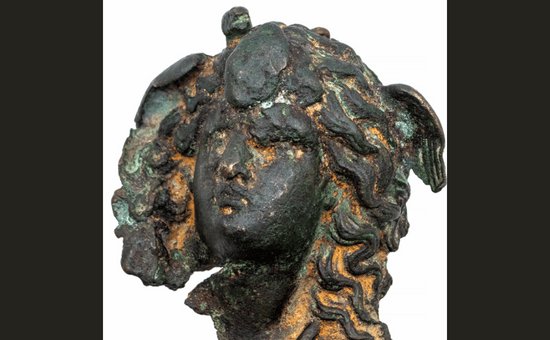
An ancient mythical bronze head – said to turn onlookers to stone – has been found by a farmer digging a ditch.
The head of Medusa was discovered by chance in a Somerset field, though the finder wasn’t sure what she had unearthed when she started pulling clumps of earth off the mysterious discovery.
The retired farmer and landowner, who wishes to remain anonymous, said: “I dug it up when I was digging a ditch in my field about six years ago. I didn’t know what it was at first but realised it was very old.
“It’s been kept in a drawer ever since. I hope a museum bids for it as I think it deserves to be on public display. If it doesn’t sell, I would be happy to have it back as I have always liked it.”
The antiquity is now set to go under the hammer on October 14 in Hansons Auctioneers’ Fine Art sale with an estimate of £1,500-£2,000.
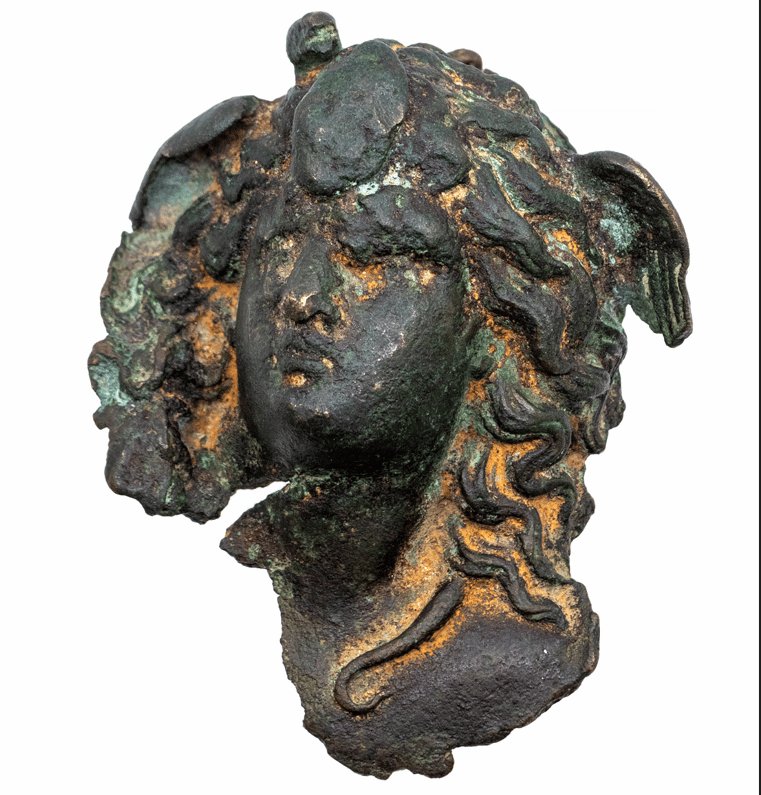
Charles Hanson, owner of Hansons Auctioneers, said: “It’s a wonderful find which demonstrates the forgotten history beneath our feet. It sweeps us back through the centuries to ancient Greek mythology. Medusa, also called Gorgo, was one of three Gorgons, described as winged females with living venomous snakes in place of hair. Those who gazed into her eyes were said to turn to stone.
“The story goes that Medusa was beheaded by Greek hero Perseus, who then used her head, which retained its ability to turn onlookers to stone, as a weapon until he gave it to goddess Athena to place on her shield. In classical antiquity, images of the head of Medusa appear in an evil-averting device known as the Gorgoneion.
“The snake-haired Medusa, seen in the example set for auction, did not become widespread until the first century BC. Roman author Ovid describes Medusa as a beautiful maiden seduced by Poseidon in a temple of Athena. Such a sacrilege attracted the goddess’ wrath, and she punished Medusa by turning her hair to snakes.
“Examples of Medusa heads are occasionally discovered around the world in countries such as Greece, Turkey and, of course, the UK. Medusa was popular in Roman antiquity and it is likely the example discovered in Somerset is Roman. Large parts of Britain, including Somerset, were occupied by the Roman Empire from AD 43 to AD 410.”
The bronze head of Medusa, lot 270, will be offered in Hansons Auctioneers’ October 14 Derbyshire Fine Art sale. Catalogue: www.hansonslive.co.uk. To find out more, email Head of Fine Art Isabel Murtough: [email protected].