







Remembrance Day – November 11 – is something we all hold dear, a time to pause, reflect and honour those who have lost their lives in conflict, writes Charles Hanson.
As the years, and decades, roll by it’s easy to forget. Stories fade from memory, time moves on. But at Hansons the opportunity to remember people whose lives have been blighted by war comes to the fore every week, all year round.
That’s due to our regular medals and militaria sales, one of Hansons’ most fascinating specialist auctions. I can’t begin to describe how it feels to open an old war diary and turn to a page describing the Battle of the Somme during the First World War.
When you handle bravery medals, vintage uniforms, military documents and more, you inevitably feel a connection to the people they belonged to decades ago.
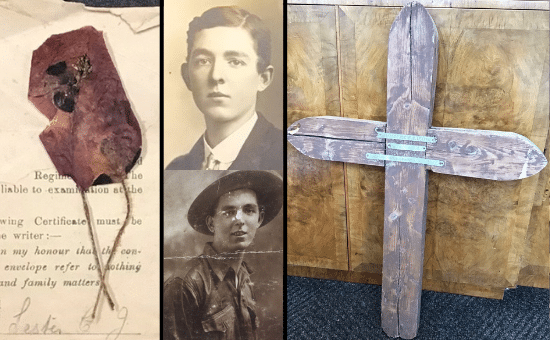
I always say that every find tells a story. When it comes to militaria discoveries, the human-interest tales that unfold are both fascinating and deeply touching. For example, our October Medals and Militaria Auction included a First World War collection relating to two servicemen from Yoxall, near Burton, Staffs. The lot included the most poignant symbol of brotherly love imaginable, a dried poppy from a WW1 battlefield.
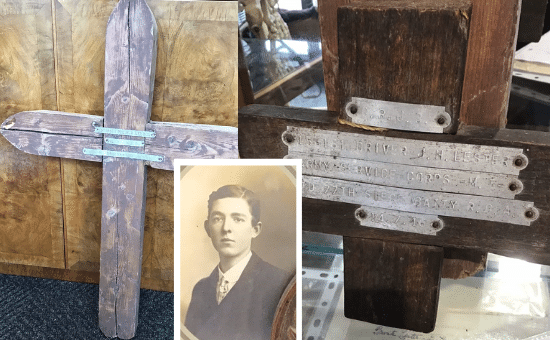
When Private James Henry Lester lost his life in Fance in 1916, aged 21, his brother Christopher Lester, a fellow serving soldier, went to the spot where he died and picked a poppy. It was part of one of the most emotive military collections I have ever seen. It also included two temporary wooden crosses used to mark James’s grave in Forceville Military Cemetery, France, plus pictures, letters, boots and a satchel. The items, lot 149, sold for £2,300.
The item is now with its new owner but the brothers’ story remains with me. I couldn’t help but imagine the emotions Christopher must have felt when he picked those flowers. A few years later in 1924 Christopher was dead at the age of 28 due to the effects of the First World War. A family lost two sons due to one of the most brutal conflicts the world has ever known. It claimed 20 million lives.

But wartime loss was not always about death. Conflict often brought people together from opposite sides of the world – but also swept them apart. The same auction included never-before-seen love letters from a Second World War Canadian airman to his Derbyshire sweetheart – sent from his German prisoner of war camp.
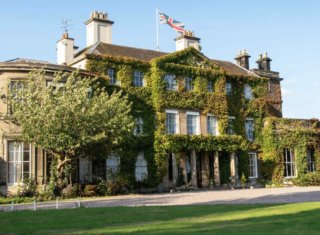
The letters, censored by his captors, shed new light on a heart-breaking WW2 love story that had intrigued visitors to National Trust property Beningbrough Hall in York for decades. For years people wondered why the names ‘1942 Gipsy – Olie’ had been scratched into wood at Beningbrough. The graffiti dated back to the time the Royal Air Force was stationed there in wartime but no one knew who the couple were – until a chance visit 45 years later.
The owner of the letters, Karen Plummer, explained that Gipsy (Dot Preston) – her mother – had served in the Women’s Auxiliary Air Force (WAAF) at Beninbrough in WW2. It was there that she fell head over heels in love with Canadian airman Sgt Harry Olsen (Olie).
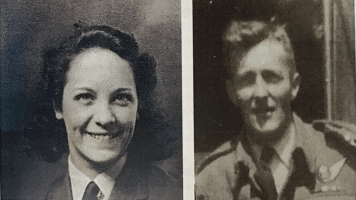
In 1987 Dot only had a short time to live. One of her last wishes was to visit Beningbrough where she was billeted in 1941 as an 18-year-old. Consequently, her daughters took her back. The Beningbrough staff were thrilled and gave them a tour. A guide showed Dot the names etched above a fireplace in the drawing room and asked, ‘Do you know who Gipsy was?’ Dot was so shocked she nearly collapsed. Finally, she said: ‘That’s me. I didn’t know he (Olie) had written anything’.
Dot began to weep and needed time to compose herself. Olie was her first love. They met in 1941. It was ‘love at first sight’. But broke Gipsy’s heart was set to be broken. Oli was captured on a flying mission and spent the final years of the war in a prisoner of war camp. They never managed to see each other again before he was sent back to Canada.

“Mum never spoke about it much but you could see that there was something inside her that was unfulfilled,” said Karen, 69, a retired musician from Chesterfield, Derbyshire. “She kept the letters in a drawer all of her life and I’ve kept them safe since she passed away at the age of 67 in 1990. I decided I had to do something with them. I don’t want her story to be forgotten. “
The 11 letters, posted to Eckington, Derbyshire,where Gipsy lived, and related WW2 RAF memorabilia sold for £540 in Hansons’ October Militaria sale.
Hansons is inviting entries for its December 16 Medals and Militaria Auction. To arrange a free valuation, email William Hayward: [email protected]. A Country Pursuits and Militaria Auction will also be held on November 23-24 at Hansons’ Staffordshire saleroom, Bishton Hall. To find out more, or to book any type of free valuation or home visit, email: [email protected].