





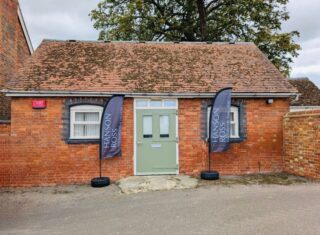



A hoard of fine jewellery – kept for safe-keeping under the floorboards – has been uncovered by Hansons and it’s dazzling.
The large and impressive collection has been treasured and passed through the generations within the same family for 200 years.
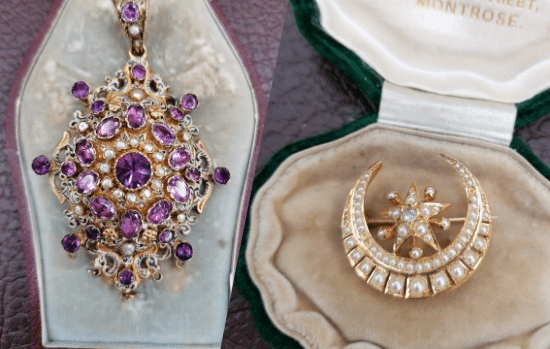
Inevitably it includes some exceptional pieces and boasts bracelets, pendants, silver thimbles, rings, pocket watches and more. As well as Edwardian and Victorian examples, it offers a selection of mourning rings and even Victorian Indian jewellery.

As is so often the case, it arrived at our Derbyshire saleroom in some unassuming cardboard boxes, each disguising the wow-factor within. As our experts delved inside, gently opening original boxes, their excitement grew.
And one person who will be thrilled to cast her expert eye over this tantalising collection is our consultant Kate Bliss. She will be at Hansons’ Etwall Auction Centre in Derbyshire on Wednesday, October 13 offering free jewellery and silver valuations from 10am-4pm. No appointment is necessary, so do pop to see Kate if you have an item you’re considering selling at auction. She would love to see it and advise.
Like all of us, she appreciates the beauty and craftsmanship of fine jewellery and silver in all its forms. She enjoys examining new finds and is sure to be enchanted by the remarkable gems from under the floorboards.

One of my favourite pieces is an exquisite, heavyweight Indian gold bracelet featuring a hand-painted portrait of a gentleman. He is pictured wearing an elaborate hat, itself festooned with jewels, multiple necklaces featuring huge emeralds and a rich red robe. A jewelled man captured within an extravagant adornment.
One of several jewellery boxes within the collection bears the name ‘James Moore, Jeweller & Optician, 18 Corn Market, Derby’. Inside was the oldest item in the collection a 211-year-old mourning ring. Hansons’ head of jewellery Helen Smith thinks it unlikely the Derby box belongs to the ring but the timing aren’t far apart.

The ring is dated 1811. Research reveals the will of James Moore, Jeweller of Derby, dated September 20, 1810, resides in the National Archives. Pigot & Co’s Commercial Directory for Derbyshire, 1835, also lists the James Moore jewellery shop.
Wherever it was made, the centuries-old Georgian memorial swivel ring displays originality and elegance. It features plaited hair and pearl on one side and enamel and faceted onyx on the other. Simple and striking, it’s sure to attract bidders.
Mourning or memento mori jewellery has been around for centuries. Locks of hair or even fragments of bone are captured within a piece of jewellery to remember a loved one. Sometimes a person’s name, age and year of death is inscribed on the piece.

It is sad but also incredibly collectable and quite moving, according to Helen. Back in the 1700s and 1800s life expectancy was much shorter and infant mortality was high. This made our ancestors accept loss more easily.
Certainly, the passion for memento mori jewellery – memento mori is Latin for ‘remember that you have to die’ – was never intended to be macabre. It was meant to act as a gentle reminder to cherish each day because life is fleeting.
Mourning jewellery dates back as early as the 14th century and is seen as an English peculiarity. Early examples may appear a little more sinister featuring skeletal forms under crystal. Some feature the word ‘Rest’ while mourning rings of this period often include white enamelled skulls set with diamond eyes.
In the Georgian era (1714-1837) memorial jewellery became more common place. One reason for this was because there was no photography. If a loved one died people wanted something to remember them by. Such items weren’t just for women. Men’s memorial cufflinks or pocket watches hung from braiding made from a deceased person’s hair were not unusual. Braided bracelets were also made.
Queen Victoria led the trend for mourning jewellery. After the loss of her beloved husband Prince Albert at the age of 42 in 1861, she wore black for the rest of her life and mourning jewellery was part of her attire.
She commissioned a memorial ring to honour her husband in gold and black enamel. The bezel contained a microphotograph of the Prince Consort and the initials V and A in white enamel was set into the shanks. The ring never left Victoria’s finger for the rest of her life.
Free valuations with Kate Bliss
Whatever jewellery you have at home, be it mourning, modern, antique or vintage, Kate Bliss can assess it for free on October 13, 10am-4pm at Hansons, Heage Lane, Etwall, Derbyshire, DE65 6LS. Alternatively, book a jewellery or silver valuation by emailing: [email protected]. Entries are invited for Hansons’ regular jewellery, silver and watches sales.